


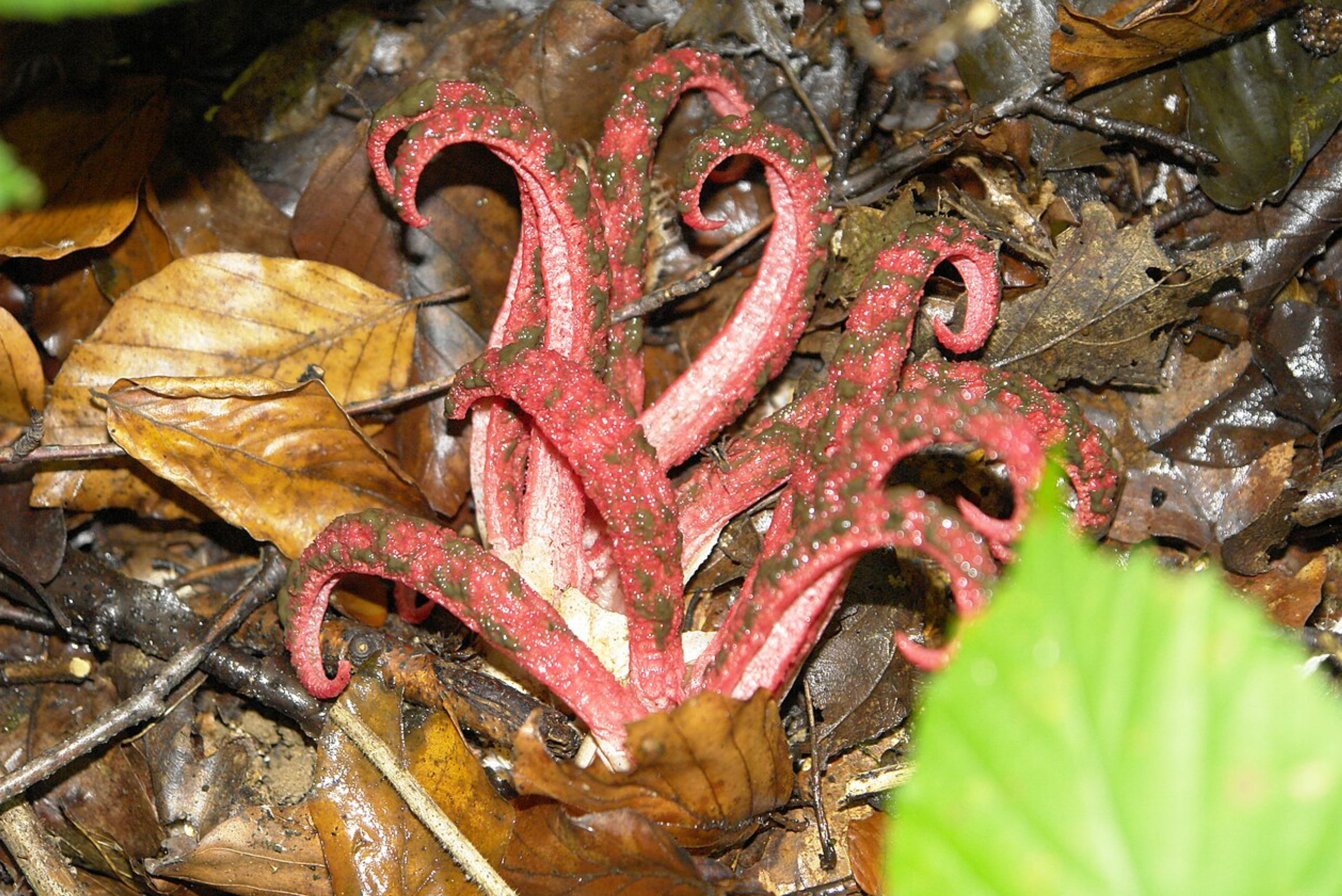
Cover image: Octopus stinkhorn, Clathrus archeri
Source: Wikimedia Commons – Clathrus archeri – Vosges, France (fr:Utilisateur:Bouba)

Something yellow appears at the tip of a stem, exactly where a flower ought to be. Insects come to it. Elsewhere, they follow the smell of decay or search for a possible mate.
Through their eyes, antennae and other senses, insects and other arthropods read the world as they always do: a colour here, a scent there, the chemistry of a surface beneath their feet. These clues help them find food, places to lay eggs and reproductive partners.
So what happens when a fungus that is neither a flower nor a carcass produces part of the same message?
A fungus cannot walk after an insect. Yet some fungi send their spores a long way, or reach new hosts, by making use of animals that move. Some form flower-like structures. Some fruiting bodies release odours associated with carrion or dung. Some parasitic fungi alter the chemical cues produced by an infected insect. Others are associated with remarkable changes in the behaviour of infected ants.
“Deception” and “manipulation” are convenient words for relationships like these. They can also mislead us. No fungus draws up a plan and decides to trick an insect. What we see is the accumulated result of traits that happened to connect with insect senses and behaviour, and that consequently improved a fungus’s chances of reproduction or transmission.
Which raises a simple question: does a disguise have to be a perfect copy? A fungus that grows false flowers offers an excellent place to begin.

False flowers and the scent of rot
Fungi can benefit from the sensory abilities that animals already use in everyday life. A fungus does not need to become a flower or a carcass. It may only need to provide part of the information that makes an insect think that something worth investigating is nearby.
A flower made entirely by a fungus
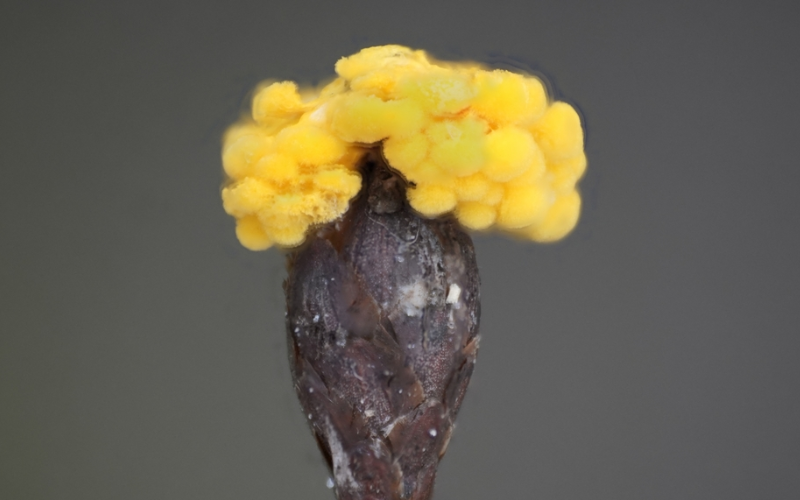
Source: iNaturalist – Fusarium xyrophilum(jackjohnsonn)
In Guyana, in north-eastern South America, a small yellow structure sometimes appears at the tip of Xyris surinamensis, a plant in the yellow-eyed grass family, Xyridaceae. From a distance, it looks rather like a modest little flower.
It is not a petal, and it is not a leaf distorted into a petal. It is a structure built entirely of fungal tissue, made by Fusarium xyrophilum. Researchers call such a structure a pseudoflower, or false flower.
The species was described as new to science online in December 2019 and formally published in the journal Mycologia in 2020.
A brief note on terms is helpful here. The fine, tube-like threads that make up much of a fungal body are called hyphae. A mass of hyphae is called a mycelium. The pale network spreading through soil or decaying wood is often mycelium.
 ミミズク先生
A small distinction may help here. The fine, tube-like filaments of a fungus are called hyphae; a mass of hyphae is a mycelium. The white threads one sees in soil or rotting wood are often part of that mycelium.
On a Xyris plant carrying pseudoflowers, ordinary flowers are rarely produced. The fungus appears to infect the host plant extensively and suppress its normal reproduction, while producing its own structures where flowers would ordinarily develop. These pseudoflowers are fungal growths, not leaves or petals reshaped into a floral disguise.
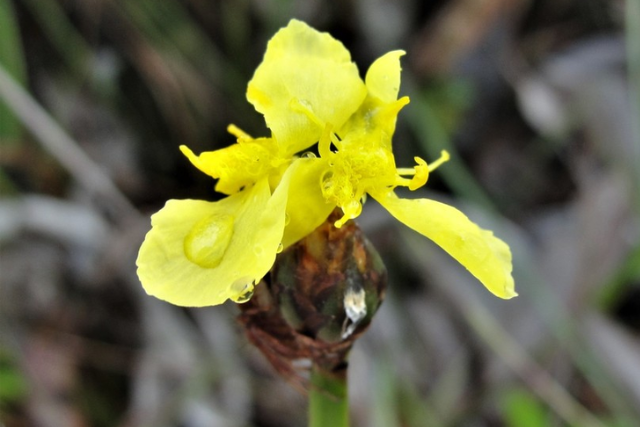
Source: iNaturalist – Xyris surinamensis(peterzika)
In a study published in 2026, researchers observed real flowers and pseudoflowers in the field and recorded the arthropods that came to each. The visitors were a broad and rather unexpected group: wasps in the Family Vespidae, ants in the Family Formicidae, jumping spiders in the Family Salticidae, grasshoppers in the Family Acrididae, and pygmy grasshoppers in the Family Tetrigidae.
Some visitors appeared on both real flowers and pseudoflowers, including katydids, carpenter ants and geometer moths. Some arthropods were also seen chewing the flowers and pseudoflowers.
The researchers captured visitors and tested them for Fusarium xyrophilum DNA using PCR, short for polymerase chain reaction. This method makes many copies of a selected piece of DNA, helping scientists detect very small quantities. The team detected fungal DNA on captured arthropods, supporting the possibility that visitors can carry fungal material away from pseudoflowers.
That result is an important part of the dispersal story, but it is not the whole story. DNA on an arthropod shows that it encountered the fungus. It does not yet prove that viable fungal material reached another plant and began a new infection. Visiting, carrying, transporting and successfully transmitting the fungus are separate steps.
A few floral clues may be enough
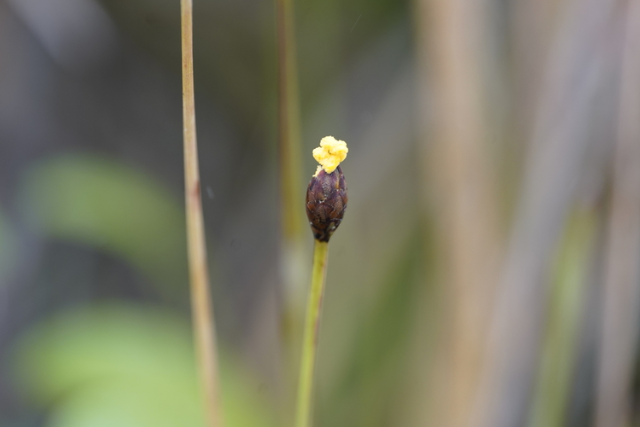
Source:iNaturalist – Fusarium xyrophilum(jackjohnsonn)
The pseudoflowers are fascinating precisely because they are not flawless replicas of real blooms. Their visitors include a range of generalist arthropods, not only insects that would normally be described as pollinators.
Researchers compared the volatile compounds released by real Xyris flowers and by pseudoflowers. Volatile compounds are chemicals that readily enter the air, where they can carry scent information.
Many of the detected compounds were shared between flowers and pseudoflowers. Yet pseudoflowers and laboratory cultures of the fungus also released a candidate compound not detected from the sampled real flowers: a sesquiterpene tentatively identified as α-gurjunene.
Sesquiterpenes are a large group of organic compounds produced by plants and fungi. Some contribute to floral, leafy or resinous scents. Exactly which arthropods respond to α-gurjunene, and whether it affects a particular behaviour, remains to be tested.
The researchers highlight an idea called sensory bias. This is an existing tendency to respond to particular colours, shapes, smells or movements. Such tendencies may reflect the way an animal’s sensory and nervous systems work, although experience, hunger and environmental conditions can also influence its response.
An arthropod approaching a flower does not first examine it as a botanist would. It responds to features that suggest a possible resource: colour, position, shape and scent.
The researchers therefore suggest that Fusarium xyrophilum may exploit generalist arthropods’ existing responses to floral signals rather than acting as a precise floral mimic.
 シロフクロウ職員
Voilà. The disguise does not have to be complete. If enough of the cues an insect reads as flower-like are present, it may still come to investigate.
This changes the question slightly. Instead of asking only, “How closely does it resemble a flower?”, we can ask, “Which features make an animal approach?”
Stinkhorns: a different invitation
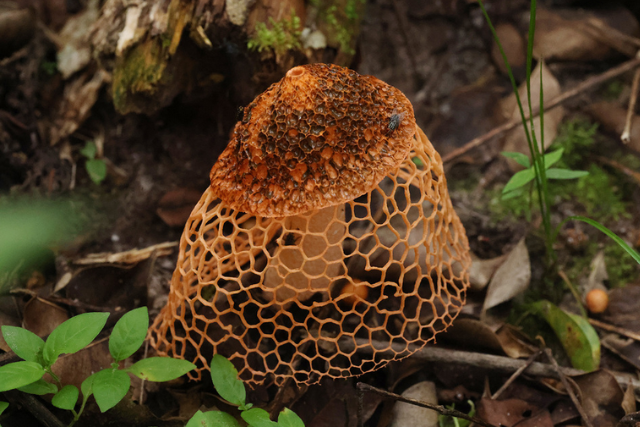
Source: iNaturalist – Phallus cinnabarinus(michel405)
Now look down towards the woodland floor. Among the leaves stands an unusual mushroom, perhaps noticeable by its smell before its shape comes into view.
These are the stinkhorns: fungi in the Order Phallales, especially within the Family Phallaceae. Some release odours that people may associate with carrion or dung. Their fruiting bodies often carry a sticky, spore-filled material called gleba.
A fruiting body is the structure a fungus produces to make and release spores. It is what we often call a mushroom, although it is neither a flower nor a fruit in the botanical sense.
In stinkhorns, the gleba provides both a rich supply of spores and a place where insects gather. Flies, beetles and other visitors may feed on it, or pick it up on their legs and bodies. When they leave, spores may travel with them.
Spores that are swallowed may also pass through an insect’s digestive tract and be carried away in droppings. The relative importance of these routes can differ among fungal species, visiting insects, habitats and seasons.
The smell of carrion
Smell is one of the main lures.
In 2010, researchers compared the volatile compounds of Clathrus archeri—often called the octopus stinkhorn or devil’s fingers—with those of fly-pollinated flowering plants that produce foul odours. For comparison, they also sampled carrion and animal dung.
Carrion flowers are familiar to anyone who has encountered a titan arum, a Rafflesia or a stapeliad. These plants attract flies with scents associated with decay and use those visitors to carry pollen.
Both Clathrus archeri and carrion flowers released oligosulphides associated with carrion odours, along with phenol, indole and p-cresol, compounds commonly associated with faecal odours.
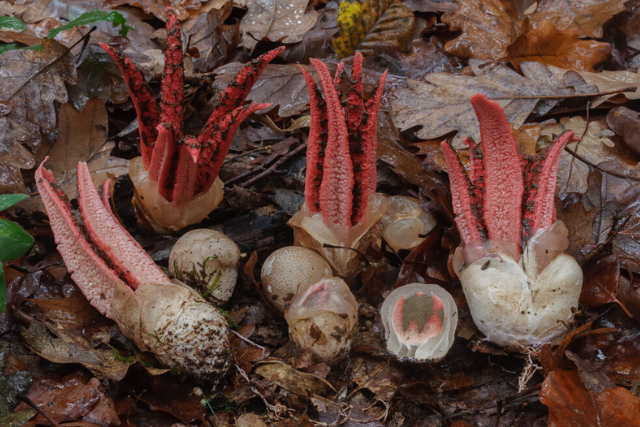
Source: iNaturalist – Clathrus archeri(nschwab)
Calling this a “fake corpse” does not mean that it looks like a dead animal. The resemblance is chemical. For insects searching for decaying matter, carrion and dung may offer food, a place to lay eggs, or both. An odour that makes a human walker step back can be useful information to a fly.
The fungus is not trying to become carrion, any more than a carrion flower is trying to become a corpse. Rather, fruiting bodies with scents that attract carrion-seeking insects may have had an advantage in spore dispersal.
Plants and fungi have arrived independently at similar ecological solutions: both can make use of insects that follow the smell of decay. This is an example of convergent evolution, in which distantly related organisms evolve similar features under similar ecological pressures.
The mystery of the indusium
Some stinkhorns have an additional striking feature: a lace-like skirt called an indusium. In Phallus indusiatus and related fungi, this net hangs beneath the cap.
Its appearance is easy to admire. Its biological role remains uncertain. Proposed functions include attracting insects visually or providing a route towards the gleba for crawling visitors. Neither explanation has yet been confirmed.
The busiest visitor is not always the best carrier
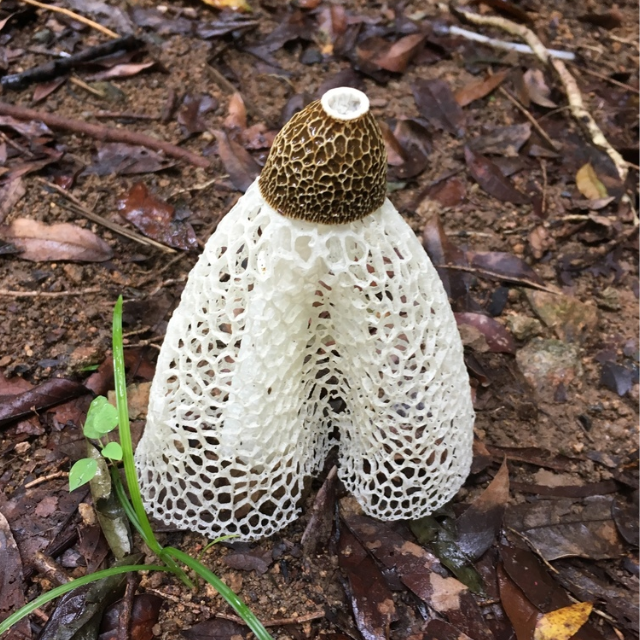
Source: iNaturalist – Phallus indusiatus(shellfishgen)
Which insect matters most to a fungus: the one that visits most often, or the one that carries the most spores?
A 2024 study investigated spore dispersal in Phallus indusiatus sensu lato in the Brazilian Amazon. The abbreviation s.l. stands for sensu lato, meaning “in the broad sense”. Scientists use it when a name refers to a broader grouping that includes closely related forms rather than one narrowly defined species.
Across six fruiting bodies, the researchers recorded 333 insects. Beetles were the most numerous visitors.
Among the insects examined, stingless bees spent the longest time foraging at the gleba and carried the largest reported spore loads. In the sampled material, more than 83 million spores were estimated on the bees’ body surfaces, and more than 60 million within their digestive tracts.
By comparison, the beetles examined carried approximately 189,000 spores on their body surfaces and about 39,000 in their digestive tracts. These figures describe the insects sampled in this study. They are not universal averages for all stingless bees, beetles or stinkhorn fungi.
The researchers concluded that, in this system, transport on an insect’s body surface was more important for dispersal than transport through droppings.
Stingless bees are social bees in the Family Apidae, found mainly in tropical and subtropical regions. Their stings are reduced and cannot be used effectively for defence. Although they are best known for collecting floral nectar and pollen, some of the bees in this study spent considerable time feeding at the gleba.
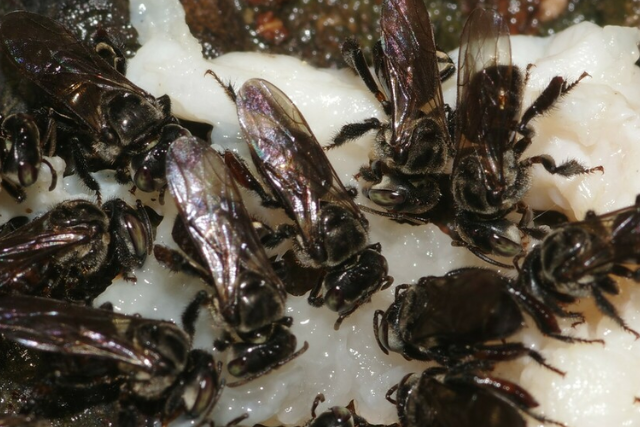
Source: iNaturalist – Trigona crassipes(rvgalli)
The wider lesson is that visitor numbers and dispersal contribution are different measures. Time spent feeding, the number of spores picked up, where spores attach, whether swallowed spores survive, and where an insect travels afterwards can all shape the outcome.
From attraction to infection
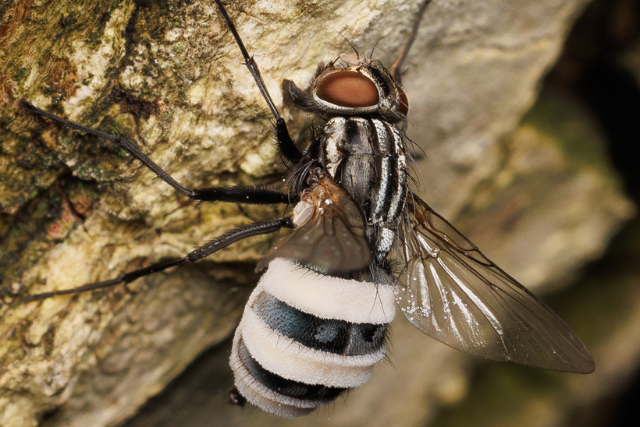
Source: iNaturalist – Entomophthora muscae species group(happywonderer)
False flowers and stinkhorns draw animals towards fungal structures. The next examples take us from a visitor approaching an object to an insect contacting a potential host—and then into the body of an infected animal.
Male flies approach infected female cadavers
Entomophthora muscae is a parasitic fungus that infects the house fly, Musca domestica. An infected fly eventually dies, and the fungus releases spores from its body.
In 2022, researchers investigated what happened when healthy male house flies encountered female flies killed by the fungus.
The infected females’ bodies had altered surface chemistry, including changes in cuticular hydrocarbons. These are components of the waxy coating on an insect’s outer surface. They help reduce water loss, but they can also carry chemical information about species, sex and reproductive condition.
The infected bodies also released a distinctive blend of airborne compounds, dominated by sesquiterpenes, that differed from the odours of uninfected fly cadavers.
Healthy males approached infected female cadavers and attempted to mate with them. Mating attempts were more frequent towards bodies at a later stage after death, when the fungus was releasing spores. Males exposed to these later-stage cadavers also had a higher risk of infection.
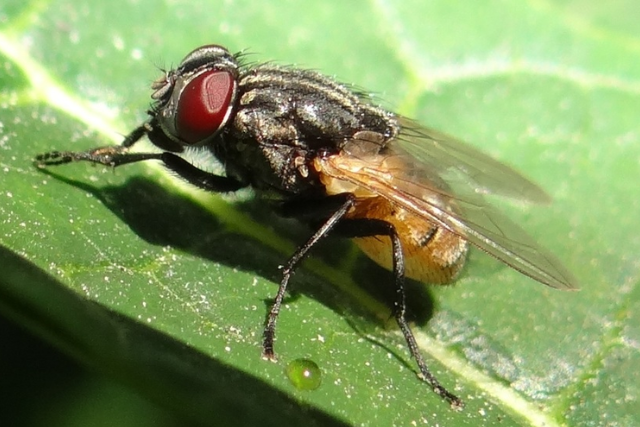
Source: iNaturalist – House fly, Musca domestica(alfredoeloisa)
This is not simply a case of a fungus making a male fly “fall in love”. Infection changes the chemical information around a dead host. A healthy male responds to that information, and his response can bring him into contact with spores.
What does the male respond to?
Finding a mate involves several kinds of information. A male fly can respond to what it sees, to airborne chemicals and to chemical cues encountered on contact.
Airborne sesquiterpenes may contribute to a male’s response from a distance, while altered cuticular hydrocarbons may matter at close range or on contact. Their respective roles have not yet been fully separated experimentally.
Different fungi work through different cues. A stinkhorn calls visitors with scent. With Entomophthora muscae, it is what the arriving male does next that creates an opportunity for infection.
The next question is more difficult: what happens when infection changes the host’s own behaviour?
An ant that dies with its jaws closed
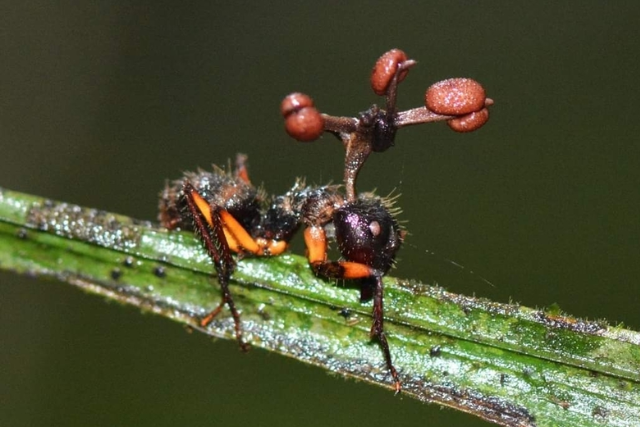
Source: iNaturalist – Ophiocordyceps unilateralis(brayancoraljaramillo)
The popular name “zombie-ant fungi” refers to Ophiocordyceps unilateralis sensu lato and related fungi. It is a convenient common name for a group, not the formal name of one species.
In several well-studied fungus–ant systems, infected ants leave their nest, move onto vegetation, and die with their mandibles clamped around a leaf vein or twig. A fungal reproductive structure later grows from the body and releases spores.
In a 2011 study in a Thai tropical forest, researchers recorded this behaviour in an ant identified at the time as Camponotus leonardi. The species is now generally treated as Colobopsis leonardi. Among 16 observed ants, the final bite was concentrated around local noon.
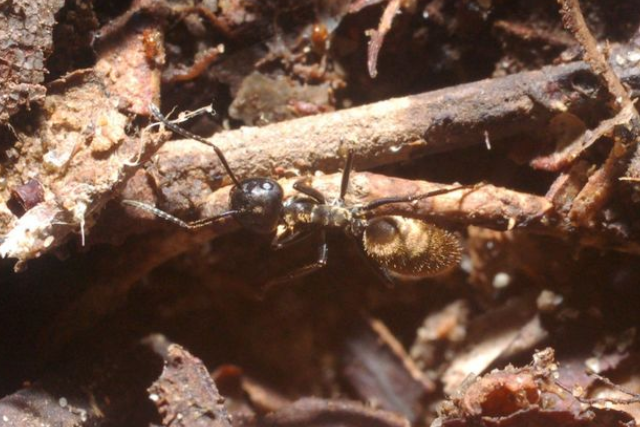
Source: AntWiki – Zryanin Camponotus leonardi.jpg(Lubertazzi)

That timing should not be treated as a rule for all zombie-ant fungi. The hour of behavioural change may vary with the particular fungus–ant pairing, as well as with light, temperature, humidity and other environmental conditions.
Other systems have shown different timing patterns. Researchers are therefore investigating the roles of circadian clocks: internal systems that organise activity and metabolism over roughly twenty-four hours.
What can be said with confidence is that infected ants show movements and biting behaviours not seen in healthy ants. “The fungus orders the ant to climb” is memorable, but it oversimplifies what the evidence currently shows.
Looking inside the ant
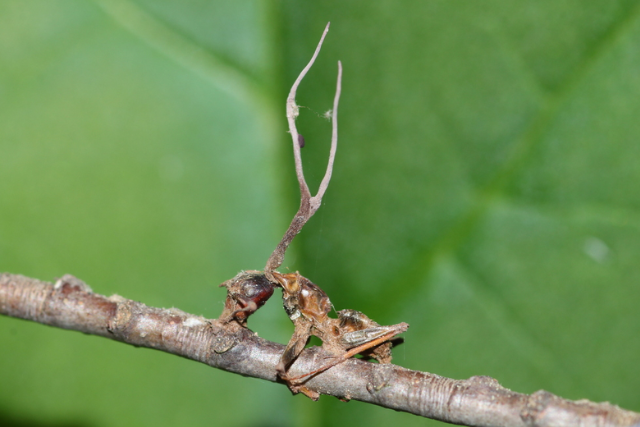
Source: iNaturalist – Ophiocordyceps kimflemingiae(roundabout1812)
Where would you expect to find a fungus that changes an ant’s behaviour so dramatically? The brain is an obvious place to look.
A 2017 study produced a surprising answer. Researchers examined the North American carpenter ant Camponotus castaneus and the parasitic fungus now known as Ophiocordyceps kimflemingiae.
They used serial block-face scanning electron microscopy to build a three-dimensional view of infected tissue. In this technique, a specimen is embedded in resin. Inside the microscope, a very thin layer is removed, the newly exposed surface is photographed, and the process is repeated. Hundreds or thousands of images can then be reconstructed in three dimensions. Deep-learning software helped distinguish fungal cells from ant tissues.
Fungal cells occurred throughout much of the body. They formed interconnected networks around muscles, including those operating the mandibles, and some entered muscle fibres.
At the stage of behavioural manipulation examined in that study, no fungal cells were found within the brain tissue.
The ant’s behaviour had changed dramatically. Yet, in the material examined, fungal cells had not physically occupied the brain. This makes a simple explanation—fungal cells invade the brain and directly pull the nervous system’s levers—difficult to support.
That does not mean the brain is irrelevant. A 2019 study reported that infected ants’ brains remained comparatively well preserved in structure while showing altered metabolic profiles. The absence of fungal cells from the brain does not demonstrate the absence of an effect on the brain or nervous system.
ミミズク先生The absence of fungal cells in the brain does not mean that muscle alone provides the answer. Nerves, muscles, fungal secretions and biological clocks may all be involved. How they fit together is what researchers are still working out.
Why do the jaws stay closed?
The ant’s grip directs attention towards the muscles that close its mandibles.
A 2011 study described these muscles as atrophied, or wasted. More detailed electron-microscope work published in 2019 identified hypercontraction: an abnormally strong state of contraction accompanied by structural changes.
Muscles generate force as fine protein filaments slide past one another. Their repeating contractile units are called sarcomeres. In infected ants examined during the death grip, the sarcomeres were shortened, while their boundary structures—the Z-lines—showed swelling and disruption.
The muscles had not simply broken down and stopped working. Identifiable motor neurones and neuromuscular junctions remained structurally preserved in the material examined, even while the mandibular muscles showed hypercontraction.
Fungal cells surrounded muscle tissue, sometimes entered muscle fibres, and were associated with tiny particles resembling extracellular vesicles.
Extracellular vesicles are small membrane-bound packages released by cells. They can carry substances such as proteins and lipids, and may participate in communication between cells.
In this study, the particles’ origin, contents and role in muscle changes remained unresolved.
These findings reveal a more intricate situation than muscles simply being destroyed and locked in place. How do fungal secretions interact with nerves and muscles? How are those changes connected to the ant’s earlier movements? And what influences the timing of the final bite?
A 2024 review brings together several leading lines of investigation: fungal proteins and metabolites, host nerve and muscle physiology, and the biological clocks of both fungus and host.
The complete chain linking infection, movement, timing and biting is still being assembled.
Classification reveals specific relationships
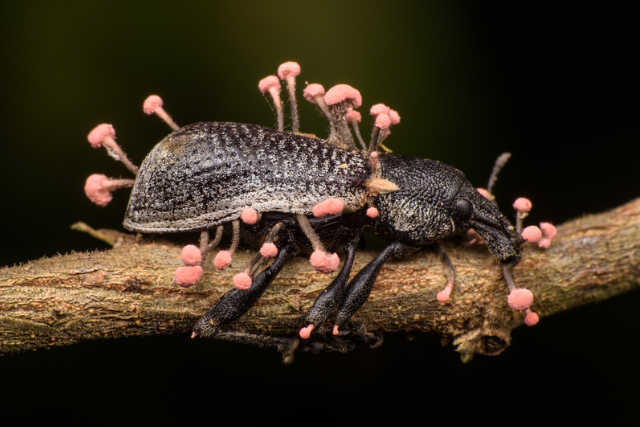
Source: iNaturalist – Ophiocordyceps curculionum(victormozqueda)
An Ophiocordyceps fungus that parasitises weevils.
“Zombie-ant fungus” can sound like one organism with one method. Classification reveals a much richer set of relationships.
Ophiocordyceps unilateralis s.l. is a species complex: a grouping that includes several closely related species. Researchers continue to describe species and refine their boundaries among ant-parasitising Ophiocordyceps.
This taxonomic detail matters. It tells us that these fungi are not interacting with “ants in general”.
A 2014 experiment examined host specificity using one fungal parasite and four ant species. One species, Formica dolosa, was excluded from the behavioural comparison because the injection procedure itself substantially affected survival.
Among the three remaining Camponotus species, infection caused deaths in all three. However, the characteristic biting behaviour appeared only in the two species already known as natural hosts.
The fungus also produced different combinations of metabolites when grown with tissue from different ant species. Yet tested candidate compounds, supplied alone or in combination, did not reproduce the characteristic infection-associated behaviour.
This suggests that there is no single chemical “control switch”. The outcome may depend on several interacting processes involving fungal chemistry, host physiology, host identity and environmental conditions.
Host associations can be highly specific, but they do not follow a universal rule of exactly one fungus for exactly one ant species. Taxonomy helps us see the real organisms and relationships behind the dramatic common name.
Resemblance is not the only kind of deception
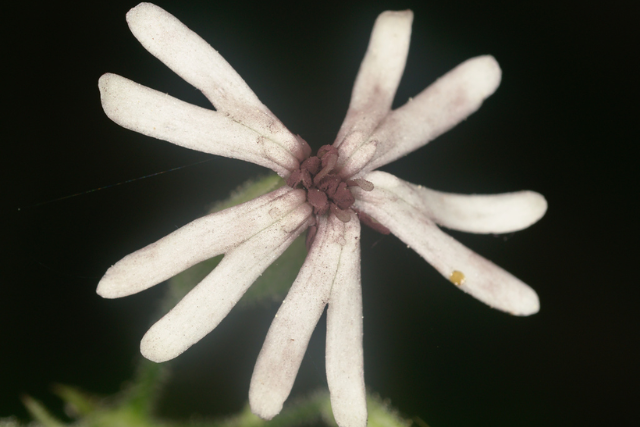
Source: iNaturalist – Microbotryum violaceum(alex_kuhn)
An anther smut fungus that produces spores in the flower’s anthers, where pollen would ordinarily develop.
A pseudoflower, a stinkhorn, a fly fungus and a zombie-ant fungus: placed side by side, these examples show that fungi do not use one single method to connect their reproduction with insect behaviour.
Yet a useful question links them all: what information is the animal using when it decides what to do next?
| Example | Animal activity involved | Fungal feature or infection-related change | Connection with fungal reproduction |
|---|---|---|---|
| Fusarium xyrophilum | Investigating flowers or flower-associated resources | Flower-like structures and floral sensory signals | Visitors may carry fungal material; successful transmission between plants remains to be demonstrated |
| Stinkhorn fungi | Investigating food, decay or possible egg-laying sites | Spore-rich gleba and odours associated with carrion or dung | Spores may travel on visitors or through their digestive systems |
| Entomophthora muscae | Finding and approaching a mate | Altered scent and surface chemistry of infected female cadavers | Healthy males make contact and may become infected |
| Ophiocordyceps species associated with zombie-ant behaviour | Movement and biting behaviour of infected ant hosts | Infection-related changes involving host tissues and physiology | Hosts die attached to vegetation where fungal reproductive structures can develop |
These are different biological relationships. False flowers and scent mimicry concern structures or signals that attract visitors. The zombie-ant examples concern parasite-induced changes in host behaviour. They are not a form of mimicry.
Nor do the four examples form a ladder from simple to advanced. Each belongs to a particular evolutionary history and a particular ecological relationship.
What they share is a connection between what an animal senses or does and what happens to the fungus. A visitor approaches, touches, feeds or moves away. An infected host changes its movements or grips a surface. Those actions can affect where fungal material travels and where reproduction becomes possible.
The fungus has no intention to deceive. Natural selection can preserve traits that make these connections effective. The resulting relationships are remarkable enough on their own.
Watching a fungus: who is doing what?
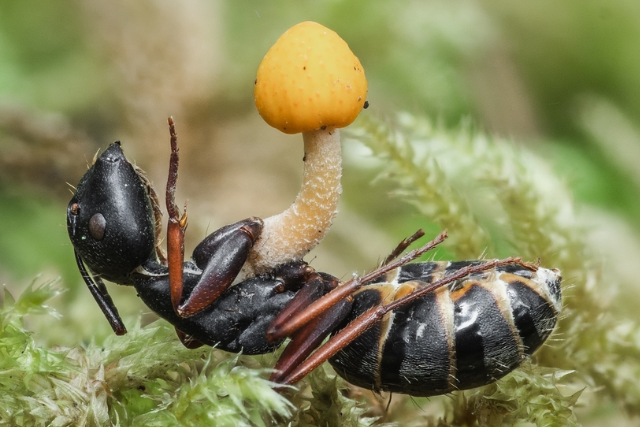
Source: iNaturalist – New Guinea spiny-ant fungus species group, Ophiocordyceps myrmecophila(muinungo)
You can bring this perspective to an ordinary woodland walk. Stinkhorns occur well beyond the tropical settings described here, including in Japanese woods and woodland edges. Veiled stinkhorns may also occur in warmer regions, including bamboo groves.
When you find a fungus, consider three things.
- Form. Where are the spores produced or held? Look for gills, pores or sticky gleba, and notice any veil, membrane or net-like structure.
- Visitors. What arrives, where does it settle, and what does it do? Walking, feeding and resting are different activities. A little distance and a few minutes of patience can help you see more.
- Surroundings. Is the fungus growing on wood, among fallen leaves or from the soil? Is the site shaded, exposed, damp or dry? The setting is part of the dispersal story.
 メンフクロウ職員
When you find a stinkhorn, do not stop at its shape. Step back a little and watch the gleba. Which insects settle there, and what do they do before they leave? A few quiet minutes can show you part of the dispersal system.
With a stinkhorn, standing downwind may be enough; you need not put your face close to the fruiting body. Do not touch the gleba, and leave the fruiting body undamaged.
Do not collect fungi in protected areas, places where collecting is prohibited, or private land without permission.
Many fungi cannot be identified to species from a photograph alone. Photograph the whole fruiting body, its separate parts, the surrounding habitat and any visiting insects. Record the date and locality as well. These notes may later help you compare your observation with field guides, museum resources and specialist literature.
“What is it called?” is a worthwhile question. Add another—“Who is visiting, and what are they doing?”—and a single mushroom becomes the centre of a much larger scene.
Fungi do not need to become a complete flower or a piece of carrion. If they connect with the cues an insect uses to find food, a place to lay eggs or a mate—or with the changes taking place inside an infected host—then the insect’s movement and contact can become opportunities for spores to travel and infection to spread.
 ミミズク先生
The next time you meet an odd fungus, look not only at what it resembles, but at what is happening beside it.
Explore More from the Museum of the Forest
ミミズク先生Please do explore the books from eco-life-planet as well. I hope they will offer you many more rewarding encounters with the living world.
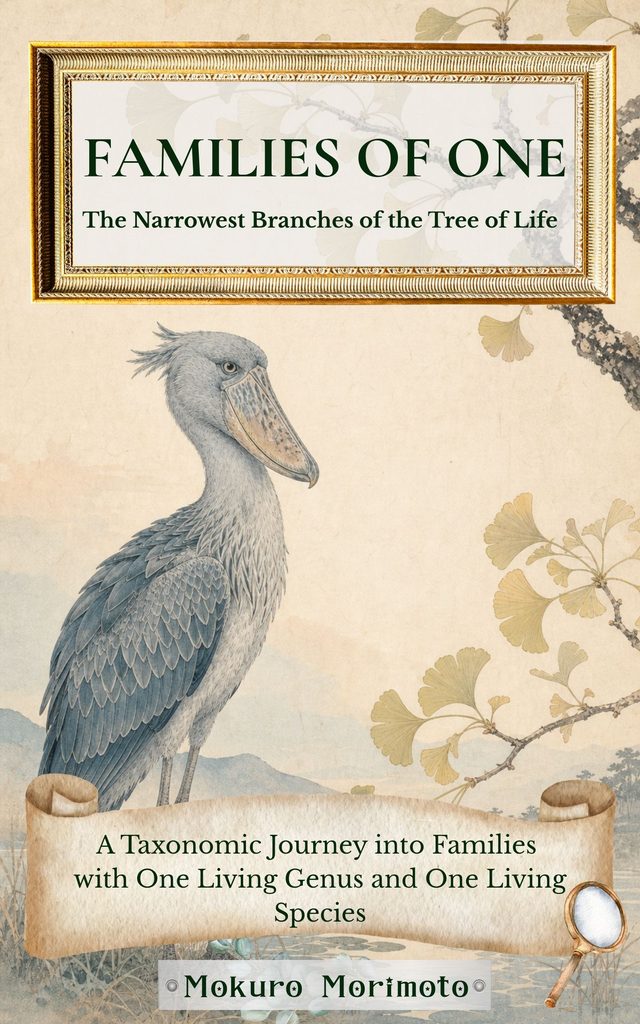
Families of One: The Narrowest Branches of the Tree of Life
Kindle Books Currently Available in Japanese
The Japanese-language Museum of the Forest series includes expanded introductions to taxonomy, nature observation and unusual branches of the tree of life.
- An Introduction to Taxonomy: The Basic Science of Organising the World, Level 1 — Japanese-language edition
- Spring Nature Observation Handbook — Japanese-language edition
- Animals from Families of One: The Narrowest Branches of the Tree of Life — Japanese-language edition

References
- Cabral, T. S., et al. (2019). Behind the veil – exploring the diversity in Phallus indusiatus s.l. (Phallomycetidae, Basidiomycota). MycoKeys, 58, 103–127.
- de Bekker, C., Beckerson, W. C., & Elya, C. (2021). Mechanisms behind the madness: How do zombie-making fungal entomopathogens affect host behavior to increase transmission?. mBio, 12(5), e01872-21.
- de Bekker, C., & Das, B. (2022). Hijacking time: How Ophiocordyceps fungi could be using ant host clocks to manipulate behavior. Parasite Immunology, 44(3), e12909.
- de Bekker, C., et al. (2014). Species-specific ant brain manipulation by a specialized fungal parasite. BMC Evolutionary Biology, 14, 166.
- Fredericksen, M. A., et al. (2017). Three-dimensional visualization and a deep-learning model reveal complex fungal parasite networks in behaviorally manipulated ants. Proceedings of the National Academy of Sciences, 114(47), 12590–12595.
- Hughes, D. P., et al. (2011). Behavioral mechanisms and morphological symptoms of zombie ants dying from fungal infection. BMC Ecology, 11, 13.
- Johnson, S. D., & Jürgens, A. (2010). Convergent evolution of carrion and faecal scent mimicry in fly-pollinated angiosperm flowers and a stinkhorn fungus. South African Journal of Botany, 76(4), 796–807.
- Laraba, I., et al. (2020). Fusarium xyrophilum, sp. nov., a member of the Fusarium fujikuroi species complex recovered from pseudoflowers on yellow-eyed grass (Xyris spp.) from Guyana. Mycologia, 112(1), 39–51.
- Laraba, I., et al. (2020). Pseudoflowers produced by Fusarium xyrophilum on yellow-eyed grass (Xyris spp.) in Guyana: A novel floral mimicry system?. Fungal Genetics and Biology, 144, 103466.
- Loreto, R. G., & Hughes, D. P. (2019). The metabolic alteration and apparent preservation of the zombie ant brain. Journal of Insect Physiology, 118, 103918.
- Mangold, C. A., et al. (2019). Zombie ant death grip due to hypercontracted mandibular muscles. Journal of Experimental Biology, 222(14), jeb200683.
- Naundrup, A., et al. (2022). Pathogenic fungus uses volatiles to entice male flies into fatal matings with infected female cadavers. The ISME Journal, 16(10), 2388–2397.
- Santana, M. D. F., & Couceiro, S. R. M. (2024). New insights on the spore dispersal of Phallus indusiatus s.l. (Basidiomycota, Phallaceae) for the Brazilian Amazon forest. Food Webs, 38, e00338.
- Torres-Cruz, T. J., et al. (2026). Fusarium xyrophilum facilitates its dispersal by exploiting sensory biases of generalist insects through pseudoflowers. Mycologia, 118(5), 950–968.
- van Roosmalen, E., & de Bekker, C. (2024). Mechanisms underlying Ophiocordyceps infection and behavioral manipulation of ants: Unique or ubiquitous?. Annual Review of Microbiology, 78, 575–593.
Further reading
- Smithsonian National Museum of Natural History. (2021). Fake flowers, real news: A new plant-fungus association in Guyana. The Plant Press, 24(1).
- University of Florida IFAS Extension. (2018). Stinkhorn Mushrooms. EDIS, PP345.
コメント