


Ants are easy to overlook on a walk. One may be carrying something across the ground, another may pause at the base of a leaf, and a third may disappear into a hollow stem. These small movements can reveal remarkable relationships between plants, insects, fungi and their surroundings.
Some ants carry seeds with food-rich appendages. Others visit nectar produced outside flowers and may discourage leaf-eating insects. In tropical forests and savannas, some ants even nest inside structures made by plants, including hollow stems, swollen thorns and leaf pouches.
Plants cannot move, but they do not live alone. By watching what ants do around them, we can begin to see a wider ecological network.
 メンフクロウ職員
I first became interested in ant plants through orchids with hollow pseudobulbs. Their unusual shapes are striking, but the relationships inside them are even more fascinating.
Not every encounter between an ant and a plant is a mutualism. The result can vary with the ant species, the plant, the season and the surrounding organisms. A useful question is therefore not simply, “Are there ants on this plant?” but “What are they doing here?”

Ants and Plants: Carry, Protect and House
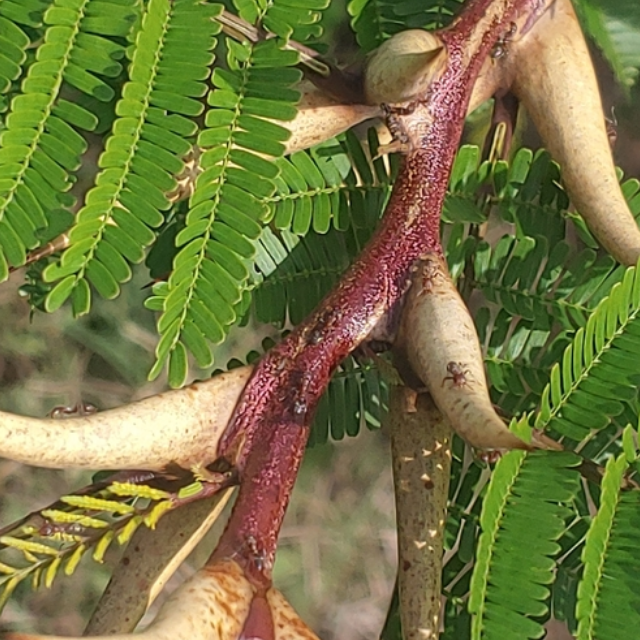
出典:iNaturalist – アリアカシア Vachellia sphaerocephala(pacorrowild)
Plants do not consciously call ants or ask them for help. Instead, certain plant traits can influence ant behaviour. Where those traits helped plants survive or reproduce, they could persist over generations.
Plant–ant relationships can be organised into three broad patterns:
| Relationship | What the plant provides | What ants may do | Examples |
|---|---|---|---|
| Carry | Food-rich appendages on seeds | Carry seeds to or near a nest | Violets, Japanese fawn lily, green foxtail |
| Protect | Extrafloral nectar or food bodies | Patrol the plant and sometimes deter herbivores | Japanese mallotus, cherries, vetches |
| House | Domatia, sometimes with nectar or food bodies | Nest inside plant-made structures | Myrmecodia, Cecropia, whistling thorn |
These categories can overlap, but they are not interchangeable. A plant whose seeds are carried by ants is not automatically an ant plant in the strict ecological sense. Nor does a plant become an ant plant merely because ants drink nectar from its leaves.
Not Every Plant Associated with Ants Is a Myrmecophyte
Several terms help us distinguish these relationships:
- Myrmecophyte or ant plant: a plant that forms specialised structures in which ants can shelter or nest.
- Myrmecochorous plant: a plant whose seeds are dispersed by ants.
- Extrafloral nectary: a nectar-producing structure located outside a flower.
- Domatium: a plant-made structure used as shelter by small animals. The plural is domatia.
- Elaiosome: a food-rich appendage attached to a seed.
- Food body: a nutrient-rich plant structure eaten by animals, often ants.
In everyday writing, “ant plant” is sometimes used more broadly. In ecology, however, myrmecophyte usually refers to a plant that provides ants with specialised nesting space.
Carrying Seeds — Myrmecochory
Seed dispersal by ants is called myrmecochory. Many myrmecochorous plants produce seeds with an elaiosome containing lipids, proteins, sugars or other nutrients.
An ant may pick up the whole seed, carry it to a nest or another nearby place, remove the elaiosome and leave the seed itself behind.
 シロフクロウ職員
So the ant is usually interested in the elaiosome rather than the seed?
 ミミズク先生
Precisely. The seed travels because it is attached to the food reward. Where it is eventually left depends on the ant and the surrounding environment.
Being moved away from the parent plant may reduce crowding or place a seed in a different patch of soil. However, dispersal does not guarantee success. A seed may be dropped nearby, buried too deeply, damaged or left somewhere unsuitable for germination.
The outcome can depend on:
- The ant species
- The size and weight of the seed
- How far the ant carries it
- Soil moisture and light
- Other animals that may find the seed
- Whether the seed remains viable
An elaiosome is therefore not simply a “payment”. It gives ants a reason to pick up and carry the seed. After the elaiosome has been removed, the seed may be left away from the parent plant—inside or near an ant nest, for example, or in a place where ants leave unused material. This can change where the seed ends up and the soil, moisture, light and other conditions it encounters before germination.
シロフクロウ職員That does not guarantee a good place to grow, then. It simply gives the seed a chance to be carried somewhere different?
 ミミズク先生
Exactly. The ant provides transport, not a promise. The seed may reach a favourable site, but it may also be left somewhere unsuitable.
Japanese Fawn Lily and Violets
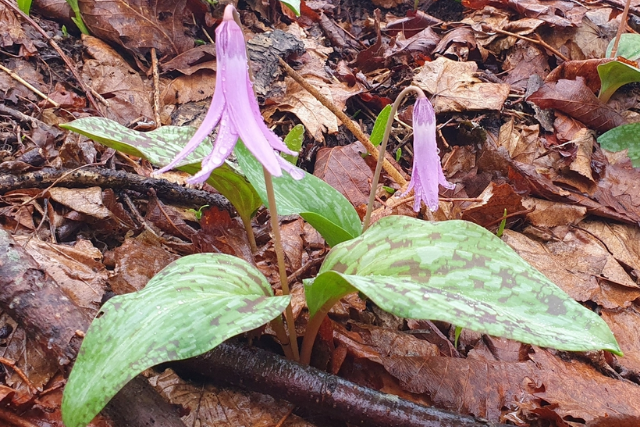
Source:iNaturalist – カタクリ Erythronium japonicum(pyological__point)
The Japanese fawn lily, Erythronium japonicum, is a woodland plant whose seeds may be carried by ants. It is also a spring ephemeral: a perennial plant that grows and flowers during the bright period before deciduous trees develop a full canopy.
After flowering, its seeds develop elaiosomes that attract ants. A seed carried through the leaf litter may reach a different patch of soil from one that falls directly beneath the parent plant.
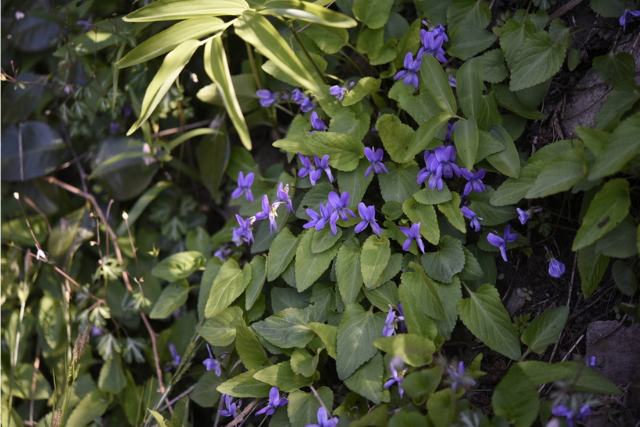
Source:iNaturalist – コスミレ Viola japonica(yanghooncho)
Violets, including many Viola species, provide another familiar example. Their ripe capsules split open and eject the seeds. Ants may then find the fallen seeds and carry them away because of their elaiosomes.
This creates two stages of dispersal:
- The fruit ejects the seed.
- Ants may move it farther.
If you find a violet growing in a pavement crack or beside an old stone wall, ant dispersal may be one part of its history—although it cannot explain every violet growing in an unexpected place.
Green Foxtail — An Unexpected Grass
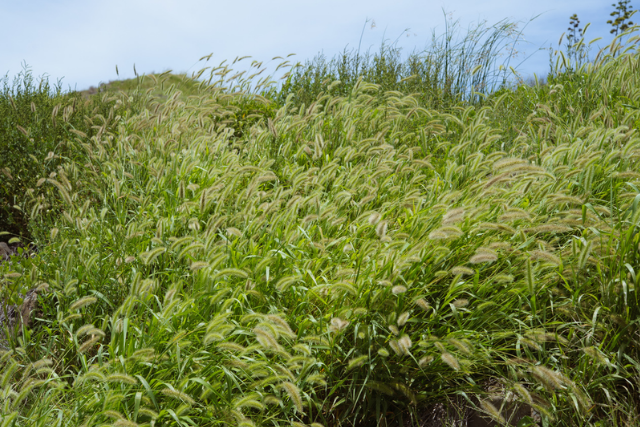
Source:iNaturalist – エノコログサ Setaria viridis(mutolisp)
Green foxtail, Setaria viridis, is a common grass of pathsides, gardens and disturbed ground. Giant foxtail, Setaria faberi, is a related species.
A study published online in 2025 and assigned to the 2026 volume of Plant Species Biology reported the first experimental evidence of myrmecochory in the grass family, Poaceae.
In field observations, ants carried the grains of both species. Laboratory experiments also showed that the ant Tetramorium tsushimae removed the outer fruit layer of S. viridis while leaving the rest intact. Lipids were detected in this outer layer, supporting the interpretation that it functions as an elaiosome-like food reward.
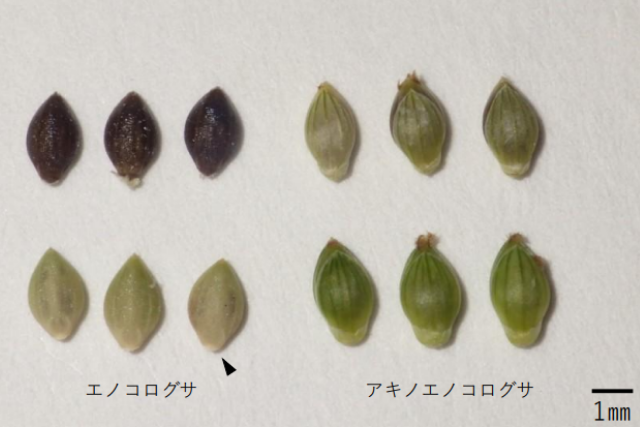
Source:京都大学 ‐ アリによる種子散布共生を、イネ科植物で初めて確認(2025年12月)
Top row: Seeds removed from nests of the ant *Tetramorium tsushimae*. Bottom row: Fresh seeds collected immediately after falling from the seed heads. Black arrows: Areas in which lipids were detected by staining.
The results for S. faberi were less straightforward: its grains were transported, but the ants in the laboratory did not remove the outer layer. The study therefore demonstrated ant-mediated dispersal in both grasses while also showing that the details can differ between closely related species.
This discovery is a useful reminder that familiar plants may still contain ecological relationships that have received little scientific attention.
Protecting Plants — Extrafloral Nectar
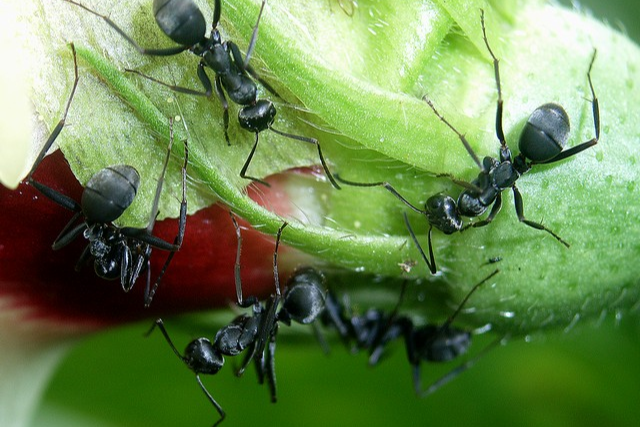
Source:福岡教育大学 ‐ 花外蜜腺
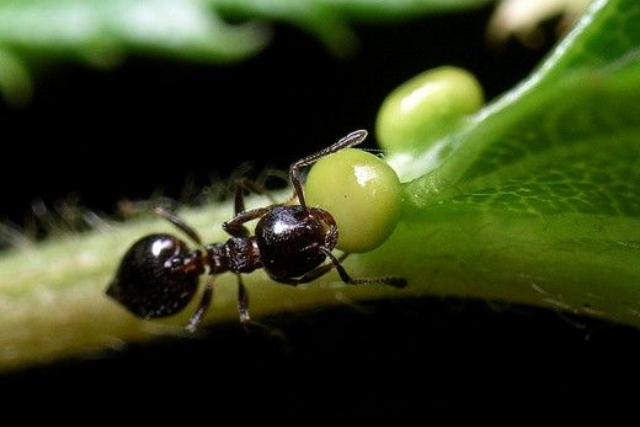
Plants can attract ants without involving seeds. Many produce nectar from extrafloral nectaries, structures located on leaves, leaf stalks, stipules, stems or buds rather than inside flowers.
Ants visit these structures for sugar-rich nectar. While moving across the plant, they may encounter caterpillars or other herbivores. Some ants attack them, remove them or drive them away. Where this reduces damage, the plant receives an indirect form of defence.
Across many studies, ants have on average reduced herbivore damage and improved plant reproduction. However, the size of the benefit varies. It can depend on the ant species, the herbivores present, the position and type of nectary, the season and the surrounding habitat.
Ant attendance should therefore not be treated as guaranteed protection.
Japanese Mallotus Changes Its Defences as Leaves Age
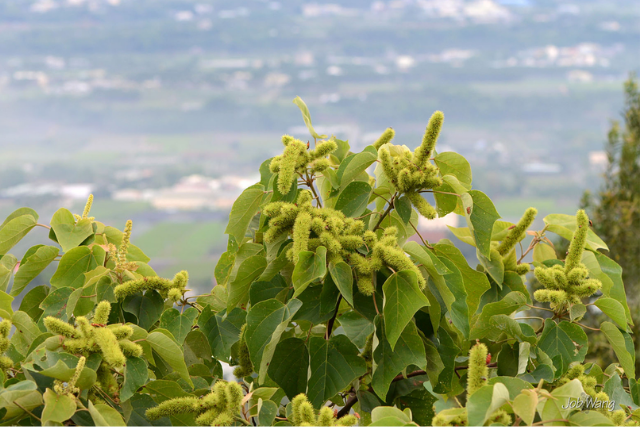
Source:iNaturalist – アカメガシワ Mallotus japonicus(jobwang)
Japanese mallotus, Mallotus japonicus, is a deciduous pioneer tree commonly found at woodland edges, along roads and in other disturbed places in Japan. Its reddish young leaves make it particularly noticeable in spring.
The plant has extrafloral nectaries and produces small food bodies that can attract ants. Research has shown that its combination of defences changes as its leaves age.
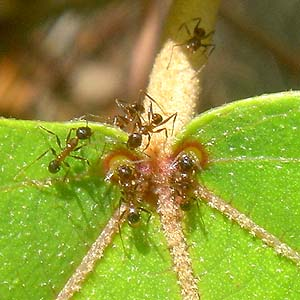
Source:岡山理科大学 ‐ アカメガシワ Mallotus japonicus (Thunb.) Muell. Arg.
Very young leaves rely strongly on direct defences, including hairs and translucent structures containing chemical compounds. As the leaves develop, indirect defence involving extrafloral nectar, food bodies and visiting ants becomes more important.
This does not mean that the plant simply turns one defence off and another on. Rather, the balance among several defences changes over the life of a leaf.
 タヌ山先生
タヌ山先生Plants rarely rely on one trick. A soft expanding leaf and a mature leaf face different risks, so the most useful combination of defences can change.
Cherries, Vetches, Aphids and Ants
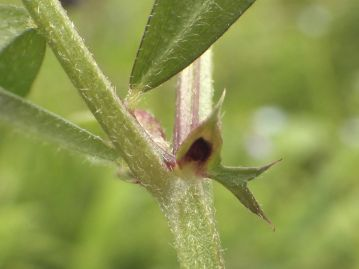
Source:重井薬用植物園 ‐ カラスノエンドウ/ヤハズエンドウ (マメ科) Vicia sativa subsp. nigra
Extrafloral nectaries can also be found on familiar plants.
Some cherry species have small nectaries near the base of the leaf stalk. After flowering, you may see ants pausing at these bead-like structures on young leaves. Vetches can have nectar-producing areas on the stipules at the base of their leaves.
However, ants on a plant are not necessarily feeding from its nectaries. They may instead be collecting honeydew, a sugar-rich liquid released by sap-feeding insects such as aphids.
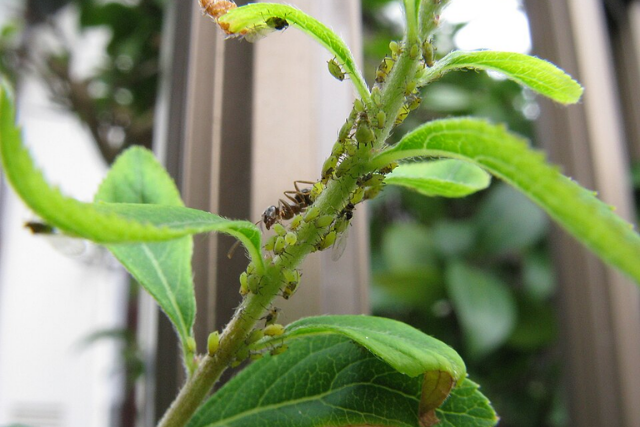
Source:WIKIMEDIA COMMONS ‐ File:Aphis citricola1.jpg(KENPEI)

Some ants protect aphids from predators and parasitoids in exchange for honeydew. The plant may then remain exposed to damage from the aphids, even if the ants discourage other insects.
A plant, an ant and an aphid can therefore form a relationship with different costs and benefits for each participant. Watching where an ant stops and what it touches is more informative than simply recording its presence.
Tropical Ant Plants — When Ants Live Inside Plants
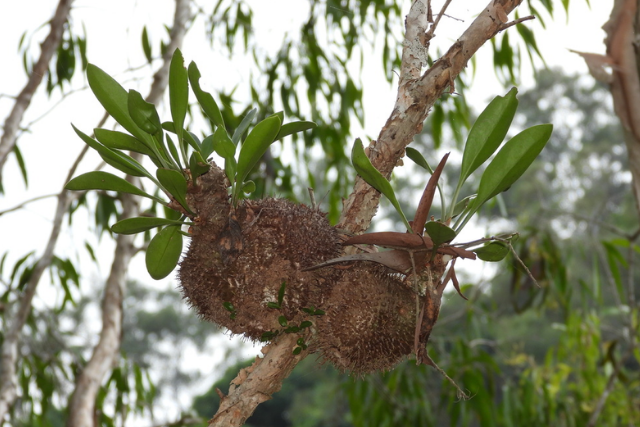
Source:iNaturalist – 属 Myrmecodia(hairybee)
Some tropical and subtropical plants form specialised structures that ants can use as nesting spaces. These are the plants most often described as myrmecophytes.
A plant may provide hollow stems, swollen stem chambers, leaf pouches, hollow pseudobulbs or enlarged thorns. Some species also supply nectar or food bodies.
Resident ants may defend their nesting site by attacking herbivores or removing climbing plants. They may also leave organic debris that becomes a source of nutrients. Even so, not every domatium is occupied, and not every ant species provides the same benefit.
Domatia — Plant Structures Used as Homes
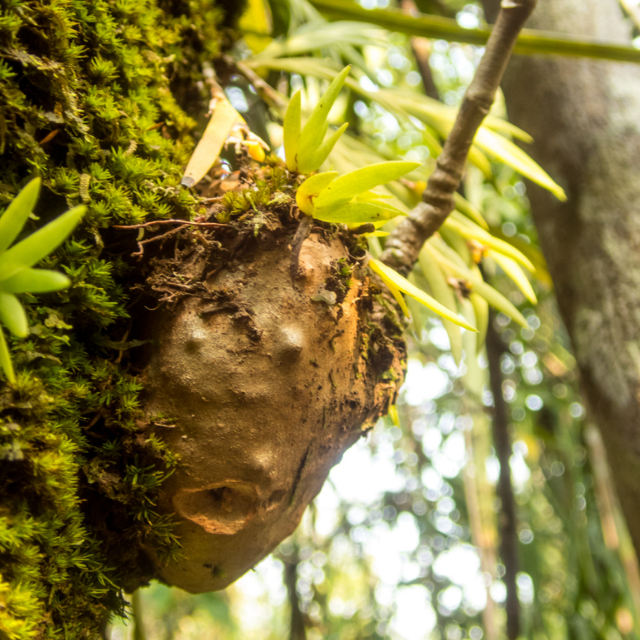
出Source:iNaturalist – Hydnophytum formicarum(geechartier)
A domatium is a structure produced by a plant and used as shelter by small animals.
Ant domatia may take the form of:
- Swollen stems with internal chambers
- Hollow internodes
- Hollow pseudobulbs
- Leaf pouches
- Enlarged thorns
A domatium is not simply a wound, broken branch or hole caused by decay. In a myrmecophyte, the basic structure develops as part of the plant’s growth, although ants may open or enlarge an entrance.
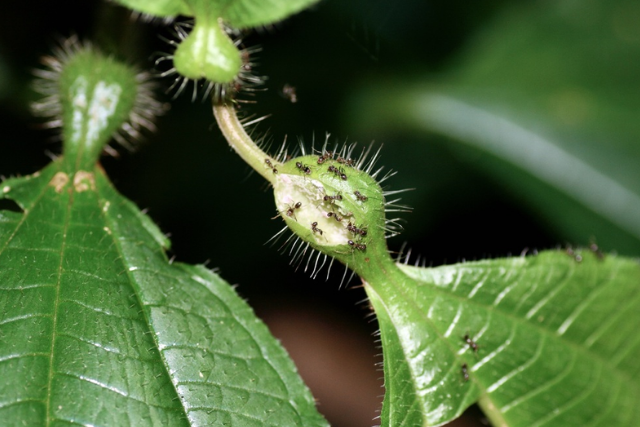
Source: iNaturalist – Miconia microphysca (botalex)
A species of Miconia (Melastomataceae).
One example is Miconia microphysca. Older sources may use the names Tococa quadrialata or Microphysca quadrialata, but Plants of the World Online currently treats these as synonyms of Miconia microphysca. The plant develops paired pouch-like structures near the bases of its leaves, which ants may use for nesting.
Myrmecodia and Hydnophytum — Mazes Inside Swollen Stems
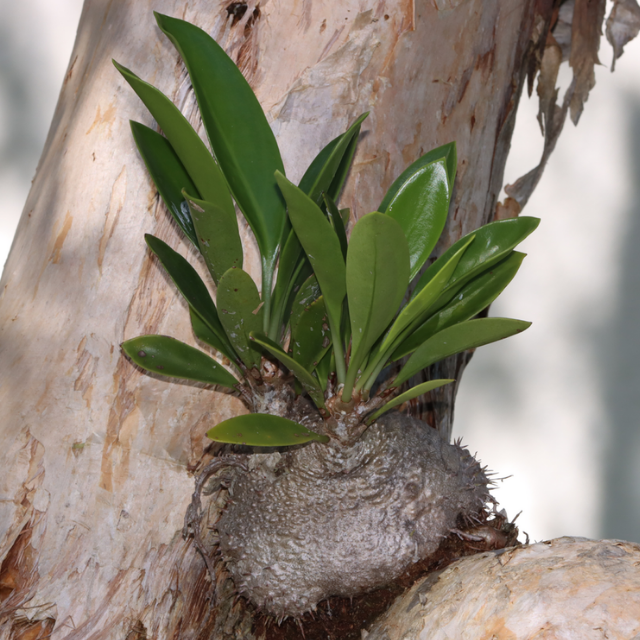
Source:iNaturalist – Myrmecodia beccarii(botanistbob)
Some of the best-known ant plants belong to the coffee family, Rubiaceae—the same large plant family that includes coffee plants, gardenias and quinine trees. Among them are species of Myrmecodia and Hydnophytum, which occur from Southeast Asia through New Guinea and nearby regions, with some extending into northern Australia.
Many are epiphytes, growing on tree trunks or branches rather than rooting in the ground. Their swollen bases may look like roots or tubers, but they are formed largely from stem and hypocotyl tissue.
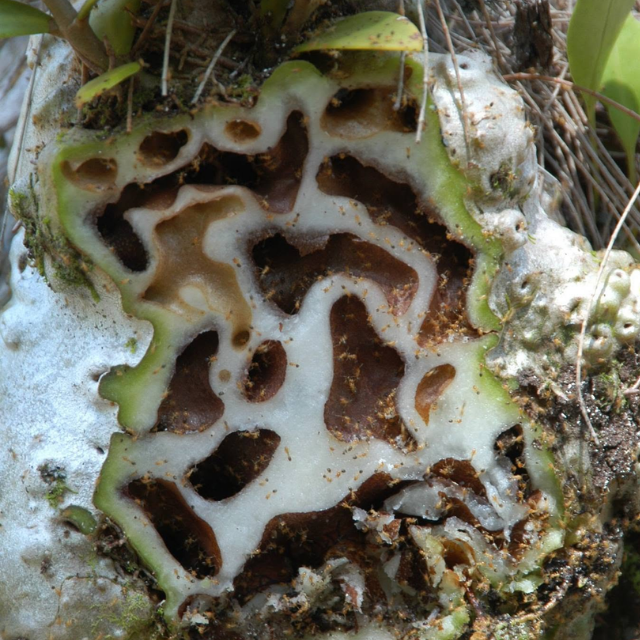
Source:高知県立牧野植物園 ‐ アリノトリデ [アカネ科] ※写真は断面図 Myrmecodia spp.
Inside are chambers and tunnels that ants can occupy. Ants may rear their brood and leave food remains, waste and other organic material in these spaces. For an epiphyte with no direct access to soil, such material can become an important nutrient source.
The details vary among plant and ant species. Fungi and other microorganisms may also contribute to the processing and movement of nutrients.
Ant Orchids — Hollow Pseudobulbs
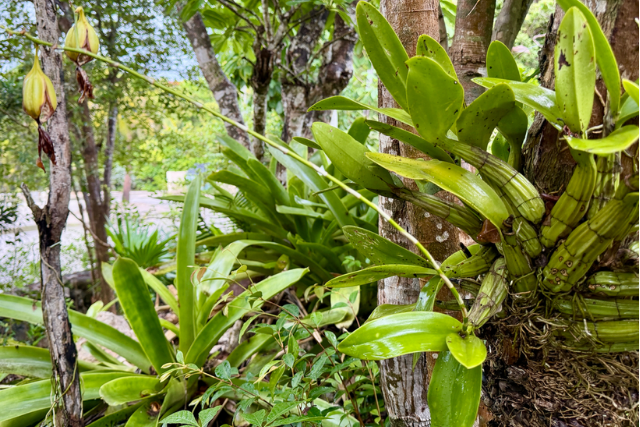
Source:iNaturalist – Myrmecophila thomsoniana var. thomsoniana(caymannature)
Some orchids in Central and South America, particularly species of Caularthron and Myrmecophila, develop hollow pseudobulbs that ants can use as shelter.
A pseudobulb is a swollen part of an orchid stem that commonly stores water and nutrients. In Caularthron bilamellatum, some internal water-storage tissue breaks down as the pseudobulb develops, leaving a cavity that ants can occupy.
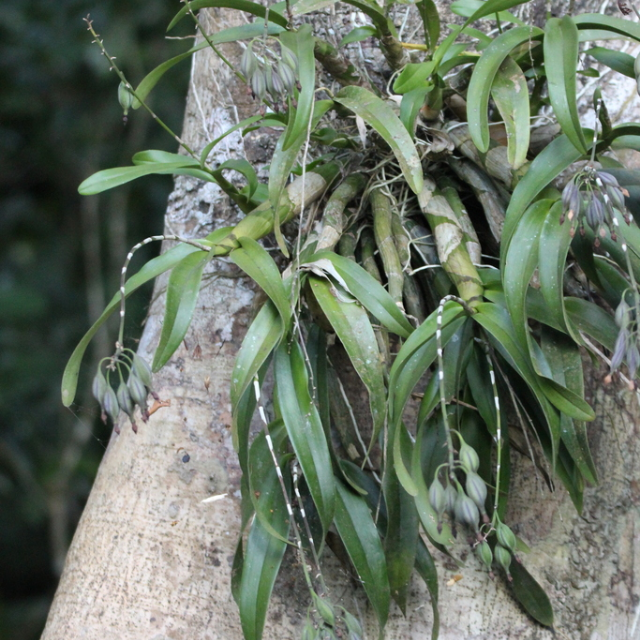
Source:iNaturalist – Caularthron bilamellatum(stefandominik)
Experiments using nitrogen-15 as a tracer have shown that nitrogen associated with ant activity can enter the orchid’s tissues. Later research found that fungi growing inside and around the pseudobulb help move nutrients from ant waste towards living orchid cells.
A hollow pseudobulb is therefore more than a nest. It can be part of a nutrient pathway involving the orchid, ants and fungi.
How can scientists follow invisible nutrients?
Nitrogen occurs in several forms called isotopes. Researchers can provide ants or ant-related material with a detectable amount of nitrogen-15 and later test whether it appears in the orchid. This allows them to trace the movement of nitrogen through the association.
Cecropia — Hollow Stems and Food Bodies
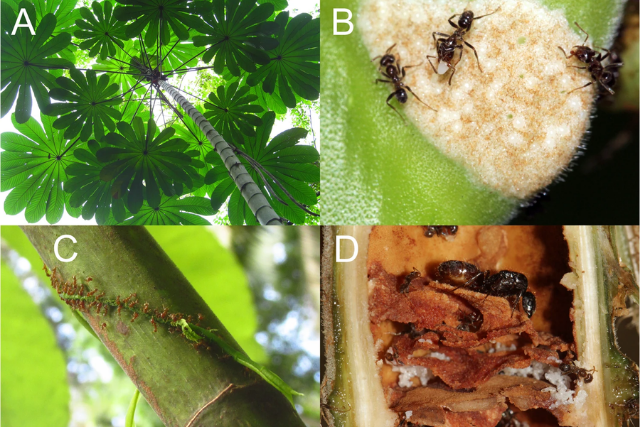
Source:Springer Nature ‐ Ant-plant sociometry in the Azteca-Cecropia mutualism(2018年12月19日)
(A) A view from below the crown of a juvenile Cecropia obtusifolia. (B) Azteca constructor havesting Müllerian food bodies from a trichilium. (C) Azteca workers attacking an enchroching vine. (D) A cross-section of the central stem shows the queen, workers, and brood residing in carton galleries inside the hollow internodes. All photos were taken by Peter Marting.
In the tropical Americas, some Cecropia trees form well-known associations with Azteca ants.
The ants can nest inside hollow stem internodes. Some Cecropia species also produce small nutrient-rich structures called Müllerian bodies on specialised hairy areas near the bases of the leaf stalks. These are food bodies rather than nesting chambers.
In return, resident ants may attack herbivores and remove climbing plants that compete with or shade the tree. The strength of these effects differs among Cecropia species, ant colonies and environments.
シロフクロウ職員Are Müllerian bodies connected with the same Müller remembered in Müllerian mimicry?
ミミズク先生Yes. Both names honour Fritz Müller, the German naturalist who worked in Brazil and made important contributions to evolutionary biology.
Whistling Thorn — Ants Inside Swollen Thorns
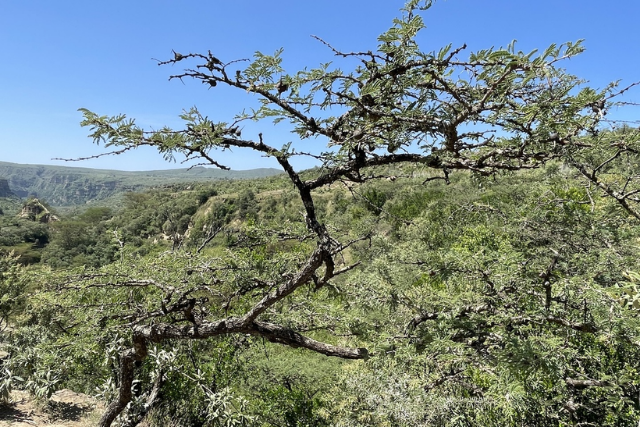
Source:iNaturalist – Vachellia drepanolobium(damontighe)
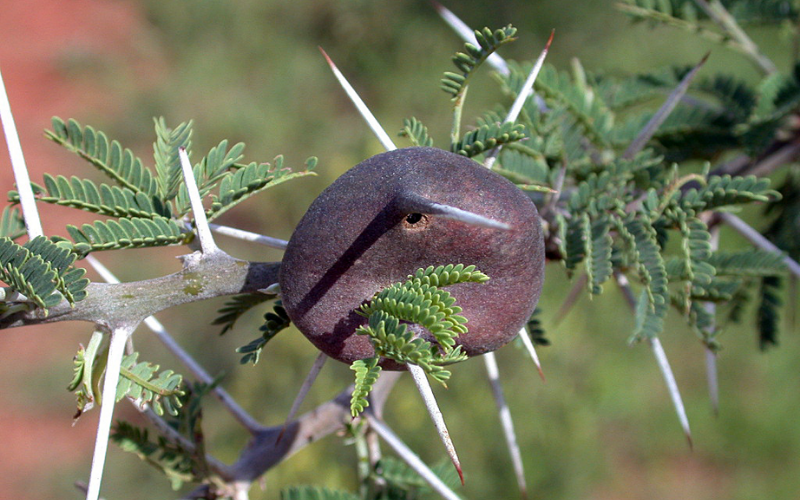
In East African savannas, whistling thorn, Vachellia drepanolobium, provides ants with another type of nesting space.
The species was formerly known as Acacia drepanolobium, and that name still appears in older publications. It develops swollen stipular thorns with hollow interiors. Ants chew entrance holes and use the thorns as nests. The tree also produces extrafloral nectar.
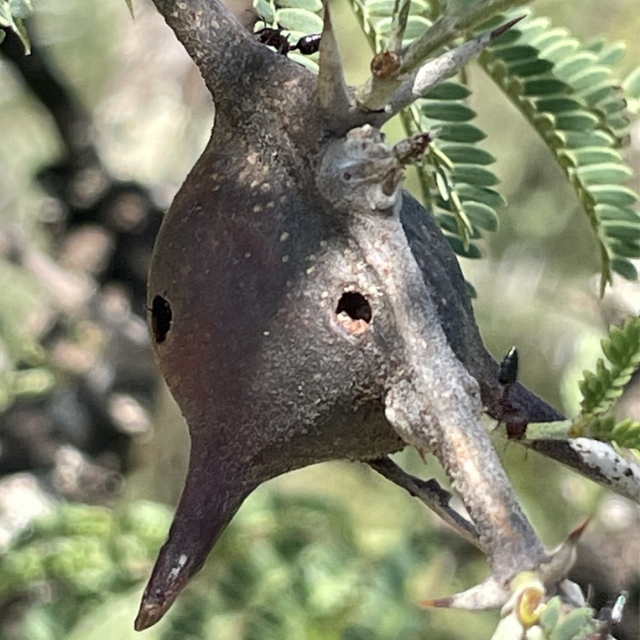
出典:iNaturalist – Vachellia drepanolobium(damontighe)
Several ant species can occupy whistling thorn, and they do not all provide the same degree of defence. The ecological outcome can therefore vary according to which ant colony lives in the tree.
The common name “whistling thorn” refers to the sound that may be produced when wind passes through holes made in the hollow thorns.
Growing Ant Plants at Home
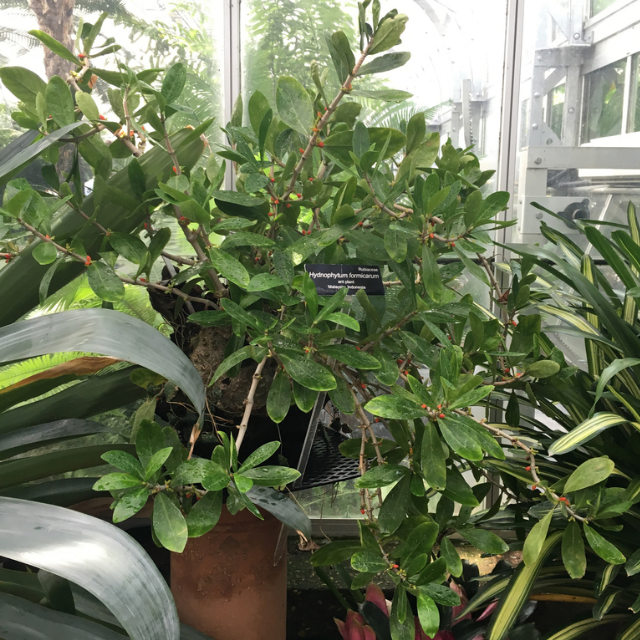
Source:iNaturalist – Hydnophytum formicarum(maryam_sed)
The swollen stems and hidden chambers of ant plants make them appealing to specialist growers. Resident ants, however, are not required for normal home or greenhouse cultivation.
Trying to introduce ants can create problems. The ants may not be natural partners of the plant, and they may leave the pot, disturb the growing medium or become household pests.
Many cultivated ant plants are tropical or subtropical epiphytes. They commonly need warmth, suitable light and good air movement around the roots. Their swollen bases may store water, but this does not mean that all species should remain completely dry for long periods. Permanently wet, poorly aerated growing media can be equally harmful.
Care should be based on the particular species, local climate, season, potting medium and condition of the plant—not on a fixed watering calendar.
Choosing and Buying an Ant Plant
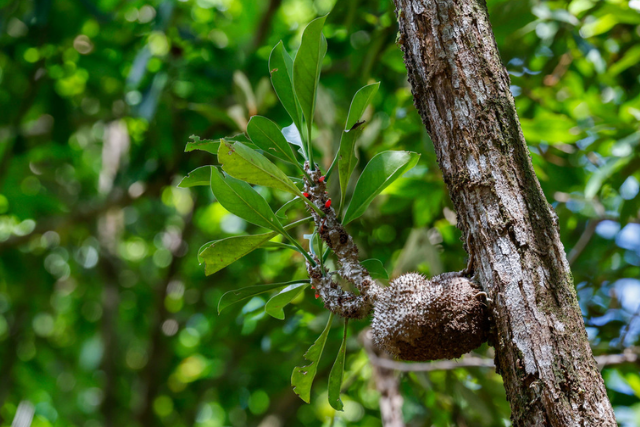
Source:iNaturalist – Myrmecodia tuberosa(tomfeild)
Plants offered by specialist growers may include:
- Hydnophytum formicarum
- Myrmecodia tuberosa
- Lecanopteris sinuosa, an ant fern with hollow rhizomes
- Some species of Dischidia, including plants with pouch-like leaves
These should not be treated as universally easy beginner plants. The healthiest choice is usually one whose needs match the temperature, light and space you can provide.
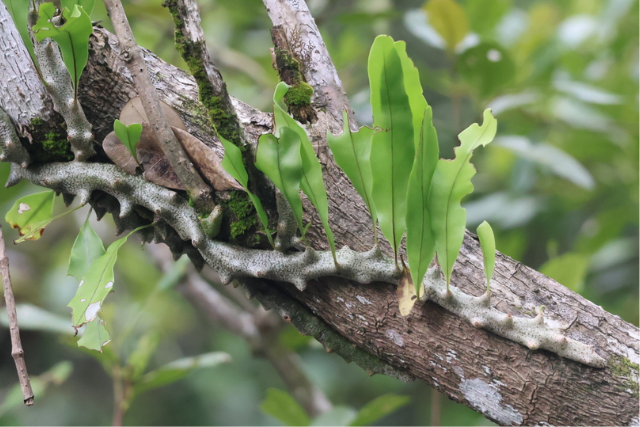
Source:iNaturalist – Lecanopteris sinuosa(abduelhakim)
Before buying, check:
- The scientific name
- Recent photographs of the actual plant
- Root and stem condition
- Whether it was propagated or established in cultivation
- Recent repotting or shipping history
- Light and temperature requirements
- Signs of pests, rot or physical damage
Choose nursery-propagated or long-established cultivated plants where possible. Plants with unclear collection histories may have been taken unsustainably from the wild.
International purchases may also be subject to plant-health inspections, phytosanitary documentation and, for some plants, CITES controls. Requirements differ among countries and species, so consult the relevant official authorities before ordering.
Watch What the Ant Is Doing
出典:福岡教育大学 ‐ 花外蜜腺
You do not need to visit a tropical rainforest to begin studying plant–ant relationships.
In spring, look at violet fruits, young cherry leaves and the stipules of vetches. From spring into summer, examine the leaves of Japanese mallotus. If you find an ant, follow it for a moment.
Is it:
- Carrying a seed?
- Feeding at a nectary?
- Tending aphids?
- Attacking another insect?
- Entering a hollow structure?
- Simply crossing the plant?
Record the date, location, habitat, weather, plant part and the ant’s behaviour. If you cannot identify the plant or ant, describe or photograph it instead. A careful record of behaviour can be more useful than an uncertain name.
Do not damage plants, dig up nests or move organisms to another place. Photographs and notes are usually enough for a first observation.
シロフクロウ職員o we can make a useful record even if we cannot identify every species?
ミミズク先生Certainly. Place, season and behaviour are valuable observations in their own right. A name can be checked later.
Plants do not travel through their surroundings as animals do, but they are not isolated. Through seeds, nectar, domatia, fungi and the behaviour of other organisms, they remain connected to the living world around them.
 メンフクロウ職員
Ecco, on your next walk, try following an ant that pauses on a plant. A movement lasting only a few seconds may reveal a relationship you have never noticed before.
Continue Your Journey
メンフクロウ職員If you have enjoyed this visit to the Forest Museum, please take a look at the books from eco-life-planet as well.
 ミミズク先生
A good book can keep a small question company for a very long time.
References and Further Reading
Ants and Plants: Carry, Protect and House
- Chomicki, G. and Renner, S. S. (2018). ‘Ant–plant interactions evolved through increasing interdependence’. Proceedings of the National Academy of Sciences of the United States of America, 115(48), 12253–12258.
- Chomicki, G., Walker-Hale, N., Etchells, J. P., Ritter, E. J. and Weber, M. G. (2024). ‘Diversity and development of domatia: Symbiotic plant structures to host mutualistic ants or mites’. Current Opinion in Plant Biology, 82, 102647.
- Royal Botanic Gardens, Kew. ‘Ants and plants: A very natural love story’.
Carrying Seeds — Myrmecochory
- Karnish, A. (2024). ‘Seed dispersal by ants: A primer’. International Journal of Plant Sciences, 185(5), 403–411.
- Lengyel, S., Gove, A. D., Latimer, A. M., Majer, J. D. and Dunn, R. R. (2010). ‘Convergent evolution of seed dispersal by ants, and phylogeny and biogeography in angiosperms’. Evolution, 64(9), 2643–2654.
- Gómez, C. and Espadaler, X. (2013). ‘An update of the worldwide myrmecochory database’. Ecography, 36(12), 1398–1405.
- Zelikova, T. J., Dunn, R. R. and Sanders, N. J. (2018). ‘From dispersal to predation: A global synthesis of ant–seed interactions’. Ecology Letters, 21(1), 127–136.
- Lanza, J., Schmitt, M. A., Awad, A. B. and Wasmuth, J. J. (1992). ‘Comparative chemistry of elaiosomes of three species of Trillium’. Journal of Chemical Ecology, 18, 209–221.
- Kimura, A., Ohsaki, H., Kaneko, T. and Yamawo, A. (2026). ‘Ant-mediated seed dispersal in the Poaceae: Evidence of myrmecochory in green foxtail (Setaria viridis) and giant foxtail (Setaria faberi)’. Plant Species Biology, 41(1), e70040.
- Kyoto University. (2025). ‘Ant-mediated seed dispersal mutualism confirmed in grasses for the first time’. Research News, 26 December 2025.
Protecting Plants — Extrafloral Nectar
- Rosumek, F. B., Silveira, F. A. O., Neves, F. S., Barbosa, N. P. U., Diniz, L., Oki, Y., Pezzini, F., Fernandes, G. W. and Cornelissen, T. (2009). ‘Ants on plants: A meta-analysis of the role of ants as plant biotic defences’. Oecologia, 160, 537–549.
- Trager, M. D., Bhotika, S., Hostetler, J. A., Andrade, G. V., Rodríguez-Cabal, M. A., McKeon, C. S., Osenberg, C. W. and Bolker, B. M. (2010). ‘Benefits for plants in ant–plant protective mutualisms: A meta-analysis’. PLoS ONE, 5(12), e14308.
- Stadler, B. and Dixon, A. F. G. (2005). ‘Ecology and evolution of aphid–ant interactions’. Annual Review of Ecology, Evolution, and Systematics, 36, 345–372.
- Yamawo, A., Suzuki, N., Tagawa, J. and Hada, Y. (2012). ‘Leaf ageing promotes the shift in defence tactics in Mallotus japonicus from direct to indirect defence’. Journal of Ecology, 100(3), 802–809.
- Yamawo, A., Katayama, N., Suzuki, N. and Hada, Y. (2012). ‘Plasticity in the expression of direct and indirect defence traits of young plants of Mallotus japonicus in relation to soil nutritional conditions’. Plant Ecology, 213, 127–132.
- Yamawo, A. et al. (2019). ‘Extrafloral nectary-bearing plant Mallotus japonicus uses different types of extrafloral nectaries to establish effective defence by ants’. Scientific Reports, 9, 13056.
- Japanese Society of Plant Physiologists. ‘Cherry nectaries, ants and sooty mould’.
- Leroy, C. et al. (2013). ‘Non-additive benefit or cost? Disentangling the indirect effects that occur when plants bearing extrafloral nectaries and honeydew-producing insects share exotic ant mutualists’. Annals of Botany, 111(1), 129–140.
Tropical Ant Plants — When Ants Live Inside Plants
- Chomicki, G., Walker-Hale, N., Etchells, J. P., Ritter, E. J. and Weber, M. G. (2024). ‘Diversity and development of domatia: Symbiotic plant structures to host mutualistic ants or mites’. Current Opinion in Plant Biology, 82, 102647.
- Royal Botanic Gardens, Kew. ‘Microphysca quadrialata: Synonym of Miconia microphysca’. Plants of the World Online.
- Gegenbauer, C., Mayer, V. E., Zotz, G. and Richter, A. (2012). ‘Uptake of ant-derived nitrogen in the myrmecophytic orchid Caularthron bilamellatum’. Annals of Botany, 110(4), 757–765.
- Gegenbauer, C. et al. (2023). ‘Exo- and endophytic fungi enable rapid transfer of nutrients from ant waste to orchid tissue’. New Phytologist, 238(5), 2210–2223.
- Marting, P. R. et al. (2018). ‘Ant-plant sociometry in the Azteca–Cecropia mutualism’. Scientific Reports, 8, 17806.
- New York Botanical Garden. ‘Müllerian bodies’. Glossary of Botanical Terms.
- Palmer, T. M. et al. (2017). ‘Distinctive fungal communities in an obligate African ant–plant mutualism’. Proceedings of the Royal Society B: Biological Sciences, 284, 20162501.
- Stanton, M. L., Palmer, T. M., Young, T. P., Evans, A. and Turner, M. L. (2019). ‘Population genomics and demographic sampling of the ant-plant Vachellia drepanolobium and its symbiotic ants from sites across its range in East Africa’. Frontiers in Ecology and Evolution, 7, 206.
- Young, T. P., Stubblefield, C. H. and Isbell, L. A. (1997). ‘Ants on swollen-thorn acacias: Species coexistence in a simple system’. Oecologia, 109, 98–107.
- Palmer, T. M. and Brody, A. K. (2007). ‘Mutualism as reciprocal exploitation: African plant-ants defend foliar but not reproductive structures’. Ecology, 88(12), 3004–3011.
- Royal Botanic Gardens, Kew. ‘Vachellia drepanolobium’. Plants of the World Online.
- San Diego Zoo Wildlife Alliance. ‘Blowing in the wind’.
Growing Ant Plants at Home
- Oxford Botanic Garden and Arboretum. ‘Myrmecodia species’.
- Royal Botanic Gardens, Kew. ‘Ants and plants: A very natural love story’.
- Ministry of Agriculture, Forestry and Fisheries, Japan, Plant Protection Station. ‘Frequently asked questions: Importing plants’.
- Ministry of the Environment, Japan. ‘CITES and the Act on Conservation of Endangered Species of Wild Fauna and Flora’.
- Convention on International Trade in Endangered Species of Wild Fauna and Flora. ‘What is CITES?’.
Watch What the Ant Is Doing
- Trager, M. D., Bhotika, S., Hostetler, J. A., Andrade, G. V., Rodríguez-Cabal, M. A., McKeon, C. S., Osenberg, C. W. and Bolker, B. M. (2010). ‘Benefits for plants in ant–plant protective mutualisms: A meta-analysis’. PLoS ONE, 5(12), e14308.
- Zelikova, T. J., Dunn, R. R. and Sanders, N. J. (2018). ‘From dispersal to predation: A global synthesis of ant–seed interactions’. Ecology Letters, 21(1), 127–136.
- Leroy, C. et al. (2013). ‘Non-additive benefit or cost? Disentangling the indirect effects that occur when plants bearing extrafloral nectaries and honeydew-producing insects share exotic ant mutualists’. Annals of Botany, 111(1), 129–140.
- Stadler, B. and Dixon, A. F. G. (2005). ‘Ecology and evolution of aphid–ant interactions’. Annual Review of Ecology, Evolution, and Systematics, 36, 345–372.
コメント