


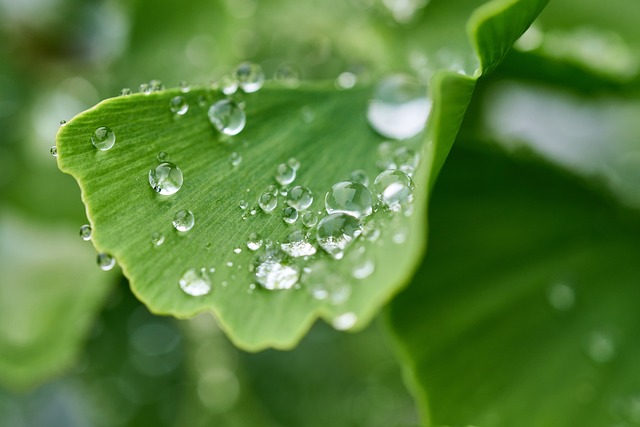
A desert plant with only two permanent leaves. A Japanese conifer found naturally nowhere else on Earth. A tiny moss that seems to shine green in the dark.
Welwitschia mirabilis, Sciadopitys verticillata, and Schistostega pennata look nothing alike. They live thousands of kilometres apart and belong to very different parts of the plant tree of life.
Yet they share one remarkable taxonomic feature.
Each is the sole recognised living species in its genus, and that genus is the sole living genus in its family. In other words, each represents an entire living plant family by itself.
Some are the sole surviving representatives of lineages that were once more diverse. Others reflect long histories of geographic isolation, ecological specialisation, extinction, or changing scientific classification.
This article presents 31 examples identified from the taxonomic sources consulted in September 2026. It is not intended as a fixed global total: the list may change as classifications are revised and new species are described.
Being alone in a family does not tell us everything about a plant. It does, however, give us a fascinating place to begin exploring its history.
Let us visit some of the thinnest living branches on the plant tree of life.

What Does “One Species, One Genus, One Family” Mean?
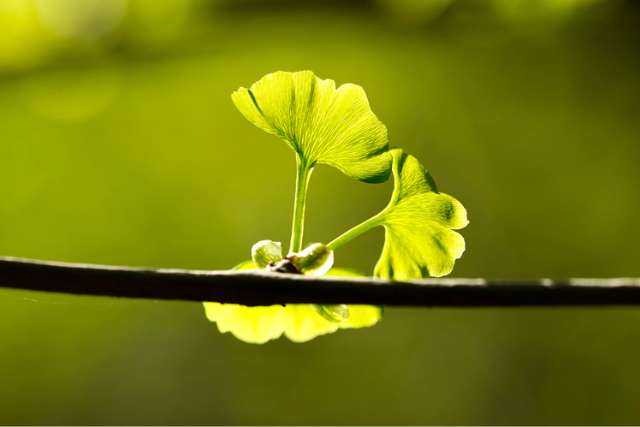
Source: iNaturalist – Ginkgo Ginkgo biloba(gg_copen)
Biologists classify organisms using a series of nested ranks. For this article, we only need three:
Family → Genus → Species
Family: Ginkgoaceae
└── Genus: Ginkgo
└── Species: Ginkgo biloba
Many plant families contain numerous genera, and each genus may contain many species. The orchid family, Orchidaceae, for example, contains an enormous diversity of both.
Ginkgoaceae is very different. Among living plants, it contains one recognised genus, Ginkgo, and that genus contains one recognised living species, Ginkgo biloba.
A group that contains only one taxon at the next relevant rank is often described as monotypic. In this article, “one family, one genus, one species” means:
A family containing one recognised living genus, which in turn contains one recognised living species.
The word living matters. A family may have a rich fossil record containing extinct genera and species, while being represented today by just one surviving species.
Monotypic Does Not Mean Primitive
A plant that stands alone in its family is not necessarily “primitive”, nor has it stopped evolving.
Every species alive today has an evolutionary history extending from its ancestors to the present. A plant with few close living relatives has not been left behind by evolution. It has simply travelled a different branch of the tree.
 シロフクロウ職員
If a plant’s lineage branches away from others very early on the family tree, does that mean it is more primitive than the plants around us today?
 ミミズク先生
Not at all. An early branch tells us about relationships, not about a ladder of progress. A plant at the end of that branch has continued evolving all the way to the present, just as orchids, daisies, and oaks have.
This distinction becomes particularly important when we meet Amborella trichopoda. Its lineage has a remarkable position near the root of the living flowering-plant tree, but that does not make it a surviving version of the first flower.
Evolution is a branching history, not a staircase from “primitive” organisms to “advanced” ones.
Monotypic Does Not Mean “Living Fossil”
You may encounter the phrase “living fossil”, particularly in descriptions of ginkgo.
The term can be useful as a shorthand for a living lineage with a long fossil history. However, it can also create the mistaken impression that the organism has remained unchanged for millions of years.
It has not.
Fossils may show that a lineage is ancient, that its relatives were once more diverse, or that it once occupied a larger geographical range. Living populations, however, have continued to reproduce, change, and evolve.
For this reason, “living fossil” is best treated as a historical metaphor rather than a precise taxonomic category.
Monotypic Does Not Automatically Mean Endangered
Being the only living species in a family does not automatically mean that a plant is endangered.
Taxonomic isolation and conservation status answer different questions. One describes a plant’s position in classification; the other describes its risk of extinction in the wild.
Some monotypic plants are grown in gardens and cities around the world. Others are restricted to small areas and survive in fragmented populations.
When those two forms of rarity do overlap, as they do in the Chilean tree Gomortega keule, conservation takes on an additional meaning: losing one species would also mean losing the sole living representative of an entire family.

Why Can a Plant Family Have Just One Living Species?
There is no single explanation. The same taxonomic pattern can emerge from very different histories.
Extinction and Deep Time
Some monotypic families belong to lineages that were once more diverse.
The fossil record of ginkgo relatives, for example, extends deep into geological time and shows that ginkgophytes were once more geographically widespread and varied than the single living species suggests.
Extinction continually removes branches from the tree of life. Climate shifts, geological events, changing habitats, competition, and chance all influence which lineages survive.
However, it is important not to reduce every monotypic family to the same story: “all the relatives died and one survivor remained”. Sometimes that is part of the history. It is not a universal explanation.
Geographic Isolation
Geography can also matter.
Several plants in this article occur on islands or within restricted regions: Amborella in New Caledonia, Tetracarpaea in Tasmania, Gomortega in Chile, and Sciadopitys in Japan.
Isolation can shape evolution and extinction by separating populations and limiting where a lineage can survive. Yet islands and isolated landscapes are not museums in which prehistoric plants have simply remained frozen in time.
Their floras have been shaped by extinction, dispersal, climate, geology, and continuing evolution.
They have histories, not time capsules.
Ecological Specialisation
Some members of monotypic families live in unusual ecological settings.
Welwitschia survives in one of the driest regions on Earth. Cephalotus traps prey in pitcher-shaped leaves. Schistostega grows in dim, sheltered places. Cynomorium does not photosynthesise and survives as a parasite connected to the roots of other plants.
These specialised ways of life help explain why the plants look so unusual.
They do not, however, automatically explain why each family contains only one living species. Ecology and taxonomic isolation may be connected, but they should not be treated as a simple cause-and-effect story.
Classification Changes as Evidence Changes
There is another reason this list can change: taxonomy itself is continually revised.
Botanists compare morphology, herbarium specimens, fossils, chromosomes, DNA sequences, and increasingly large genomic datasets. A plant once placed in one family may later be recognised as belonging to another. Genera may be combined or divided. A newly discovered species may turn a formerly one-species genus into a multi-species genus.
Registrar Snowy: So even a list of one-family, one-genus, one-species plants can change?
Dr Tanuyama: Exactly. Discovering another species or revising a family can change the list. Classification is evidence-based, but it is always open to better evidence.
That is why the table later in this article is a 2026 working list based on the taxonomic sources consulted for this revision, rather than a claim that the number can never change.
Now that the rules are clear, let us meet the plants.
Extraordinary Monotypic Plant Families Around the World
Welwitschia mirabilis: Two Leaves for a Lifetime
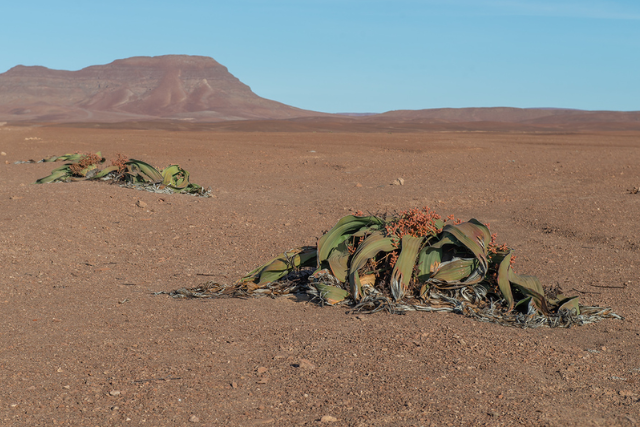
Source: iNaturalist – Welwitschia Welwitschia mirabilis(darkraptormacro)
- Family: Welwitschiaceae
- Distribution: South-western Angola and Namibia
- Plant group: Gymnosperm
- Why it stands out: Its two permanent foliage leaves continue growing from their bases throughout the plant’s life
Few plants look quite like Welwitschia mirabilis.
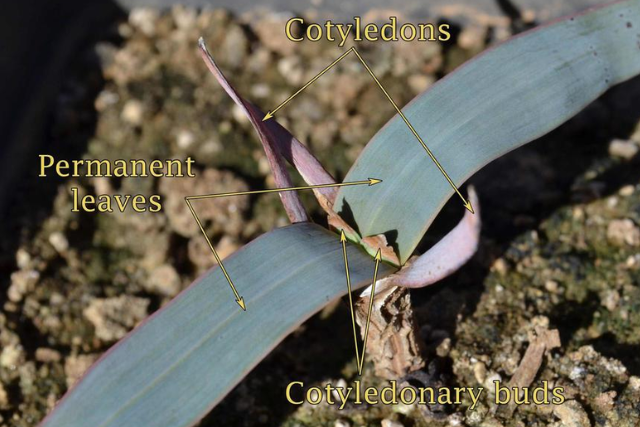
It grows in the Namib region of south-western Africa, where an extremely short woody stem supports two remarkable strap-like leaves.
Source: iNaturalist – Welwitschia Welwitschia mirabilis(jan-hendrik)
Just two.
Unlike most trees and shrubs, Welwitschia does not regularly replace its foliage with new leaves. Instead, the two permanent leaves continue growing from their bases. Wind, sand, and age gradually split their ends into ribbons, so an old plant may appear to possess a great tangled mass of leaves.
The effect can be wonderfully untidy.
Welwitschia is also famous for its longevity. Individual plants may survive for many centuries, although their exact ages are estimates rather than dates conveniently written on a botanical label.
The Namib is extraordinarily dry, and coastal fog is an important feature of the region. However, the popular idea that Welwitschia simply “drinks fog through its leaves” is too simple. Its survival involves root uptake, water availability, and physiological adaptations to an arid environment.
Taxonomically, Welwitschia belongs to the gnetophytes, one of the living gymnosperm lineages.
 タヌ山先生
タヌ山先生Look at the morphology. Two permanent foliage leaves, growing from the base for the plant’s entire life. Wind turns them into ribbons, but they are still only two leaves. That is not a broken growth pattern. It is a specialised one.
Amborella trichopoda: Near the Root of the Flowering-Plant Tree
Source: iNaturalist – Amborella Amborella trichopoda(narido)
- Family: Amborellaceae
- Distribution: New Caledonia
- Plant group: Angiosperm
- Why it stands out: Its living lineage is sister to all other extant flowering plants
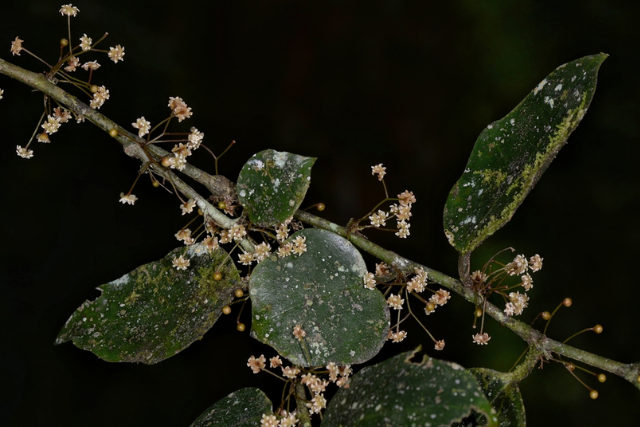
Compared with Welwitschia, Amborella trichopoda looks almost modest.
It is a shrub or small tree from the humid forests of New Caledonia. Its flowers are not huge, spectacular, or carnivorous. Yet few living plants have attracted more attention from researchers studying the origin and early evolution of flowering plants.
Large molecular datasets have repeatedly placed the Amborella lineage as the sister lineage to all other living angiosperms.
Imagine the family tree of all living flowering plants. One early branch leads to Amborella. The other leads eventually to water lilies, magnolias, grasses, orchids, roses, sunflowers, and almost every other flowering plant alive today.
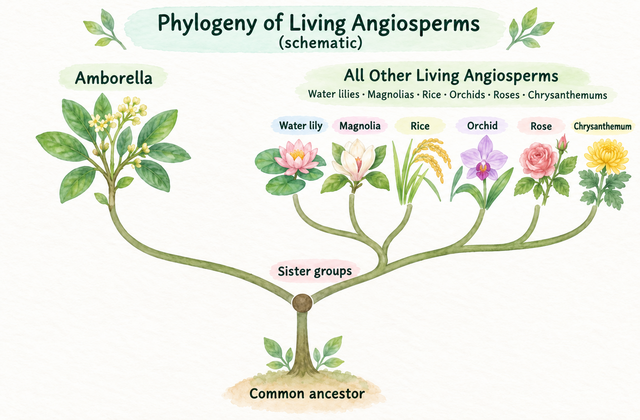
That position makes Amborella exceptionally useful for comparison.
Scientists can compare its anatomy, genes, reproductive biology, and other traits with those of other flowering plants. These comparisons help researchers investigate how important angiosperm features may have evolved.
シロフクロウ職員Then could we look at Amborella and say, “This is what the first flowering plant looked like”?
ミミズク先生No. That would ask a modern species to impersonate its distant ancestor. Amborella has had its own long evolutionary history in New Caledonia. What matters is its position in the tree and the comparisons that position allows us to make.
An early-diverging lineage is not a primitive organism.
That distinction is small in wording, but enormous in evolutionary thinking.
Ginkgo biloba: A Familiar Tree with an Extraordinary Family Tree
Source: iNaturalist – Ginkgo Ginkgo biloba(sunjiao)
- Family: Ginkgoaceae
- Distribution: Native to China; cultivated widely worldwide
- Plant group: Gymnosperm
- Why it stands out: The only living species of a lineage with a rich fossil history
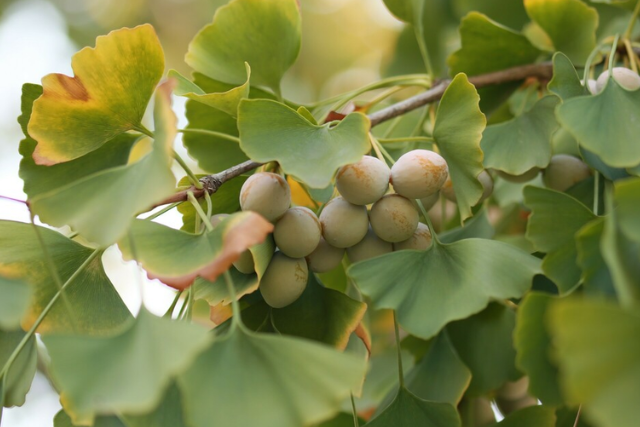
A ginkgo hardly looks lonely.
In autumn, avenues and parks in cities across the world become bright yellow beneath its fan-shaped leaves. In Japan, the species is especially familiar around temples, shrines, schools, parks, and city streets.
Yet Ginkgo biloba stands alone among living plants.
It is the only accepted living species of the genus Ginkgo, and Ginkgo is the only living genus of Ginkgoaceae.
The ginkgo is not native to Japan—its natural range lies in China—but few trees feel more at home in the Japanese landscape. Its golden autumn leaves can transform an ordinary street into something worth slowing down for. The seeds, known in Japan as ginnan, are also part of Japanese food culture.
Beneath this familiarity lies a much deeper history.
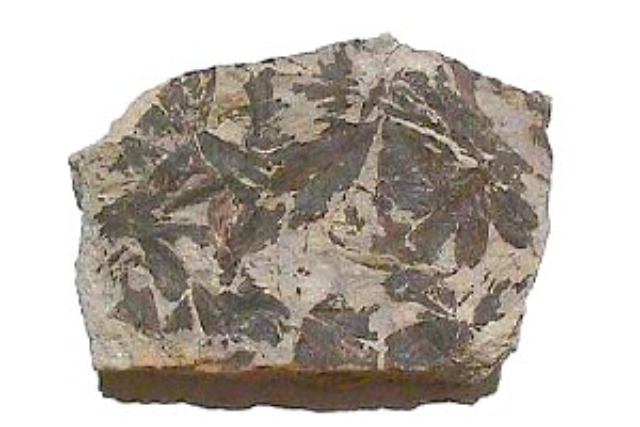
Source: Wikimedia Commons – File: Fossil Plant Ginkgo.jpg

Fossils attributed to ginkgo relatives show that ginkgophytes were once far more diverse and geographically widespread. This is why ginkgo is so often described as a “living fossil”.
The phrase is memorable, but a tree beside a Japanese pavement is not literally an unchanged survivor from the age of dinosaurs. It is a living, reproducing species whose lineage happens to extend into an exceptionally rich fossil past.
シロフクロウ職員So something can be entirely ordinary on the walk to work and taxonomically extraordinary at the same time?
 メンフクロウ職員
Quite easily. Museums teach that lesson rather often. Familiarity and scientific importance are not opposites.
Sciadopitys verticillata: Japan’s Living Botanical Original
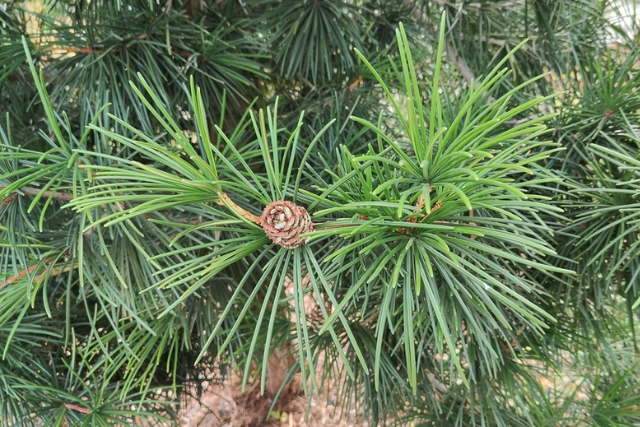
Source: iNaturalist – Japanese umbrella-pine Sciadopitys verticillata(wolfram06)
- Family: Sciadopityaceae
- English name: Japanese umbrella-pine
- Japanese name: Kōyamaki
- Distribution: Japan
- Plant group: Gymnosperm
- Why it stands out: A Japanese endemic conifer representing an entire living family
Japan has one of these remarkable solitary plant families too.
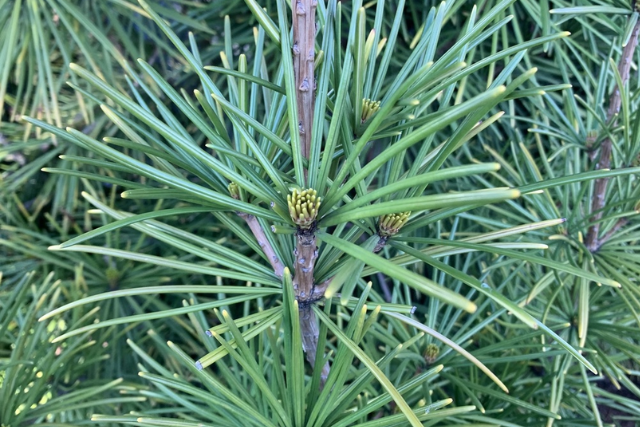
The Japanese umbrella-pine, Sciadopitys verticillata, grows naturally nowhere else on Earth. Known in Japanese as kōyamaki, it is an evergreen conifer native to parts of central and southern Japan.
Its foliage is unmistakable. Dark-green, glossy, needle-like structures form elegant whorls around the shoots, producing the umbrella-like appearance behind its English name.
Even here, however, appearances can deceive.
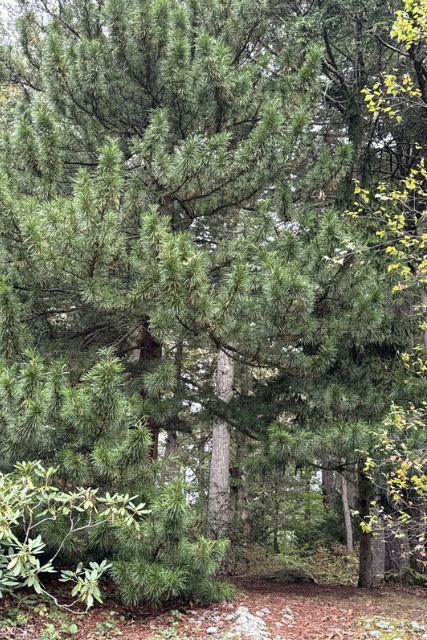
Source: iNaturalist – Japanese umbrella-pine Sciadopitys verticillata(petegilmore)
The conspicuous green structures are generally regarded as cladodes rather than ordinary conifer needles. They arise from the axils of small scale-like leaves and act as the main photosynthetic organs of the mature plant. Their exact morphological origin has been debated for well over a century.
メンフクロウ職員Attenzione. What looks like a ring of needles is rather more unusual than it first appears. The green structures do the work of leaves, but botanically they are treated as cladodes, while the true leaves are reduced to small scales. It is a lovely reminder that even a familiar-looking conifer can hide a surprisingly complicated piece of plant morphology.
Sciadopityaceae has a long fossil history, and related forms occurred outside modern Japan in the geological past. Today, however, its living diversity has narrowed to one genus and one species.
That makes kōyamaki more than an attractive garden tree. It is one of Japan’s distinctive contributions to the living diversity of conifers.
Schistostega pennata: The Moss That Seems to Glow
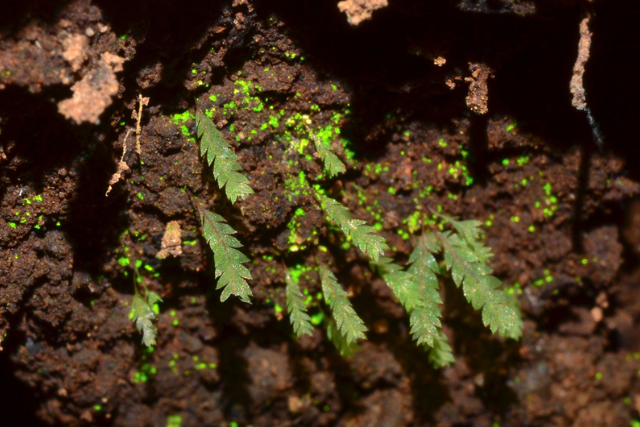
Source: iNaturalist – Luminous moss Schistostega pennata(corndog)
- Family: Schistostegaceae
- English names: Luminous moss; goblin gold
- Distribution: Cool regions of the Northern Hemisphere, including Japan
- Plant group: Moss
- Why it stands out: Lens-like cells in its protonema create a green-gold optical effect in dim places
From a conifer that can become a substantial tree, we now move almost to the ground.
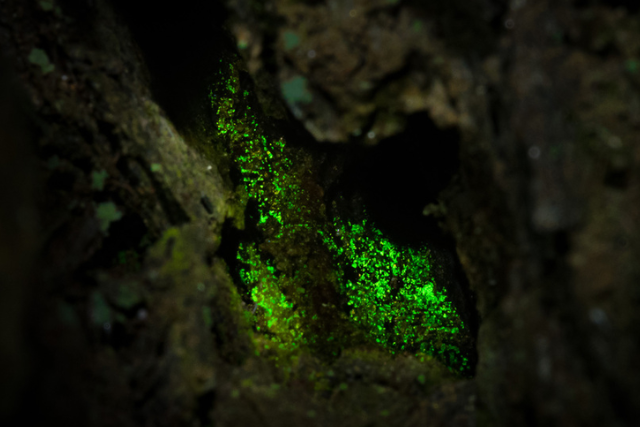
Schistostega pennata is a small moss associated with dim, sheltered places such as rock crevices, cave entrances, soil banks, and spaces beneath roots.
Under the right conditions, it seems to glow.
Source: iNaturalist – Luminous moss Schistostega pennata(tobiasgratzer)
The effect is not bioluminescence. The moss is not producing light.
Instead, its persistent protonema—an early stage of moss growth—contains specialised lens-like cells. These help focus faint incoming light towards the chloroplasts. Green light that is not absorbed can be reflected back towards the direction from which it entered, creating the characteristic green-gold appearance.
Move your position slightly, and the glow may weaken or disappear. This is one clue that the moss is reflecting outside light rather than producing its own.
Japan has its own celebrated populations of Schistostega, and some localities supporting the moss have been protected as Natural Monuments.
You do not need a vast desert horizon to appreciate it. You need a dark corner, a little light, the right viewing angle, and enough patience to notice something only a few centimetres high.
Cephalotus follicularis : Australia’s One-of-a-Kind Pitcher Plant
Source: iNaturalist – Albany pitcher plant Cephalotus follicularis(amphib_dr)
- Family: Cephalotaceae
- English name: Albany pitcher plant
- Distribution: South-western Australia
- Plant group: Angiosperm
- Why it stands out: A carnivorous plant with ordinary leaves and specialised pitcher leaves
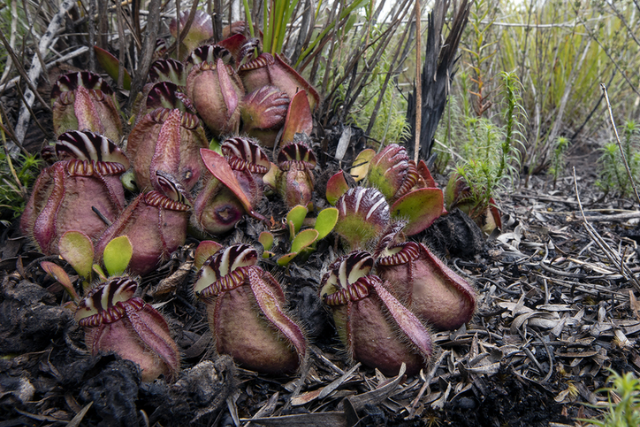
The Albany pitcher plant, Cephalotus follicularis, produces two visibly different kinds of leaves. Flat leaves carry out most of the plant’s photosynthesis, while specialised pitcher leaves function as pitfall traps for prey.
Nectar near the rim attracts small animals. If they fall inside, the inner surface and downward-pointing structures make escape difficult. The plant can then obtain nutrients from captured prey.
 メンフクロウ職員
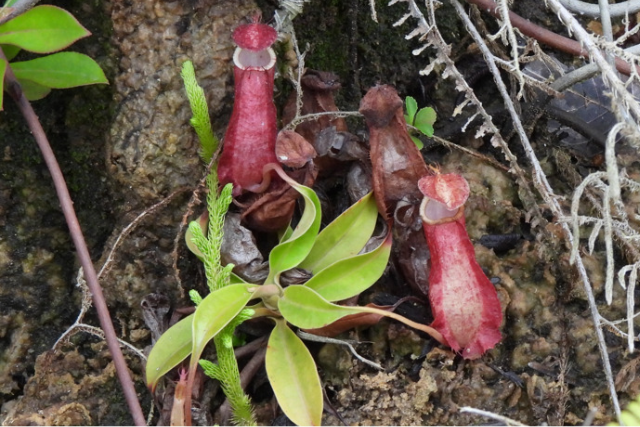
Yet Cephalotus is not a miniature Nepenthes. For comparison, here is one species of tropical pitcher plant: Nepenthes rafflesiana. 👇
Source: iNaturalist – Raffles’ pitcher plant Nepenthes rafflesiana(nduip)
 シロフクロウ職員
The traps certainly look alike, don’t they?
The resemblance is a product of convergent evolution. Cephalotus belongs to Oxalidales, whereas Nepenthes belongs to Caryophyllales. Their pitcher traps arose independently on separate branches of flowering-plant evolution.
タヌ山先生Similar traps do not necessarily mean close relatives. Cephalotus and Nepenthes evolved broadly similar pitfall traps on different branches of the plant tree. Same ecological problem; separate evolutionary solutions.
Carnivory can be useful where nutrients such as nitrogen and phosphorus are difficult to obtain from the soil. In south-western Australia, the specialised leaves of Cephalotus help the plant supplement nutrients available from its wet, nutrient-poor habitat.
Andreaeobryum macrosporum: An Entire Branch of Moss Evolution
出典:iNaturalist – Andreaeobryum macrosporum(sheriff_woody_pct)
- Family: Andreaeobryaceae
- Distribution: North-western North America and parts of eastern Russia
- Plant group: Moss
- Why it stands out: A highly isolated moss lineage associated particularly with calcareous rock
Not every extraordinary family announces itself with giant leaves or elaborate traps.
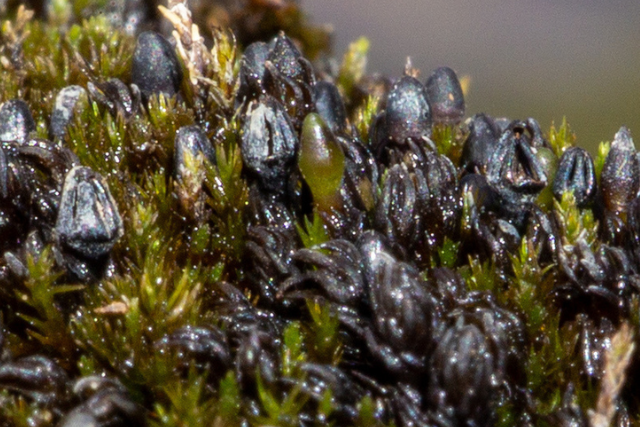
Andreaeobryum macrosporum is a small moss recorded from north-western North America and, more recently, parts of eastern Russia. It is particularly associated with calcareous rock, including limestone.
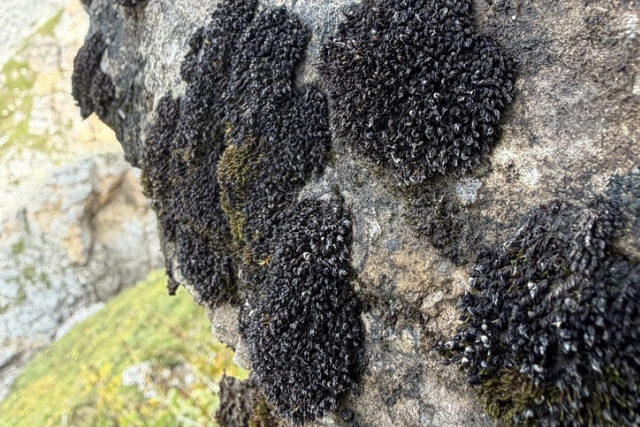
Source: iNaturalist – Andreaeobryum macrosporum(sheriff_woody_pct)
The genus and species were described in 1976 from material collected in Alaska and north-western Canada. Its evolutionary isolation is striking even among mosses.
Depending on the classification used, that isolation is reflected not only at family level but also in higher ranks. For a general reader, the essential point is simpler than a long hierarchy of Latin names: this modest moss represents a deep and distinctive living branch of moss evolution.
A moss scarcely covering a stone can carry an evolutionary history just as remarkable as that of a towering tree.
Cynomorium coccineum: A Plant That Barely Looks Like a Plant
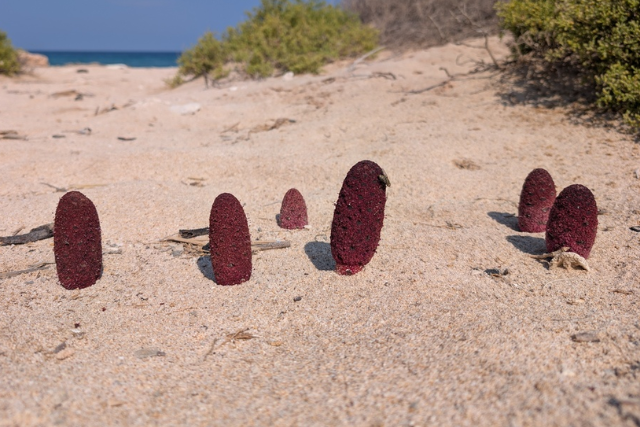
Source: iNaturalist – Maltese fungus Cynomorium coccineum(kenraiz)
- Family: Cynomoriaceae
- Distribution: Mediterranean region, North Africa, and parts of western and central Asia
- Plant group: Angiosperm
- Why it stands out: A non-green holoparasitic flowering plant connected to the roots of host plants
At first glance, Cynomorium coccineum may not look like a flowering plant at all. Its fleshy reddish-brown flowering shoots emerge from dry ground without the broad green leaves we usually associate with plants.
There is a reason.
Cynomorium is a holoparasite. It does not photosynthesise. Through specialised organs called haustoria, it connects to host roots and obtains carbon, water, and mineral nutrients from them.
Because Cynomorium no longer photosynthesises, it does not need the broad green leaves used by most plants to capture light. Its unusual form is therefore not evidence that it is a fungus. It remains a flowering plant that produces flowers and seeds.
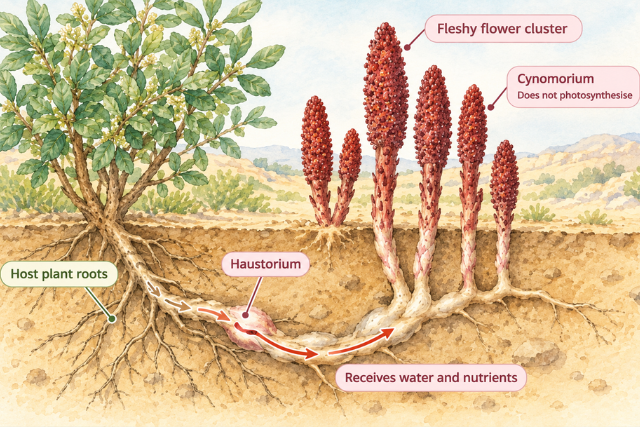 タヌ山先生
タヌ山先生First, look at the morphology. When a plant abandons photosynthesis entirely, its visible structure can change so radically that its evolutionary relationships are not obvious at first glance. That is why morphology, specimens, and molecular evidence all matter.
Pentadiplandra brazzeana: The Plant Behind an Extraordinary Sweet Protein
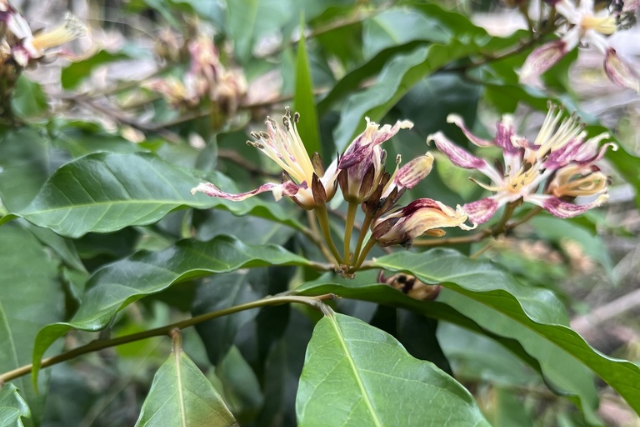
Source: iNaturalist – Pentadiplandra brazzeana(nickramsey)
- Family: Pentadiplandraceae
- Distribution: West-central tropical Africa
- Plant group: Angiosperm
- Why it stands out: Its fruit is the natural source of the intensely sweet protein brazzein
Taxonomy sometimes leads somewhere unexpected.
In the case of Pentadiplandra brazzeana, it leads to sweetness.
This tropical African plant is the sole accepted species of Pentadiplandra, itself the only genus of Pentadiplandraceae.
Its fruit contains brazzein, a small sweet-tasting protein first reported scientifically in the 1990s.
Its sweetness is remarkable. Experimental comparisons have found brazzein to be hundreds to thousands of times sweeter than sucrose by weight, although the precise comparison depends on concentration and testing conditions.
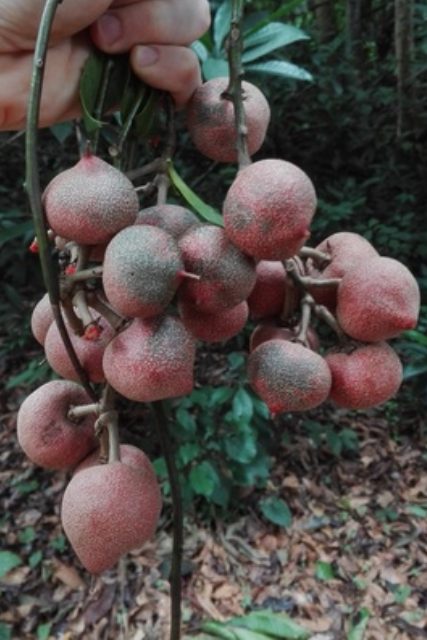
Source: Wikimedia Commons – File: Pentadiplandra brazzeana.jpg(SKG713)

That combination of strong sweetness and protein chemistry has made brazzein a subject of continuing interest in food and biochemical research.
But it is worth remembering where the molecule came from.
Before brazzein became a protein sequence, laboratory sample, or possible ingredient, it was part of the biology of a plant growing in tropical African forests.
A family with one living species can therefore carry more than phylogenetic information. It may also contain chemistry found nowhere else in quite the same form.
Gomortega keule: A Solitary Tree with a Conservation Story
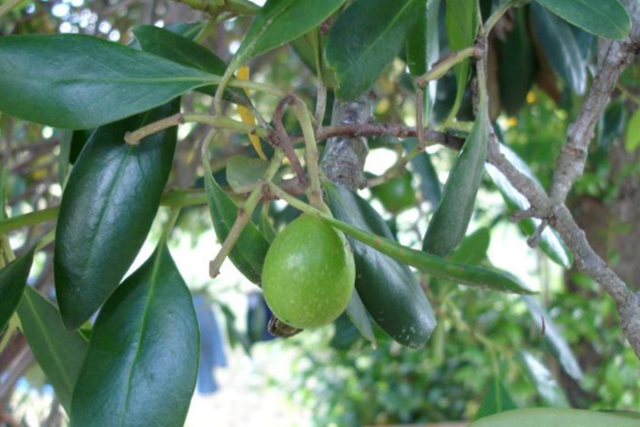
Source: iNaturalist – Keule Gomortega keule(tomasirarrazabal)
- Family: Gomortegaceae
- Common name: Keule
- Distribution: Central Chile
- Plant group: Angiosperm
- Conservation: Endangered
- Why it stands out: Taxonomic isolation and extinction risk occur together
The keule tree, Gomortega keule, brings us to a more serious side of taxonomic isolation.
It is endemic to a restricted part of central Chile and is the sole accepted living species of Gomortega, the only genus of Gomortegaceae.
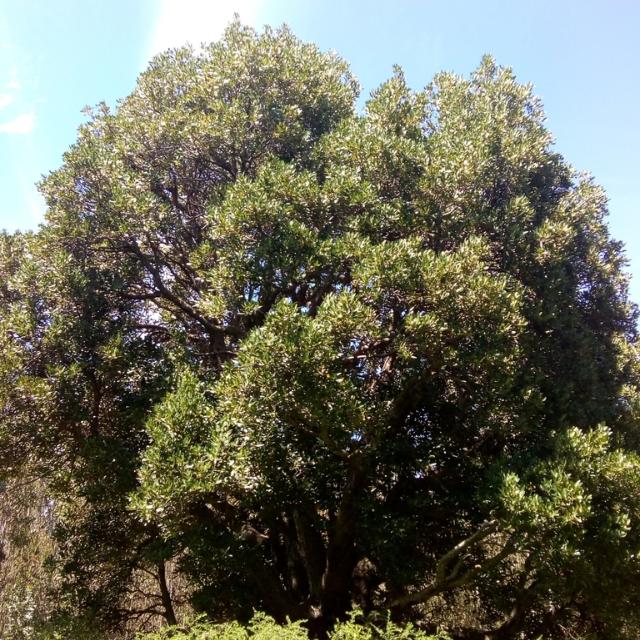
Source: iNaturalist – Keule Gomortega keule(pabloazuagarcia)
Unlike the familiar ginkgo planted in cities around the world, keule survives in small and fragmented natural populations.
The species is classified as Endangered in Chilean conservation assessments. Habitat fragmentation, replacement of native vegetation by commercial forestry plantations, fire, and other pressures affect the forests where it survives.
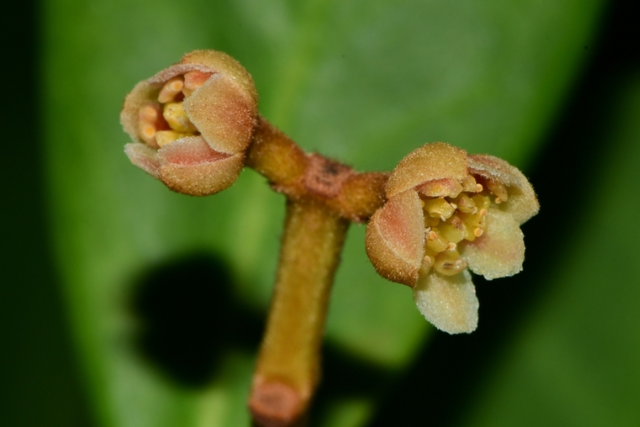
Source: iNaturalist – Keule Gomortega keule(joeysantore)
Earlier, we separated two ideas: being taxonomically isolated and being threatened with extinction.
Here, the two meet.
When an ordinary species disappears, the loss is already profound. When the sole living species of a monotypic family disappears, an entire living family-level lineage disappears with it.
That does not make the species more deserving than every other organism.
It does, however, add another dimension to what would be lost.
31 Plant Families Represented Here by One Living Genus and One Living Species
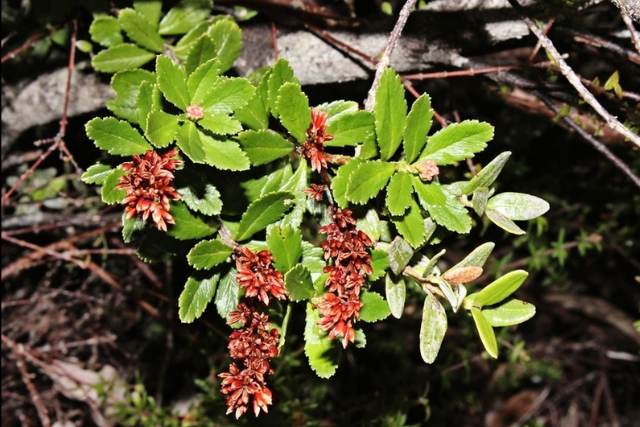
Source: iNaturalist – Tetracarpaea tasmannica(kenharris)
The following table brings together 31 plant families treated in this article as having one recognised living genus and one recognised living species, under the taxonomic sources consulted for the 2026 revision.
It should not be read as a permanent claim that exactly 31 such plant families exist worldwide. Classification differs among authorities and changes as new species are described and relationships are reassessed.
Two revisions from the earlier Japanese version are particularly important.
Lactoris fernandeziana is treated by Kew’s Plants of the World Online within Aristolochiaceae rather than a separate Lactoridaceae. It therefore does not fit this article’s definition under that treatment.
Likewise, Strasburgeria robusta remains the sole species of Strasburgeria, but Strasburgeriaceae also includes Ixerba. The family is therefore not monogeneric.
They have been replaced here by Eucommia ulmoides and Ticodendron incognitum.
| Species | Family | Major group | Native region | Notable feature |
|---|---|---|---|---|
| Aextoxicon punctatum | Aextoxicaceae | Angiosperm | Chile to south-western Argentina | Tree of temperate South American forests |
| Amborella trichopoda ★ | Amborellaceae | Angiosperm | New Caledonia | Sister lineage to all other living angiosperms |
| Andreaeobryum macrosporum ★ | Andreaeobryaceae | Moss | North-western North America and parts of eastern Russia | Highly isolated moss lineage |
| Aphloia theiformis | Aphloiaceae | Angiosperm | Eastern and southern Africa; western Indian Ocean islands | Sole accepted species of Aphloia |
| Barbeuia madagascariensis | Barbeuiaceae | Angiosperm | Madagascar | Malagasy endemic lineage |
| Barbeya oleoides | Barbeyaceae | Angiosperm | North-eastern Africa and south-western Arabian Peninsula | Tree of dry regions |
| Cephalotus follicularis ★ | Cephalotaceae | Angiosperm | South-western Australia | Carnivorous pitcher plant |
| Cynomorium coccineum ★ | Cynomoriaceae | Angiosperm | Mediterranean region to western and central Asia | Non-green holoparasite |
| Cystodium sorbifolium | Cystodiaceae | Fern | Malesia to Melanesia | Distinctive tropical fern lineage |
| Discelium nudum | Disceliaceae | Moss | Northern Hemisphere | Small moss of disturbed or exposed soil |
| Emblingia calceoliflora | Emblingiaceae | Angiosperm | Western Australia | Unusual low-growing Australian shrub |
| Eucommia ulmoides | Eucommiaceae | Angiosperm | Central and southern China | Rubber-producing tree; sole living species of its family |
| Geissoloma marginatum | Geissolomataceae | Angiosperm | Cape region of South Africa | South African endemic lineage |
| Ginkgo biloba ★ | Ginkgoaceae | Gymnosperm | China | Sole living ginkgophyte species |
| Gomortega keule ★ | Gomortegaceae | Angiosperm | Chile | Endangered endemic tree |
| Guamatela tuerckheimii | Guamatelaceae | Angiosperm | Southern Mexico to Honduras | Central American shrub lineage |
| Halophytum ameghinoi | Halophytaceae | Angiosperm | Western and southern Argentina | Salt-tolerant annual |
| Hemidictyum marginatum | Hemidictyaceae | Fern | Tropical America | Distinctive tropical fern |
| Galbulimima belgraveana | Himantandraceae | Angiosperm | Papuasia to northern and north-eastern Australia | Large tropical forest tree |
| Lanaria lanata | Lanariaceae | Angiosperm | South Africa | Cape-region monocot |
| Oedipodium griffithianum | Oedipodiaceae | Moss | Cool Northern Hemisphere regions | Morphologically unusual moss |
| Pentadiplandra brazzeana ★ | Pentadiplandraceae | Angiosperm | West-central tropical Africa | Natural source of brazzein |
| Petenaea cordata | Petenaeaceae | Angiosperm | South-eastern Mexico to Guatemala | Distinctive Central American tree |
| Plocosperma buxifolium | Plocospermataceae | Angiosperm | Mexico and Central America | Isolated lineage within Lamiales |
| Schistostega pennata ★ | Schistostegaceae | Moss | Northern Hemisphere, including Japan | Reflective protonema creates a luminous appearance |
| Sciadopitys verticillata ★ | Sciadopityaceae | Gymnosperm | Japan | Japanese endemic conifer |
| Setchellanthus caeruleus | Setchellanthaceae | Angiosperm | Mexico | Distinctive Mexican flowering-plant lineage |
| Simmondsia chinensis | Simmondsiaceae | Angiosperm | South-western United States and northern Mexico | Source of jojoba oil |
| Tetracarpaea tasmannica | Tetracarpaeaceae | Angiosperm | Tasmania | Tasmanian endemic lineage |
| Ticodendron incognitum | Ticodendraceae | Angiosperm | Southern Mexico to Central America | Sole species of a distinctive Fagales family |
| Welwitschia mirabilis ★ | Welwitschiaceae | Gymnosperm | Angola and Namibia | Two permanent foliage leaves |
★ Featured in detail above.
There is another small taxonomic lesson hidden in the table.
The accepted spelling is Tetracarpaea tasmannica, with a double n, rather than Tetracarpaea tasmanica. Scientific names are not immune to the occasional detail that makes a registrar reach for the records.
Registrar Snowy: Which, I should point out, is exactly why we check the label before printing thirty copies.
Curator Barn: Preferably before thirty.
A Thin Branch Is Still Part of a Vast Tree
Source: iNaturalist – Japanese umbrella-pine Sciadopitys verticillata(jonahpeters)
A Namib desert gymnosperm. A modest shrub from New Caledonia. A ginkgo beside a Japanese temple. A carnivorous plant in Western Australia. A moss shining from a dark crevice. An endangered tree in Chile.
These plants are not gathered here because they are close relatives. They occupy different parts of the plant tree of life, live in different environments, and arrived at their present taxonomic situations through different histories.
What they share is a feature of modern classification: each represents a whole living family through a single recognised species.
One Species, Three Different Questions
Three ideas are easy to confuse:
- One family, one genus, one species describes taxonomic structure: one recognised living genus in a family, with one recognised living species in that genus.
- Endemic describes natural range: a species occurs naturally only in a particular country, island, or region.
- Endangered describes conservation status: it indicates a serious risk of extinction in the wild, according to the criteria used by the assessing authority.
These labels can overlap, but they do not mean the same thing.
Amborella trichopoda is endemic to New Caledonia, while the Japanese umbrella-pine, Sciadopitys verticillata, is endemic to Japan. A limited natural range makes habitat protection important, but it does not automatically mean that a species is endangered.
The reverse can also surprise us. Ginkgo biloba is planted so widely in parks, streets, temple grounds, and gardens that it may seem anything but rare. Yet its natural wild populations are assessed as Endangered on the IUCN Red List.
Chile’s keule, Gomortega keule, shows another possibility. It is the sole living representative of Gomortegaceae and is classified as Endangered in Chilean conservation assessments. Its populations are small and fragmented, while habitat loss, plantation forestry, and fire affect the forests where it survives.
シロフクロウ職員So “one family, one genus, one species”, “endemic”, and “endangered” are three different labels?
 タヌ山先生
タヌ山先生Exactly. One describes classification, one describes geographical range, and one describes extinction risk. They sometimes overlap, but we should never assume that one automatically implies the others.
A thin branch is not an evolutionary failure. Nor is it necessarily a relic waiting to disappear. It is simply a branch with remarkably little living company—and, in some cases, a much larger history written into fossils, genes, geography, and form.
ミミズク先生Sometimes understanding biodiversity begins not by counting how many species there are, but by noticing how much history can remain in just one.
Taxonomy does not merely give organisms names. It helps us see how much evolutionary history can be carried by one living species.
The next unusual plant you notice in a garden, forest, roadside, herbarium sheet, or museum collection may be connected to a story far larger than its appearance suggests.
Sometimes all it takes is to stop, look a little more closely, and ask where on the tree of life that small piece of green actually belongs.
メンフクロウ職員Sometimes all it takes is to stop, look a little more closely, and ask where on the tree of life that small piece of green actually belongs.
Tante buone cose!
Continue Your Journey
 メンフクロウ職員
If you have enjoyed this visit to the Forest Museum, please take a look at the books from eco-life-planet as well.
 ミミズク先生
A good book can keep a small question company for a very long time.
シロフクロウ職員Bon moment, belles découvertes !
References
What Does “One Species, One Genus, One Family” Mean?
- Royal Botanic Gardens, Kew — Plants of the World Online (POWO)
- World Flora Online Consortium — World Flora Online
- Govaerts, R. et al. (2021). The World Checklist of Vascular Plants, a continuously updated resource for exploring global plant diversity. Scientific Data 8: 215.
- Amborella Genome Project. (2013). The Amborella genome and the evolution of flowering plants. Science 342: 1241089.
Why Can a Plant Family Have Just One Living Species?
- Royal Botanic Gardens, Kew — Plants of the World Online (POWO)
- World Flora Online Consortium — World Flora Online
- Govaerts, R. et al. (2021). The World Checklist of Vascular Plants, a continuously updated resource for exploring global plant diversity. Scientific Data 8: 215.
- Amborella Genome Project. (2013). The Amborella genome and the evolution of flowering plants. Science 342: 1241089.
Extraordinary Monotypic Plant Families Around the World
- Royal Botanic Gardens, Kew — Welwitschia Hook.f., Plants of the World Online
- Wan, T. et al. (2021). The Welwitschia genome reveals a unique biology underpinning survival in the Namib Desert. Nature Communications 12: 4247.
- Royal Botanic Gardens, Kew — Amborella trichopoda Baill., Plants of the World Online
- Amborella Genome Project. (2013). The Amborella genome and the evolution of flowering plants. Science 342: 1241089.
- Royal Botanic Gardens, Kew — Ginkgo L., Plants of the World Online
- Royal Botanic Gardens, Kew — Sciadopitys verticillata (Thunb.) Siebold & Zucc., Plants of the World Online
- Trees and Shrubs Online — Sciadopitys verticillata
- World Flora Online — Schistostega pennata (Hedw.) F.Weber & D.Mohr
- British Bryological Society — Schistostega pennata
- Royal Botanic Gardens, Kew — Cephalotus Labill., Plants of the World Online
- Bittleston, L.S. et al. (2022). Characterization and Comparison of Convergence Among Cephalotus follicularis Pitcher Plant-Associated Communities With Those of Nepenthes and Sarracenia Found Worldwide. Frontiers in Plant Science 13: 887635.
- World Flora Online — Andreaeobryum macrosporum Steere & B.M.Murray
- Royal Botanic Gardens, Kew — Cynomorium coccineum L., Plants of the World Online
- Royal Botanic Gardens, Kew — Pentadiplandra brazzeana Baill., Plants of the World Online
- Ming, D. & Hellekant, G. (1994). Brazzein, a new high-potency thermostable sweet protein from Pentadiplandra brazzeana B. FEBS Letters 355: 106–108.
- Royal Botanic Gardens, Kew — Gomortega keule (Molina) Baill., Plants of the World Online
- Botanic Gardens Conservation International — Conserving Two Iconic Endemic Trees in Chile
31 Plant Families Represented Here by One Living Genus and One Living Species
- Royal Botanic Gardens, Kew — Plants of the World Online (POWO)
- World Flora Online Consortium — World Flora Online
- Govaerts, R. et al. (2021). The World Checklist of Vascular Plants, a continuously updated resource for exploring global plant diversity. Scientific Data 8: 215.
- Royal Botanic Gardens, Kew — Lactoris Phil., Plants of the World Online
- Royal Botanic Gardens, Kew — Ixerba A.Cunn., Plants of the World Online
- Royal Botanic Gardens, Kew — Eucommia ulmoides Oliv., Plants of the World Online
- Royal Botanic Gardens, Kew — Ticodendron Gómez-Laur. & L.D.Gómez, Plants of the World Online
A Thin Branch Is Still Part of a Vast Tree
- Royal Botanic Gardens, Kew — Plants of the World Online (POWO)
- World Flora Online Consortium — World Flora Online
- IUCN Red List of Threatened Species — Ginkgo biloba
- Chile Ministry of the Environment — Queule (Gomortega keule): Antecedentes generales
- Chile Agricultural and Livestock Service — Conservation regulations for Gomortega keule
- Botanic Gardens Conservation International — Keule (Gomortega keule)
- Endemia.nc — Amborella trichopoda
- Royal Botanic Gardens, Kew — Sciadopitys verticillata (Thunb.) Siebold & Zucc., Plants of the World Online
コメント