


When you see the word “eco” in this blog’s name, eco-life-planet, what comes to mind?
Perhaps you think of ecology, or of the familiar idea of being “eco-friendly”. Those meanings are certainly related, but they are not quite the whole story.
As our subtitle suggests—Cycles, Life, Earth, and Everyday Living—the word “eco” is intended to bring to mind the idea of an ecosystem: living things, their surroundings, and the many connections between them. Above all, it points to the cycles that help sustain life.
 メンフクロウ職員
Piacere! I am Curator Barn, the author of this article and a member of staff at the Forest Museum.
You do not need to worry too much about the terminology in order to enjoy these stories. Still, I thought it was worth mentioning at least once…
Today, we shall begin with one of the largest and most familiar of these cycles: the water cycle.
Water moves continuously between the sea, the land and the atmosphere. It rises as water vapour, forms clouds, returns as rain or snow, and travels through rivers, soil and living things before continuing its journey. The cycle is vast, but it is also close to us: it shapes the water we use, the weather we notice, and the habitats on which life depends.
By following this journey of water, we may begin to see why something so ordinary—and so easy to take for granted—is so precious.

Dynamic! Earth’s Water Cycle

“Diagram of the Water Cycle” by Ehud Tal, via Wikimedia Commons, licensed under CC BY-SA 4.0.

Have you ever paused to think about the journey made by the water you use each day?
Water is always on the move. The water cycle, also called the hydrological cycle, is the continual movement of water between the atmosphere, the land and the sea. Energy from the Sun drives evaporation, while gravity helps bring water back to the ground and carry it downhill towards rivers, lakes and the sea. Water is stored and travels not only in clouds and rivers, but also in soil, groundwater, ice and living things.
メンフクロウ職員Water evaporates, falls as rain or snow, flows over the land or seeps into the ground, and eventually reaches the sea or another body of water. As surface water and groundwater, it circulates through river catchments and beyond. It is one of the fundamental systems that supports life on this planet.
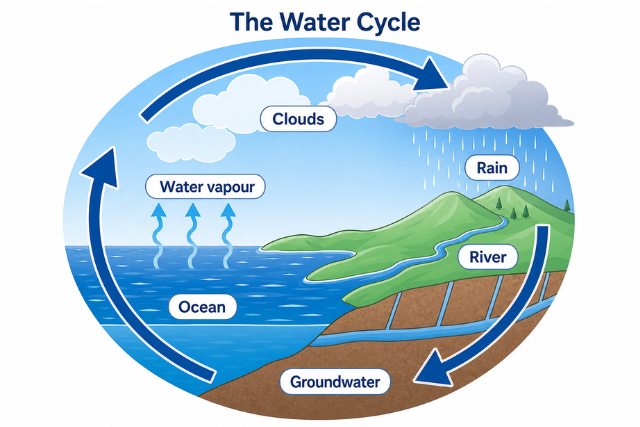
※Illustration adapted and translated into English by the author.
Water is not simply replaced by a completely new supply each time we use it. Instead, it changes form and moves from place to place: from oceans, rivers and land into the atmosphere, then back to Earth as precipitation.
It may travel as water vapour, gather into clouds, fall as rain or snow, soak into a forest floor, flow along a river, and return to the sea. The molecules in a glass of water today may have been part of water on Earth in the age of dinosaurs. It is a wonderful thought—but one we cannot trace to a particular animal.
A Small Share of Freshwater
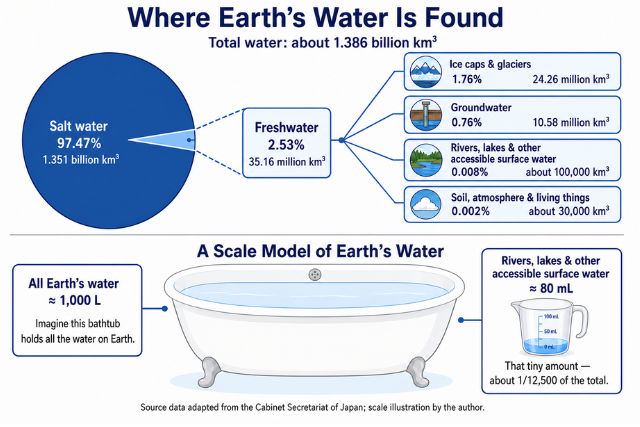
Data adapted from the Cabinet Secretariat of Japan; illustration by the author.
Earth is often called the “water planet”. Yet the freshwater that people can readily obtain is surprisingly limited.
The total volume of water on Earth is estimated at about 1.4 billion cubic kilometres. In the figures used by Japan’s Cabinet Secretariat, approximately 97.47% is salt water and 2.53% is freshwater. Most freshwater is held in glaciers, ice sheets and groundwater, rather than in rivers and lakes.
Water in rivers, lakes and other sources that people can access relatively easily accounts for only about 0.008% of Earth’s total water—roughly one ten-thousandth. These figures are useful for showing the scale of the challenge, although the exact proportions vary slightly between datasets because water is measured and classified in different ways.
The Remarkable Mechanics of the Water Cycle

.jpg)
After considering the water cycle on a planetary scale, let us look more closely at how it works. Modern observations—from satellites to chemical measurements—are revealing details that were once difficult to see. The water cycle is not a perfect machine. It is a continually changing system, shaped by sunlight, gravity, temperature, air movement and living things.
From Evaporation to Precipitation
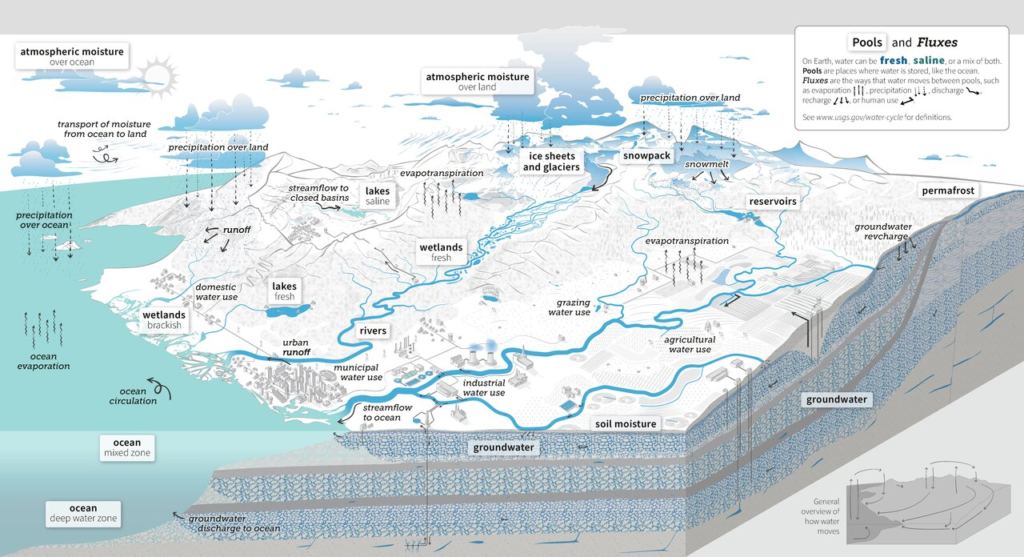
Source: U.S. Geological Survey (USGS), USGS WaterCycle English (2022), via Wikimedia Commons.
At its simplest, the water cycle is a continuing movement of water. Energy from the Sun causes water to evaporate from oceans, lakes, rivers, wet soil and other surfaces. Plants also release water vapour from their leaves. This process is called transpiration.
As moist air rises and cools, some of its water vapour condenses into tiny droplets or ice crystals. These form clouds. When cloud particles grow large enough, some fall as precipitation—rain, snow, sleet or hail. Water that reaches land may be taken up by plants, stored as snow or ice, flow into streams and rivers, or seep into the ground. Some then moves as groundwater.
メンフクロウ職員Much of it eventually returns to the sea, and the journey continues.
A Subtle Solar Influence
Water moves because of the Sun and gravity, but its pathways and storage also change over time. A 2025 study by researchers at Kyoto University, JAMSTEC※ and collaborating institutions examined an approximately 11-year variation in global mean sea level. The researchers found evidence that this repeating signal is linked to the movement of freshwater between the oceans and land. They propose that changes in solar activity can influence rainfall patterns through their effect on the El Niño–Southern Oscillation, or ENSO.
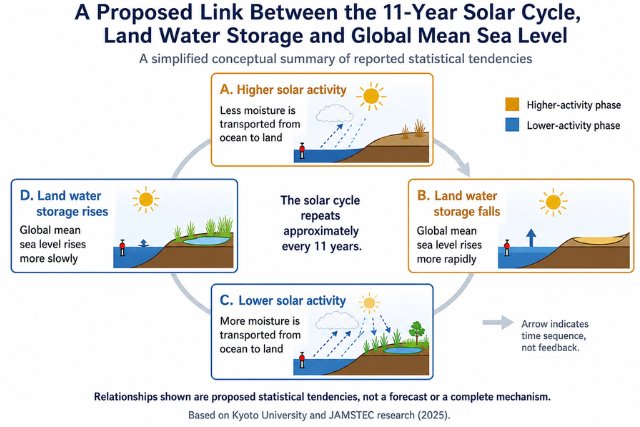
Conceptual diagram adapted from findings reported by Kyoto University and JAMSTEC (2025); English illustration by the author.
メンフクロウ職員The diagram can be read rather simply. When solar activity is relatively high, the study suggests that less moisture is transported from the oceans to land. Water stored on land may then decrease, while global mean sea level tends to rise slightly. During quieter periods, the opposite tendency may occur.
The team compared about 160 years of historical climate data with around 30 years of precise satellite observations. This is an intriguing result, but it needs careful interpretation. It does not mean that solar activity is the main cause of current sea-level rise, or that it determines every El Niño and La Niña event. Rather, it offers a possible explanation for one small, repeating part of natural sea-level variation.
What Is ENSO?
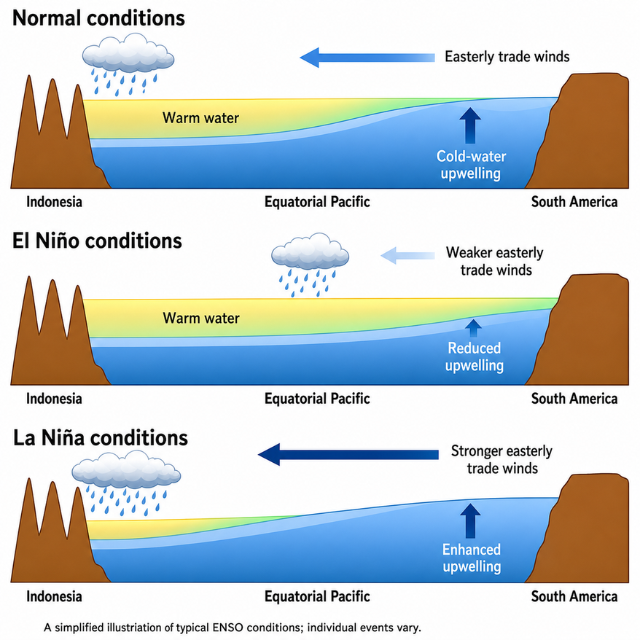
Conceptual diagram adapted from the Japanese Wikipedia article on the El Niño–Southern Oscillation (ENSO); English illustration by the author.
ENSO is a naturally occurring pattern of linked changes in sea-surface temperature, winds and air pressure across the tropical Pacific Ocean. Its warm phase is called El Niño; its cool phase is La Niña. These events occur irregularly, generally every two to seven years, and can influence weather patterns far beyond the Pacific. Their effects in Japan vary by season, region and individual event, so it is best not to treat them as a simple weather forecast.
メンフクロウ職員ENSO has its own rhythm, and many factors influence it. The solar cycle may be one influence among many—not a timetable that decides exactly when El Niño or La Niña will occur.
The Sun’s Eleven-Year Cycle
The Sun’s activity rises and falls in a cycle of roughly 11 years. During more active periods, sunspots become more numerous, and events such as solar flares and coronal mass ejections occur more often. During quieter periods, they become less frequent.
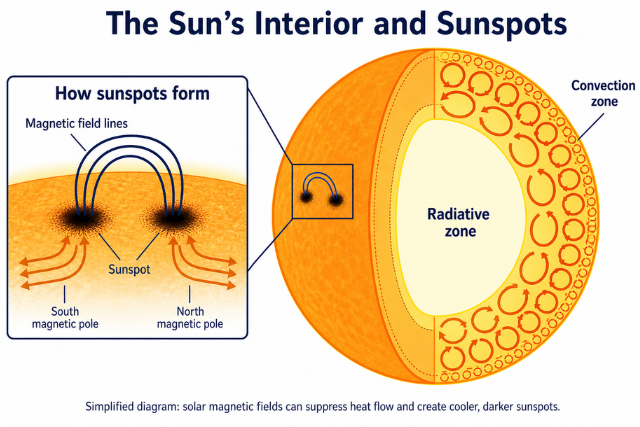
Conceptual diagram adapted from Figure 1B in RIKEN R-CCS, “The 11-Year Sunspot Cycle Is Emerging in the K Computer”; English illustration by the author.
The Sun’s magnetic field reverses polarity over a longer cycle of about 22 years. Although solar activity can look dramatic, the Sun’s total energy reaching Earth changes by only about 0.1% during a typical 11-year cycle. The links between this small change, atmospheric circulation and regional climate remain an active field of research.
メンフクロウ職員Astronomers have observed sunspots through telescopes for more than four centuries. We understand a great deal, yet the detailed workings of the solar dynamo—the process behind the cycle—are still being investigated.
Water Isotopes: Clues to a Journey
Another powerful tool for studying the water cycle is the measurement of stable isotopes of hydrogen and oxygen. Water molecules are not all exactly alike. Some contain slightly heavier forms of hydrogen or oxygen, such as deuterium (²H) or oxygen-18 (¹⁸O). These are still ordinary water molecules, but their different masses mean that they behave slightly differently during evaporation and condensation.
Water isotopes
The changing balance between lighter and heavier water molecules is called an isotope ratio. Scientists use these ratios as clues to the conditions water has experienced, such as evaporation, cloud formation and rainfall. They are best interpreted alongside weather data, geography and computer models. During evaporation, molecules with lighter isotopes tend to enter water vapour slightly more easily. During condensation and rainfall, molecules with heavier isotopes tend to leave the vapour first. As an air mass travels and rains out, its remaining vapour often becomes relatively poorer in heavier isotopes. This is known as isotope fractionation.
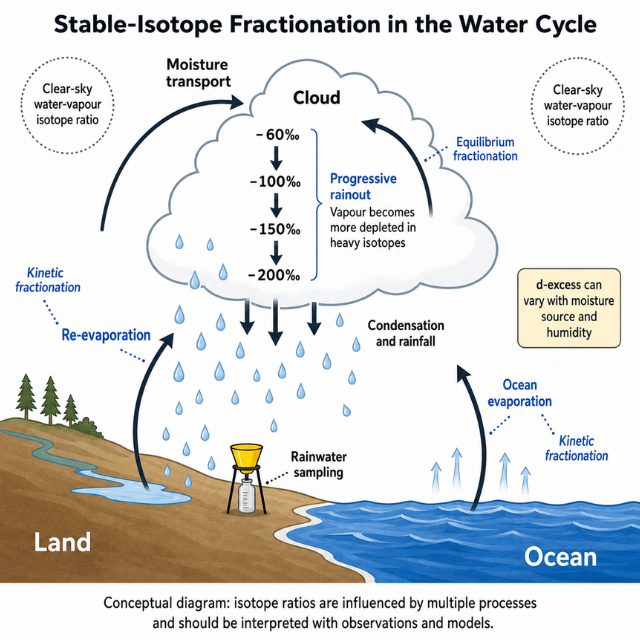
Conceptual diagram adapted from Figure 1 in the University of Tokyo Climate System Research Center’s “Water-Cycle Research Using Stable Isotopes: Observation by Satellite”; English illustration by the author.
Source: CCSR News, No. 13, pp. 3–5.
メンフクロウ職員The physics can look rather specialised. The main point is pleasantly simple: water retains small chemical clues about its journey.
The Global Network of Isotopes in Precipitation has collected measurements of hydrogen and oxygen isotopes in rain and snow worldwide since 1960. These long-term records help scientists investigate water resources, atmospheric circulation and past climates.
In Japan, the National Institute for Environmental Studies and partner institutions have developed NICAM-WISO, a high-resolution global atmospheric model that includes stable-water-isotope processes. The model can simulate isotope patterns together with rainfall, temperature and cloud systems, helping researchers investigate how moisture is transported through the atmosphere.
By combining isotope measurements with field observations and models, scientists can investigate the sources and pathways of water in rainfall, rivers, groundwater and the atmosphere. In some circumstances, they can also estimate how long water remains within part of the system. This intricate water-cycle system supports life, but it is not beyond harm. Next, let us consider how human activity and environmental change can disrupt its balance.
Is the Water Cycle Under Pressure?
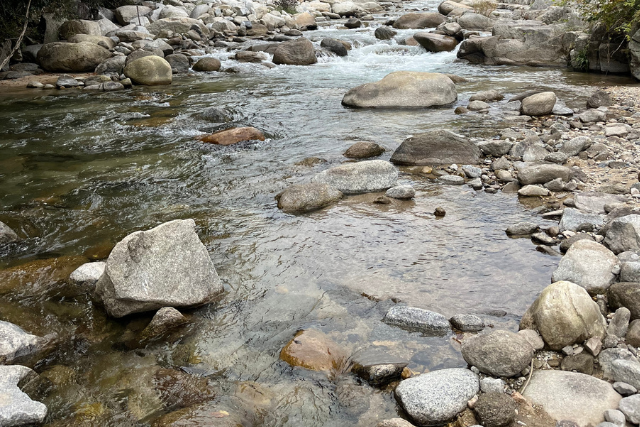
The water cycle has supported life for a very long time, but it is not untouched by human activity. Climate change, pollution, changes in land use and growing demand for water are altering where water is stored, how it moves and whether it remains safe to use. The result is not simply “less water”. It is a less predictable balance: too much water in some places, too little in others, and poorer-quality water in many rivers, lakes and aquifers.
Climate Change and Water Extremes
A warmer atmosphere can hold more water vapour. This can make heavy rainfall more intense when weather systems are able to draw on that additional moisture. At the same time, higher temperatures can increase evaporation from soils and water surfaces, adding to drought risk in some regions. Climate change therefore does not make every place uniformly wetter or drier. It changes the timing, location and intensity of water movement. A single region may face both damaging downpours and longer dry periods at different times of year. The IPCC concludes that the risks of both floods and droughts increase with every additional degree of warming.
Frozen Water Stores
Glaciers, ice sheets and snow are major freshwater stores. Together, glaciers and ice sheets hold most of Earth’s freshwater, while billions of people depend on water supplied by mountain snow and glacier melt for homes, farming, ecosystems and energy.
As glaciers retreat, melting may initially increase flood and landslide risks. Over the longer term, however, smaller glaciers can provide less meltwater during dry seasons. For communities downstream, this can mean an unstable sequence: too much water at first, followed by less reliable water later.
World Water Day 2025 chose “Glacier Preservation” as its theme, highlighting the close connection between frozen water, the water cycle and water security.
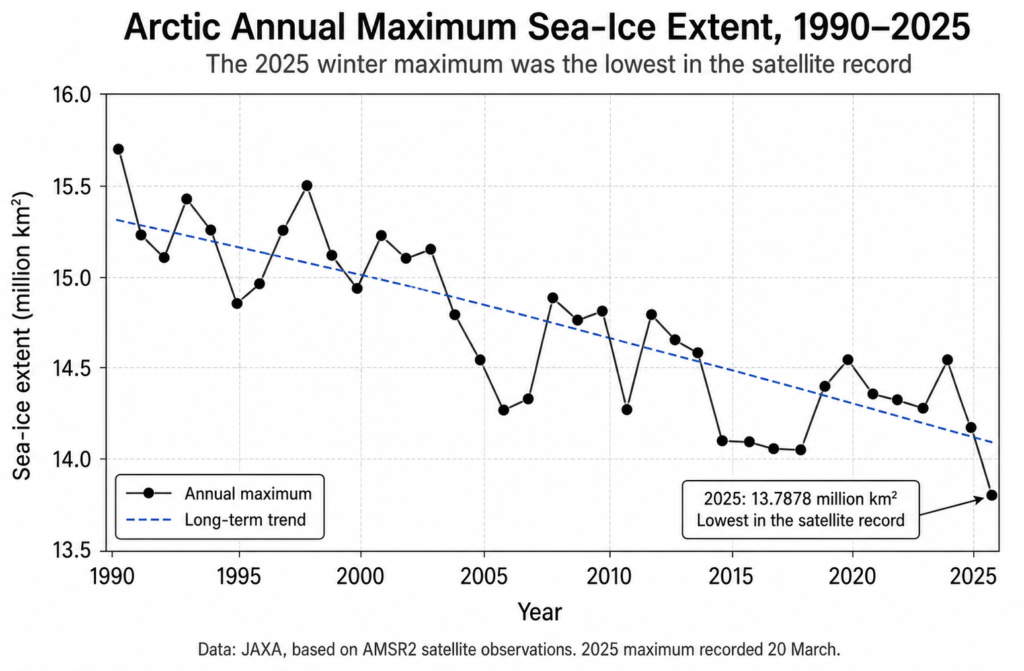
Data adapted from Japan Aerospace Exploration Agency (JAXA), “Global Sea-Ice Extent Reaches a Record Low in February 2025”; chart by the author.
メンフクロウ職員Sea ice and glaciers are both frozen water, but they play different roles. Sea ice already floats in the ocean, so its melting has only a very small direct effect on sea level. Glaciers and ice sheets on land are especially important because their meltwater adds to the ocean.
When Pollution Travels with Water
Water can carry pollutants as it moves through the landscape. Wastewater, industrial chemicals, agricultural fertilisers, pesticides and materials washed from roads can enter rivers, lakes, wetlands, groundwater and coastal waters.
Pollution does not stop the physical water cycle. However, it can make water unsafe to drink, damage habitats and reduce the ability of wetlands, soils and rivers to filter water and support biodiversity. Excess nitrogen and phosphorus from fertilisers, livestock waste and sewage can cause eutrophication. This encourages excessive algal growth. When algae die and decompose, oxygen in the water can fall, creating low-oxygen conditions in which fish and many other aquatic organisms struggle to survive.
Safe water is also a major issue for public health. In 2022, around 2.2 billion people lacked safely managed drinking-water services, and 115 million people relied directly on untreated surface water from rivers, lakes or other sources.
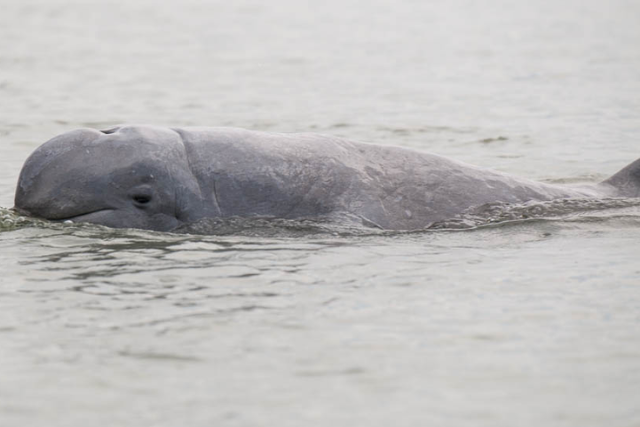
Adapted from a photograph by Stefan Brending (2eight), via Wikimedia Commons, CC BY-SA 3.0 DE; cropped by the author.

The Mekong River subpopulation of the Irrawaddy dolphin, Orcaella brevirostris, is listed as Critically Endangered. Pollution can add to the pressure on this population, but it is not the only threat: entanglement in fishing gear, habitat change and altered river flows are also serious concerns.
Too Much Water, Too Little
Floods and droughts are natural parts of many climates. Yet climate change and human water use can make their consequences more severe. The World Meteorological Organization reported that only about one-third of global river basins experienced normal conditions in 2024. The remainder had either above- or below-normal river flows, continuing a pattern of widespread imbalance observed over the previous six years.
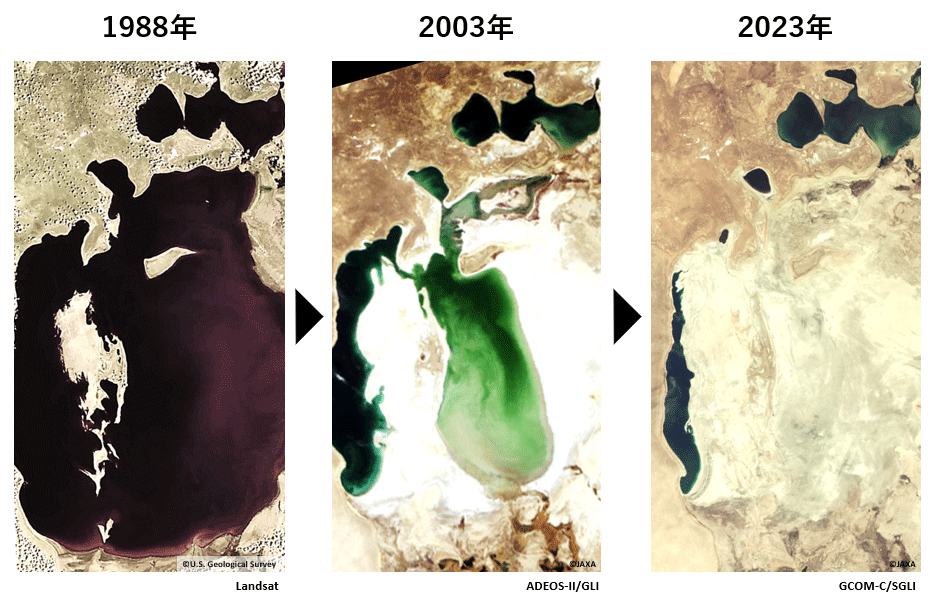
Source: Japan Aerospace Exploration Agency (JAXA), “The Disappearing Aral Sea”.
The Aral Sea shows how decisions about water use can transform an entire region. From the 1960s, large volumes of water from the Amu Darya and Syr Darya rivers were diverted for irrigation, particularly cotton cultivation. Water entering the Aral Sea then fell sharply while evaporation continued.
As the lake shrank, salinity increased, fisheries collapsed and large areas of former lakebed were exposed. The dry lakebed became a source of salt and dust, creating further environmental and health problems for nearby communities.
The water cycle is not an isolated natural process. It is connected to climate, wetlands, wildlife, farms, cities and the choices people make about water. Understanding these connections is the first step towards protecting the water systems on which both people and other species depend.
The Same Everyday Water, Seen More Deeply

Source: U.S. Geological Survey (USGS), “The Water Cycle”.
メンフクロウ職員If you have read this far, I hope water feels a little less ordinary.
Learning about the water cycle helps us notice one of the natural systems that supports everyday life. The water we drink, use for cooking or see falling as rain is part of a much larger journey—between the air, land, rivers, groundwater and sea.
Clean water from a tap may seem simple. Yet it depends on many connected processes. Energy from the Sun helps water evaporate; clouds form and release rain or snow; water moves through catchments, soils, rivers and underground stores. It also depends on people: on the systems that collect, treat and deliver drinking water, and on the systems that treat wastewater afterwards.
 シロフクロウ職員
When I turn on a tap now, I cannot help imagining clouds over the sea, rain falling over the land, and water continuing its journey beneath our feet.
メンフクロウ職員You are quite right, Registrar Snowy. A glass of water is never merely water in a glass. It connects us to sunlight, weather, soil, living things and the care that people give to water systems.
We are not outside this cycle. We drink water, release it from our bodies, use it to grow food, make products and care for our homes and communities. Our choices also affect water: we can take more than a river or aquifer can replace, send pollutants into drains, or help protect wetlands and catchments.
The water cycle does not ask every one of us to become a water scientist. It does invite us to pay attention. Using only the water we need, keeping harmful substances out of drains, and noticing the streams, ponds and wetlands around us are small ways to care for the larger system.
 メンフクロウ職員
A little understanding can make an ordinary day feel richer. Vero?
シロフクロウ職員Thank you for joining us on this journey. Until our next story, do keep an eye on the water around you.
 ミミズク先生
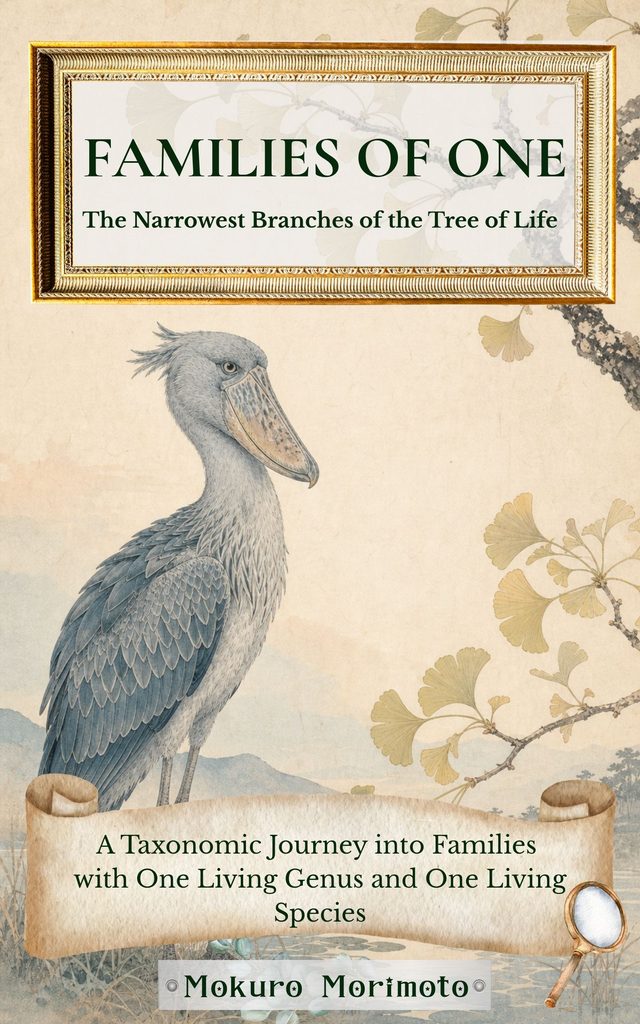
Please do explore the books from eco-life-planet as well. I hope they will offer you many more rewarding encounters with the living world.

References and Further Reading
政府広報オンライン『飲み水はどこから?使った水はどこへ? 暮らしを支える「水の循環」』(2024年7月)
国立環境研究所『大気の水循環を追跡する高解像度シミュレーション—次世代の水同位体・大気大循環モデルの開発—』(2023年12月)
京都大学『太陽活動とシンクロする海面高度変動―11年周期の太陽サイクルに合わせて、海と陸の間で水が動いていた―』(2025年5月)
国土技術政策総合研究所『水循環研究室 流域治水デジタルテストベッドWEBページ』
日本水環境学会『水環境企業・研究機関情報』(2025年1月)
JAXA『衛星観測と数値シミュレーションの融合で陸面水循環の姿を”確率的”に再現~全球アンサンブル水循環シミュレーション「TE-Global NEXRA」を公開しました~』(2023年8月)
JAXA『2025年2月 地球上の海氷域面積が衛星観測史上最小値を記録』(2025年5月)
IEI『Major Effects of Water Pollution on Ecosystems』(2025年5月)
Metro Connects『The Water Cycle: Everything is Interconnected』(2023年1月)
コメント