


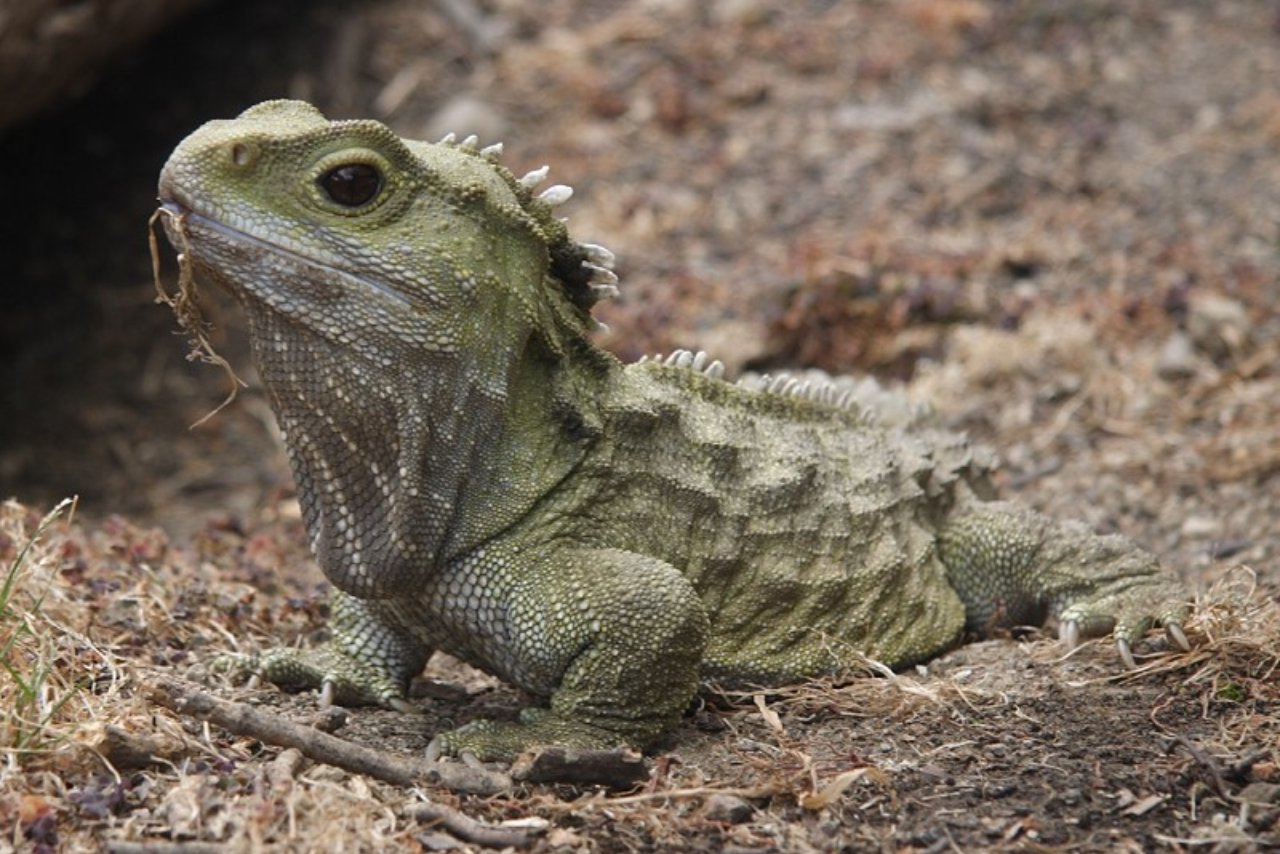
Cover image: Wikimedia Commons — Tuatara

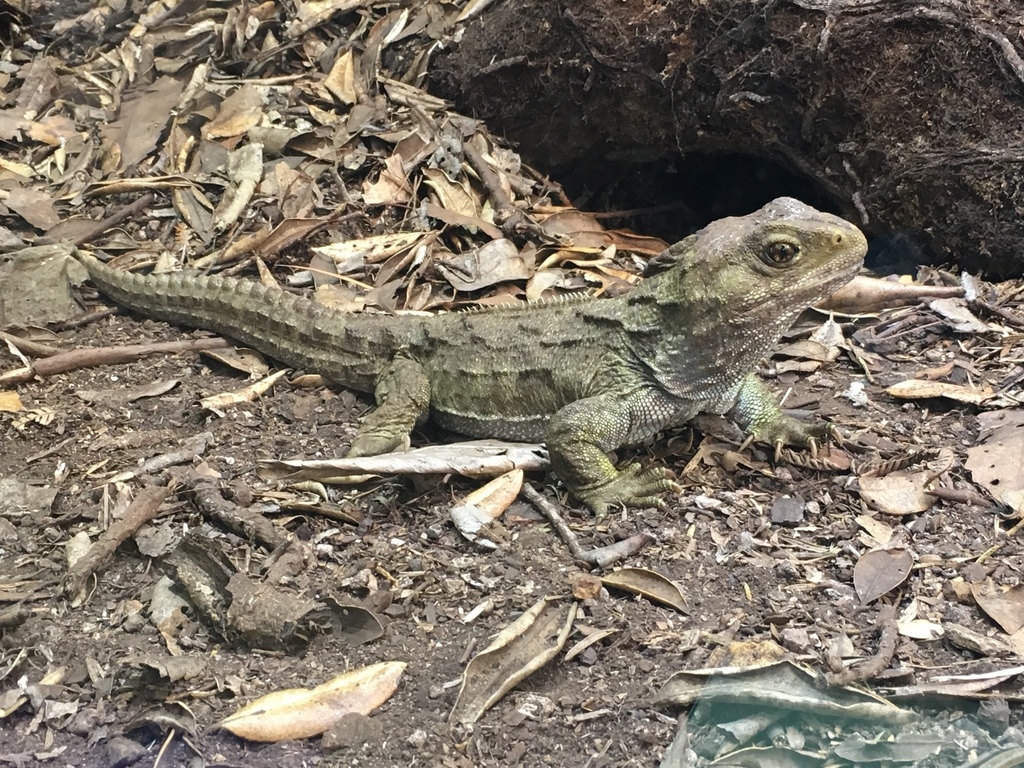
A leatherback turtle crosses the open ocean. A tuatara rests beside a burrow on a New Zealand island. They look very different, yet they share something surprising: each is the only living species in its family.
Here, “family” means a group in biological classification—not parents and offspring. Some reptile families contain hundreds of living species. The families featured here contain just one.
That does not necessarily mean these animals are rare in the wild. It tells us how they are classified, not how many individuals remain.
Our ten reptiles include a freshwater turtle with flippers, a legless reptile that digs with its head, and a tiny snake that remained hidden from scientific view for about a century. Their names give us a starting point. Their shells, snouts and teeth offer plenty to discover along the way.

What Does “One Living Species in a Family” Mean?
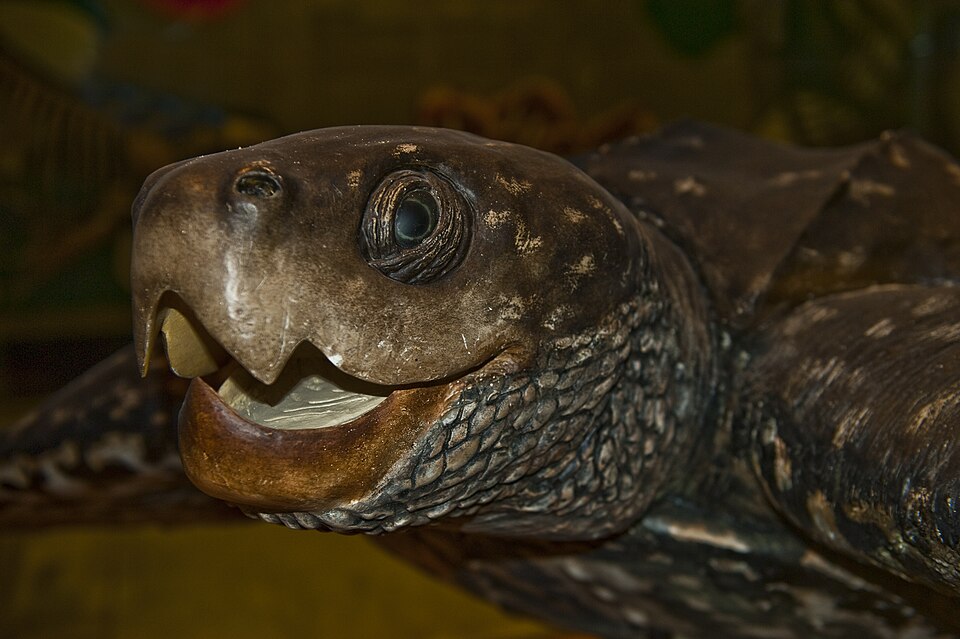
Source: Wikimedia Commons — Lederschildkr dermochelys-coriacea-senkenberg hg

Biologists organise living things into groups that help describe their relationships. For this article, we need three levels, moving from a broader group to a narrower one:
Family → Genus → Species
A family contains one or more genera—the plural of “genus”. A genus contains one or more species.
The leatherback turtle provides a straightforward example:
| Level | Name | Living members |
|---|---|---|
| Family | Dermochelyidae | One genus: Dermochelys |
| Genus | Dermochelys | One species: Dermochelys coriacea |
| Species | Dermochelys coriacea | The leatherback turtle |
Each reptile in this article follows that pattern: its family contains one living genus, and that genus contains one living species. Fossil species and species that have already become extinct are not included in this count.
 メンフクロウ職員
At ECO LIFE PLANET, we describe this arrangement as “one family, one genus, one species”. This is an explanatory phrase rather than a formal taxonomic term.
You may also encounter the word monotypic, which describes a taxonomic group containing only one immediately subordinate group. The important point here is the full arrangement: one living genus containing one living species.
Two distinctions are worth keeping in mind.
First, “one species” counts kinds of animals, not individuals. A species can have many individuals across a wide area while remaining the only living representative of its family.
Second, having no other living species in the same family does not mean having no relatives. Follow the evolutionary tree further back, and these animals share ancestors with members of other families.
 シロフクロウ職員
So we are counting species, not individual animals. A family with one living species does not necessarily have a small population?
 ミミズク先生
Exactly. Classification tells us about the groups we recognise. To understand how many animals remain, we need a different set of evidence
Meet the Ten Reptiles
This selection follows the classification adopted for this article, principally based on The Reptile Database, with a classification reference date of 21 October 2026. The database brings together scientific names, classification, distribution records and references for living reptiles. As research changes species boundaries, a list like this can change too.
Scientific names have two parts: the genus name comes first, followed by the specific epithet. Together, they identify the species. There is no need to memorise them before we begin; you can return to this table as we meet the animals.
| Common name | Scientific name | Family | Main distribution |
|---|---|---|---|
| Leatherback turtle | Dermochelys coriacea | Dermochelyidae | Oceans worldwide |
| Pig-nosed turtle | Carettochelys insculpta | Carettochelyidae | Southern New Guinea and northern Australia |
| Central American river turtle | Dermatemys mawii | Dermatemydidae | Southern Mexico, Belize and Guatemala |
| Chinese crocodile lizard | Shinisaurus crocodilurus | Shinisauridae | Southern China and northern Vietnam |
| Earless monitor lizard | Lanthanotus borneensis | Lanthanotidae | Borneo |
| Florida worm lizard | Rhineura floridana | Rhineuridae | Florida and Georgia, USA |
| Red pipe snake | Anilius scytale | Aniliidae | Northern South America, including Amazonia |
| Mexican burrowing python | Loxocemus bicolor | Loxocemidae | Mexico to Costa Rica |
| Madagascar blind snake | Xenotyphlops grandidieri | Xenotyphlopidae | Northern Madagascar |
| Tuatara | Sphenodon punctatus | Sphenodontidae | New Zealand |
These are ten examples under the classification followed here, rather than a list that will remain unchanged forever. Later, we will meet a turtle that no longer qualifies—and see why a change in classification can tell an interesting story.
Three Turtles: Different Ways to Live in Water
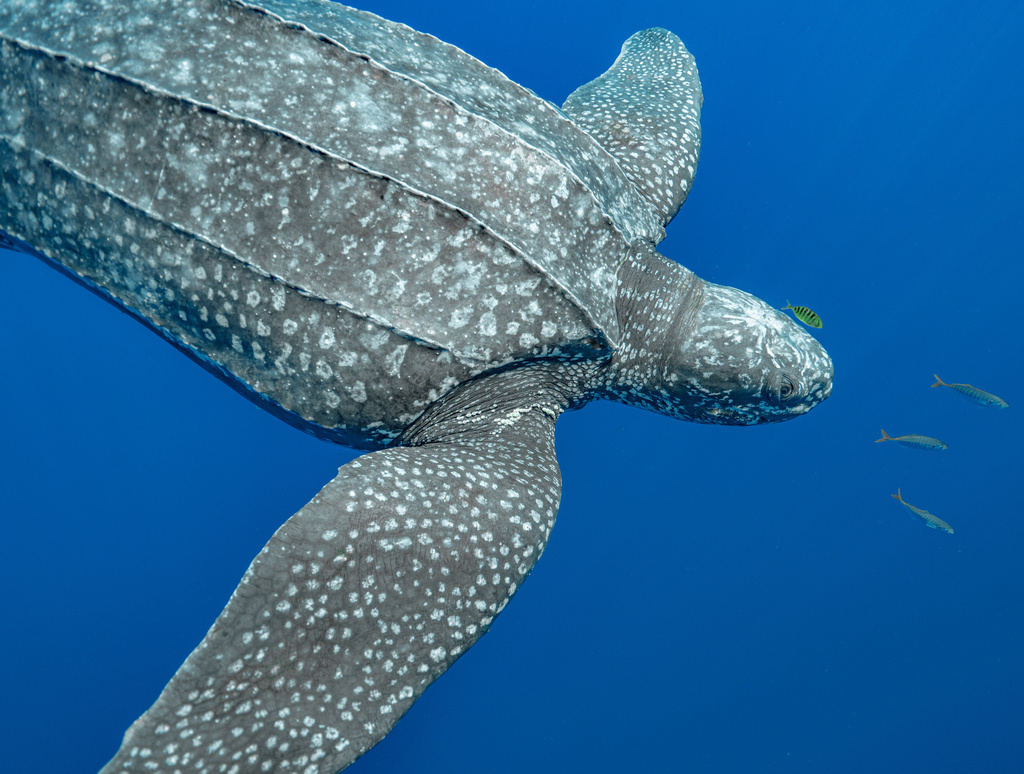
Source: iNaturalist – オサガメ Dermochelys coriacea(azure27014)
Our first three reptiles are turtles. One travels through the open ocean; the other two inhabit fresh water.
Their shells and front limbs provide an easy way into their lives. Their food then leads us further, connecting jellyfish in the sea with leaves falling from riverside trees.
1. Leatherback Turtle: A Shell Covered in Skin
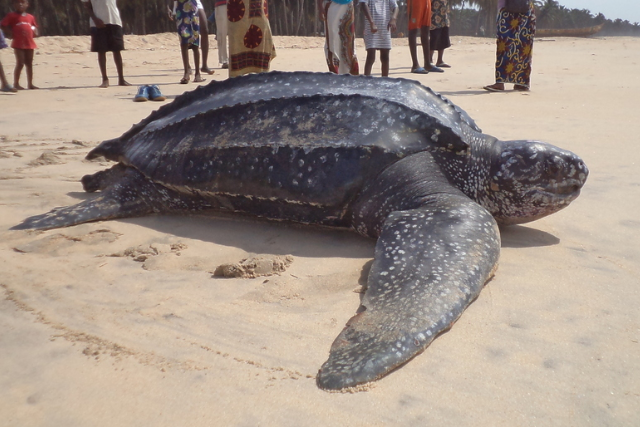
Source: iNaturalist – オサガメ Dermochelys coriacea(tomjamonneau)
- Family: Dermochelyidae
- Main range: Oceans worldwide, from tropical waters to colder seas at high latitudes
The leatherback is the largest living turtle. Its shell also has a distinctive surface.
Most familiar turtles have shells covered in hard, keratinous plates called scutes. Keratin is also the material that forms our fingernails. The leatherback lacks this covering of hard scutes. Instead, tough skin covers a mosaic of small bones, and seven ridges run lengthways down its back.
Long front flippers propel it through the water. It travels great distances between nesting beaches in warm regions and feeding grounds that may lie in much colder seas.
Its food includes jellyfish and salps. Salps are transparent, barrel-shaped animals that drift in the sea. Although they may look rather jellyfish-like, they are relatives of sea squirts.
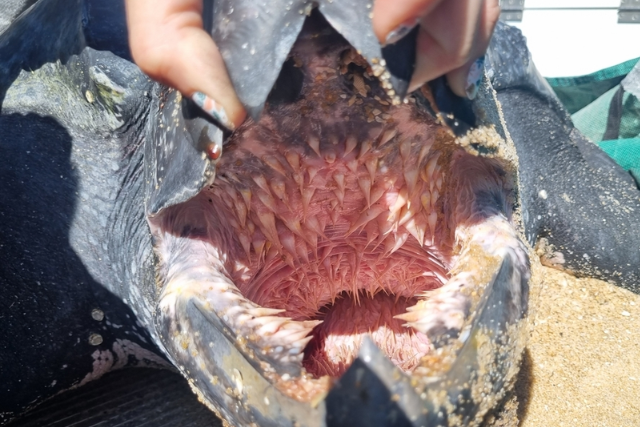
Inside the leatherback’s mouth and throat, backward-pointing projections help retain slippery, soft-bodied prey.
Source: iNaturalist – オサガメ Dermochelys coriacea(rach-d)
A whole-body photograph shows the swimming equipment: long flippers and a streamlined body. A photograph of the mouth reveals another part of the same life—the structures that help it hold its food.
When comparing the leatherback with another sea turtle, such as a loggerhead, begin with the shell surface. The contrast between skin and hard scutes is easier to remember once you have noticed it yourself.
2. Pig-nosed Turtle: Flippers in Fresh Water
Source: iNaturalist – スッポンモドキ Carettochelys insculpta(aquarist-watch)
- Family: Carettochelyidae
- Main range: Southern New Guinea and northern Australia
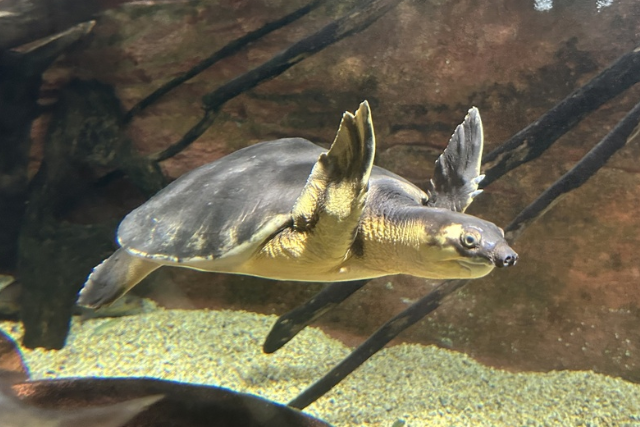
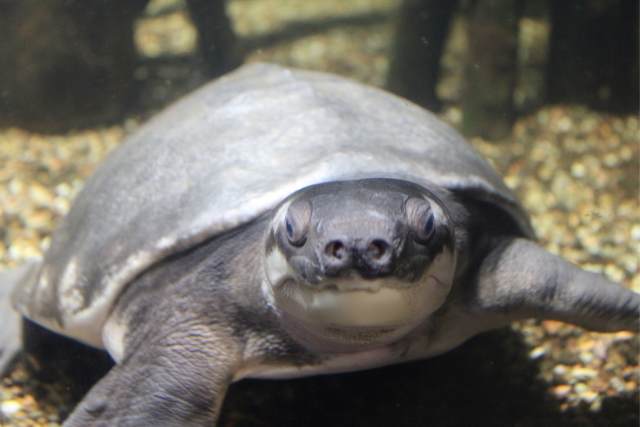
Look at a pig-nosed turtle from the front, and its name needs very little explanation. A fleshy, rounded snout projects from the head, with the nostrils at its tip.
Its front limbs offer another surprise. They are broad and flipper-like, resembling those of a sea turtle, although this species lives in fresh water.
Source: iNaturalist – スッポンモドキ Carettochelys insculpta(saraalien1)
The turtle moves its front flippers together as it swims. Look closely at their tips, and you can see two claws on each.
Its diet includes both animal and plant food: molluscs, crustaceans, leaves, fruit and seeds. However, its strong connection to water does not remove its need for land. Females come ashore to dig nests and lay eggs on riverbanks.
The habitat therefore includes more than the river itself. Suitable banks are where the next generation begins.
3. Central American River Turtle: A Meal from the Riverbank
Source: IUCN/SSC Tortoise and Freshwater Turtle Specialist Group – Dermatemys mawii, 058
- Family: Dermatemydidae
- Main range: Atlantic-draining rivers and lakes of southern Mexico, Belize and Guatemala
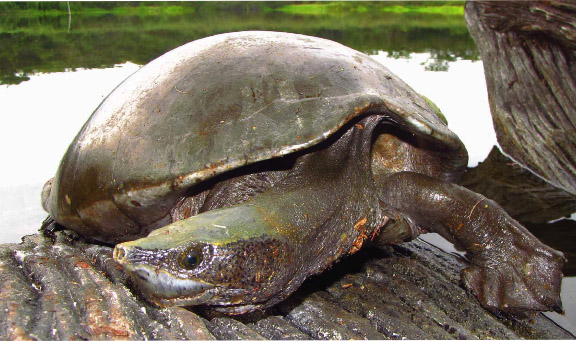
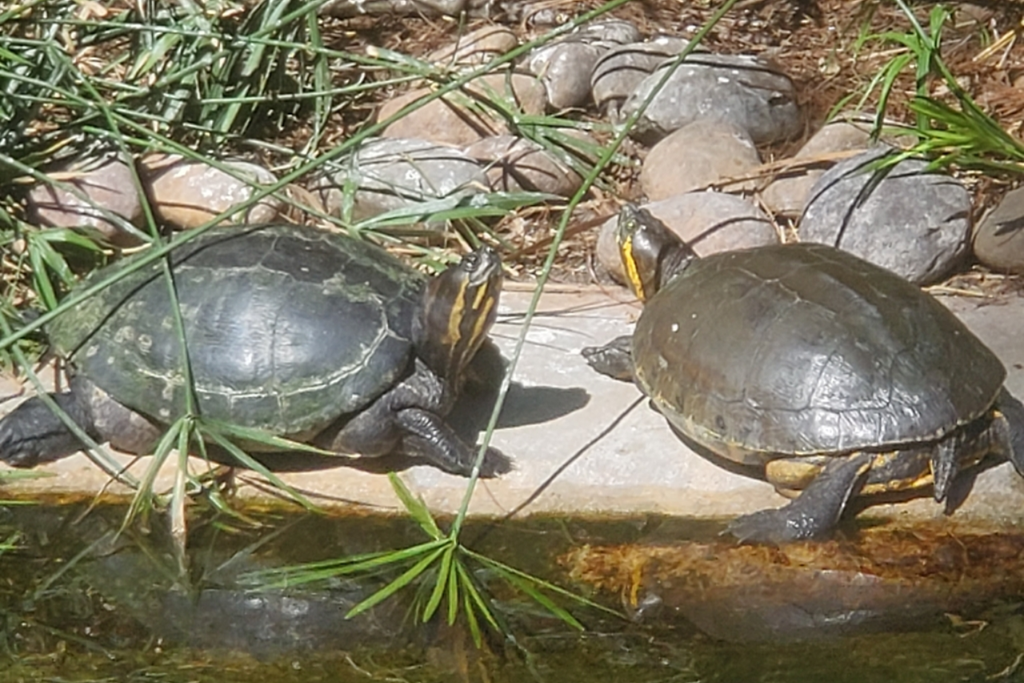
The Central American river turtle, also known as the hickatee, is a large freshwater turtle. It is the only living species in Dermatemydidae and is strongly associated with rivers and lakes.
Adults feed mainly on plants. But does an aquatic turtle necessarily eat plants that grow underwater?
A 2022 study by Bishop and colleagues provides a useful answer. The researchers examined the stomach contents of 66 turtles legally harvested for local consumption in Belize. They found leaves, flowers, stems, seeds and fruit, among other plant material. Diet differed between river and lagoon habitats, and leaves from riverside trees were especially important in rivers.
An animal beneath the surface can therefore depend on plants growing above it.
When looking at a river, we might separate the water from the wooded bank. The turtle’s meals connect them: a leaf falls, sinks or drifts, and becomes food.
Lizards and a Worm Lizard: From Streamside Branches to Soil
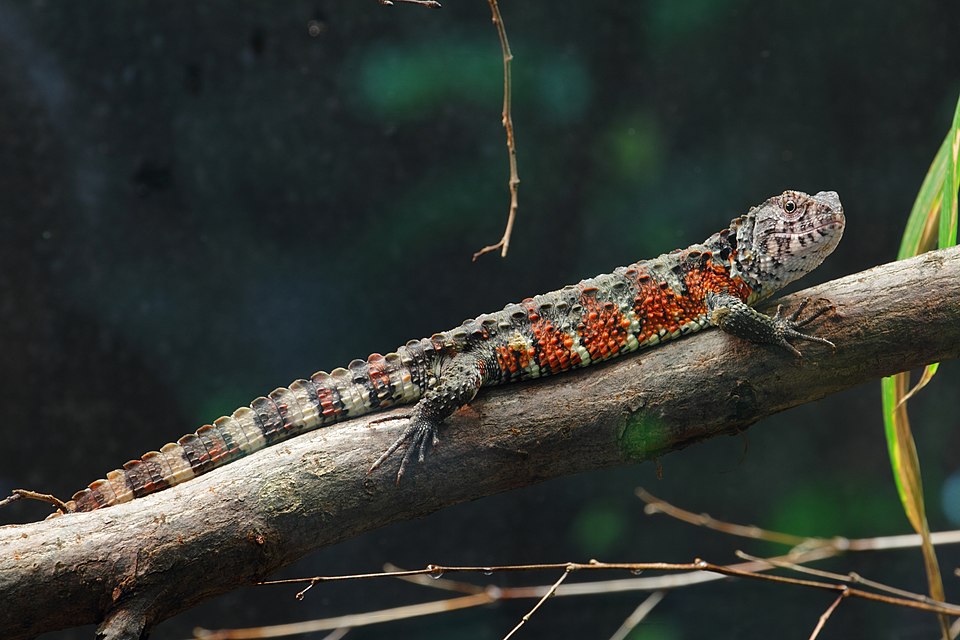
Source: Wikimedia Commons — Shinisaurus crocodilurus – Tiergarten Schönbrunn 3

Our next three reptiles lead us from forest streams into the ground.
Their shapes can be misleading at first. A crocodile-like tail does not make an animal a crocodile, and a long, legless body does not automatically make it a snake.
Looking at where an animal rests—and how it moves—helps make sense of its appearance.
4. Chinese Crocodile Lizard: A Perch Above the Water
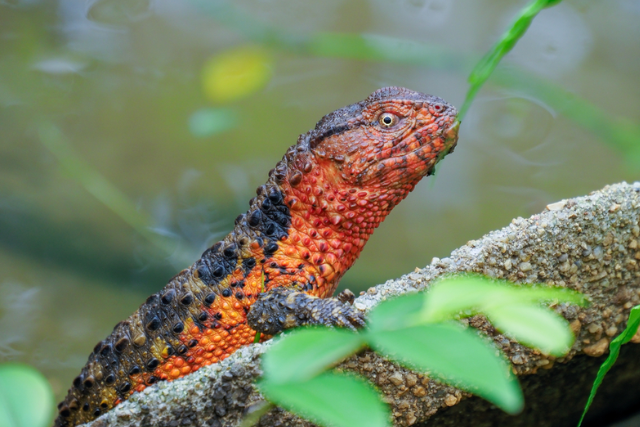
Source: iNaturalist – シナワニトカゲ Shinisaurus crocodilurus(zenjay)
- Family: Shinisauridae
- Main range: Southern China and northern Vietnam
The Chinese crocodile lizard lives around slow-moving streams and pools in forest.
Its name draws attention to its crocodile-like appearance, particularly the tail. But the branch beneath its feet tells us something equally useful.
A branch overhanging water is more than a resting place. If danger approaches, the lizard can drop into the stream and hide underwater.
The water is also a place to find food. Its prey includes insects, earthworms, snails and tadpoles.
Imagine the habitat in three dimensions: branches above, banks beside, and water below. The lizard uses the connections between them.
That helps explain why the surrounding forest matters. Losing it removes perches and shelter, while capture for the pet trade puts additional pressure on the species. Protecting the lizard means protecting the wooded stream as a whole.
5. Earless Monitor Lizard: Looking Beneath the Scales
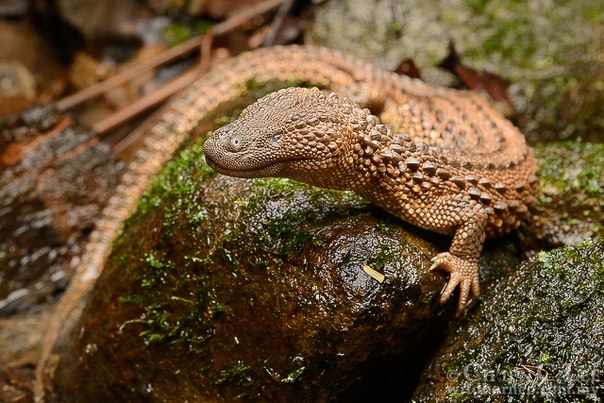
Image reference: Wikipedia – ミミナシオオトカゲ
- Family: Lanthanotidae
- Main range: Borneo
The earless monitor lizard has an elongated brown body, short legs and rows of raised, knobbly scales.
Its name refers to the absence of external ear openings. In a photograph, the textured skin may attract your attention first, followed by the small limbs and long body.
Much of its life takes place concealed in soil or water, making its behaviour difficult to follow in the wild. Field studies are gradually adding to our understanding of its activities.
Researchers can also investigate what lies beneath the scales.
The University of Texas at Austin’s DigiMorph resource provides images of the skull reconstructed from CT scans. CT scanning uses X-rays to reveal internal structures, allowing researchers to examine bones while leaving the specimen intact.
An external photograph and a reconstructed skull offer two views of the same head. One shows the surface encountered by the outside world; the other reveals the framework beneath it.
For a museum specimen, that distinction matters. Preserving the whole animal can leave several kinds of evidence available for future study.
6. Florida Worm Lizard: A Head Built for Digging
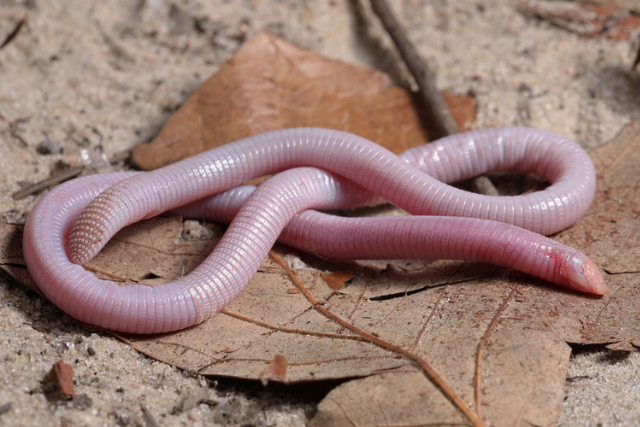
Source: iNaturalist – Rhineura floridana(jakescott)
- Family: Rhineuridae
- Main range: Florida and Georgia, USA
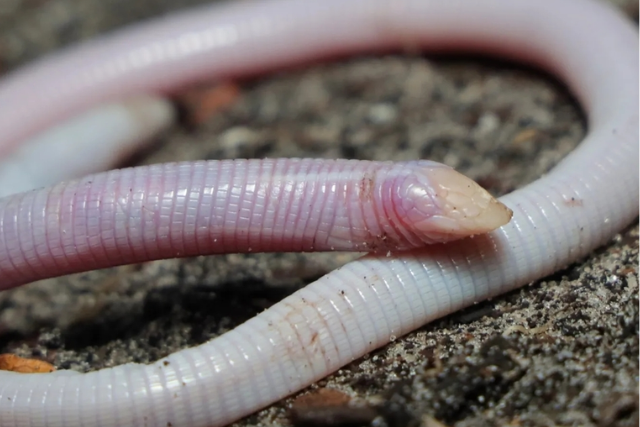
The Florida worm lizard lives beneath the soil. Its long, legless body may bring an earthworm or a snake to mind.
It is neither. It belongs to the amphisbaenians, commonly called worm lizards—a group of reptiles distinct from snakes.
Source: iNaturalist – Rhineura floridana(tommyh44)
The head is the feature to examine. Its broad, shovel-like front helps push through soil, opening a route for the body behind it.
We often associate digging with limbs and claws. Here, the front of the head does the work.
The Florida worm lizard is the only living species in Rhineuridae and the only amphisbaenian native to the United States. Yet one species does not mean that every population is identical.
By comparing genetic information with records of where animals were found, researchers can investigate relationships between populations. Even for a reptile hidden underground, a precise locality record helps place an individual within a wider story.
Three Snakes: Clues Near and Below the Ground
Source: iNaturalist – サンゴパイプヘビ Anilius scytale(nickvolpe)
Worm lizards are not snakes. Our next three reptiles, however, are.
They range from a brightly banded species to a pale, worm-like burrower. To learn about them, researchers draw on observations of living animals, preserved specimens and the records that accompany them.
7. Red Pipe Snake: A Specimen’s Last Meal
Source: iNaturalist – サンゴパイプヘビ Anilius scytale(conradsreptiles)
- Family: Aniliidae
- Main range: Northern South America, including the Amazon region
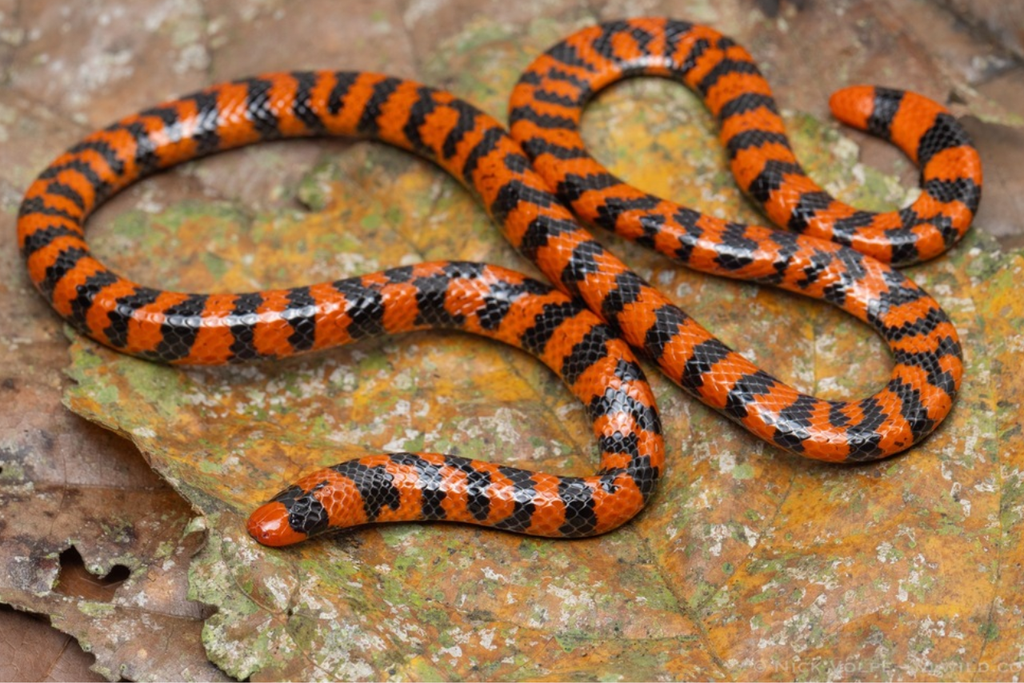
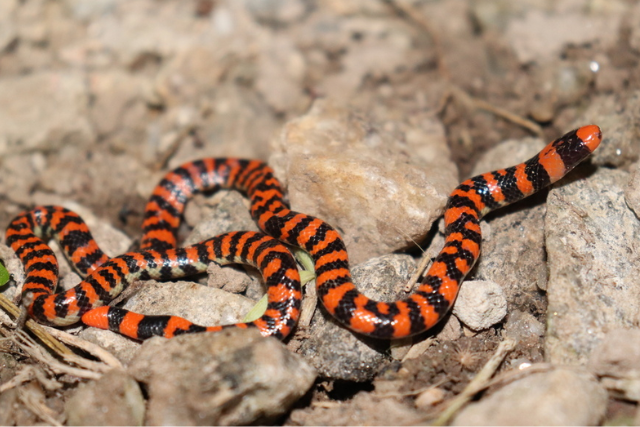
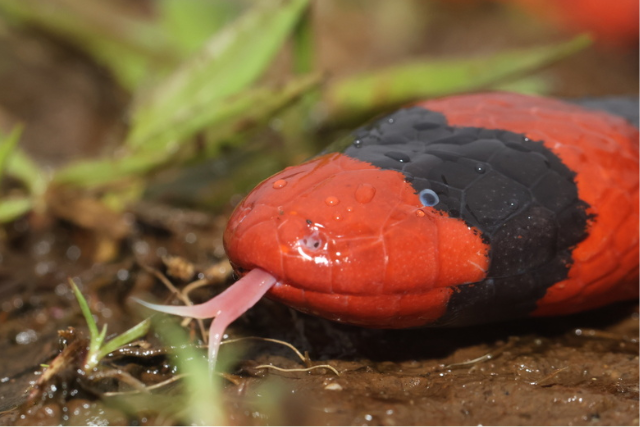
The red pipe snake has striking red and black bands. It spends much of its life concealed, and large individuals can approach 1.2 metres in total length.
Females give birth to live young rather than laying eggs.
Its food often has something in common with the snake itself: a long, narrow body. Prey includes worm lizards, other snakes and caecilians. Caecilians are limbless amphibians—not snakes, despite the similar outline.
A study published by Maschio and colleagues in 2010 investigated the diet of red pipe snakes from Brazilian Amazonia by examining preserved specimens. Remains inside the digestive tract provided evidence of their meals.
Source: iNaturalist – サンゴパイプヘビ Anilius scytale(panisseclement)
A researcher does not always have to witness a feeding event to learn from it. A specimen may preserve both the predator and traces of its prey.
メンフクロウ職員A specimen holds more than an animal’s shape. Sometimes it preserves evidence of a meal that nobody saw—and a question that nobody thought to ask when it was collected.
In the field, observe snakes from a distance. Red and black colouring alone is not a reliable guide to whether a snake is venomous.
8. Mexican Burrowing Python: A Familiar Name, a Different Family
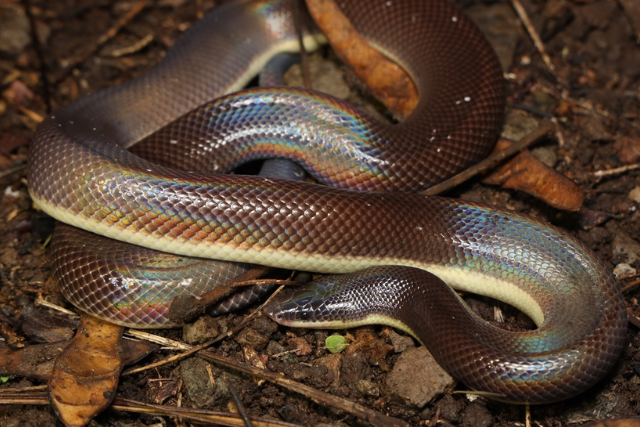
Source: iNaturalist – メキシコパイソン Loxocemus bicolor(tommyh44)
- Family: Loxocemidae
- Main range: Mexico and parts of Central America, south to Costa Rica
The Mexican burrowing python’s name seems to tell us where to place it. Surely a python belongs in the python family?
In this case, the common name and the family name do not line up. This snake belongs to Loxocemidae, not Pythonidae.
Common names are useful introductions, but they do not always provide a precise guide to classification.
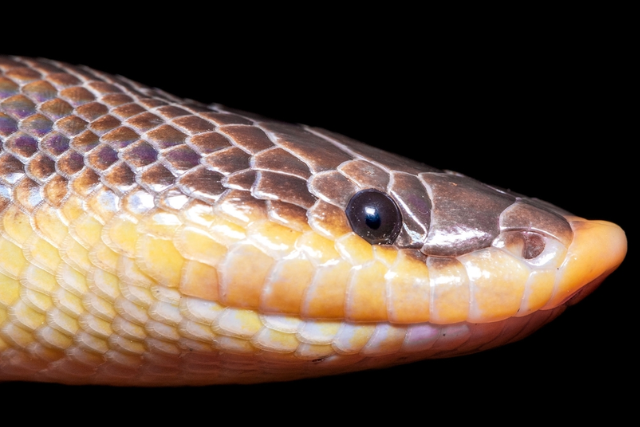
Source: iNaturalist – メキシコパイソン Loxocemus bicolor(leomcampos24)
Look at the head from the side. The snout projects forwards, with a sloping front that looks almost as though it has been cut off at an angle.
This species lays eggs, unlike the live-bearing red pipe snake.
Both are the only living species in their families, but that shared feature tells us neither what their heads look like nor how they reproduce. It gives us a reason to compare them—not a reason to expect them to be alike.
9. Madagascar Blind Snake: A Rediscovery Beneath the Sand
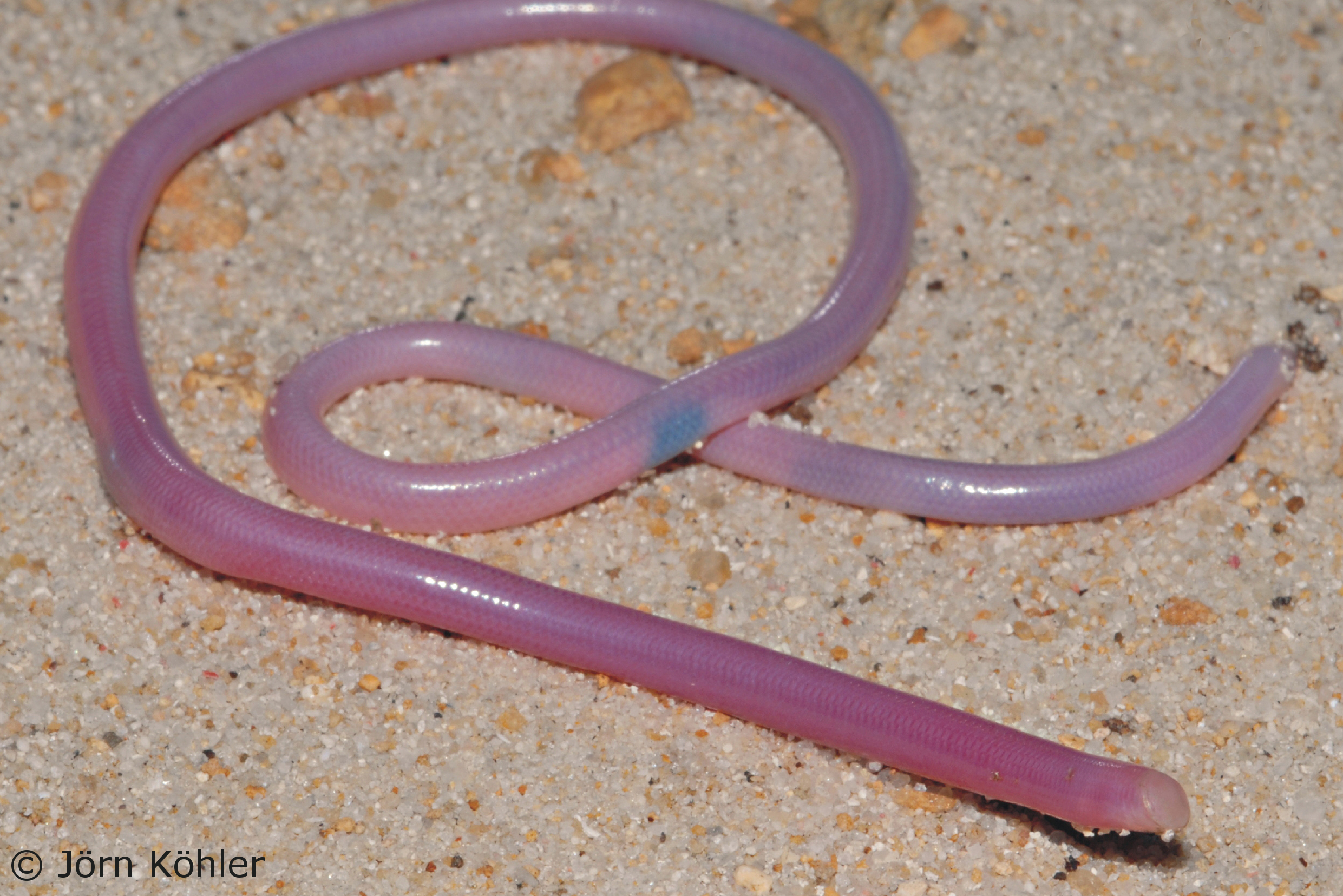
Source: EDGE of Existence – Madagascar blind snake
Photograph: Dr Jörn Köhler
- Family: Xenotyphlopidae
- Main range: Coastal northern Madagascar, around Antsiranana
Pale pink and slender, the Madagascar blind snake looks remarkably like an earthworm.
At the front of its small head is an enlarged scale that helps it push through sand. Its body is suited to a life largely hidden from view—which also makes it difficult for people to find.
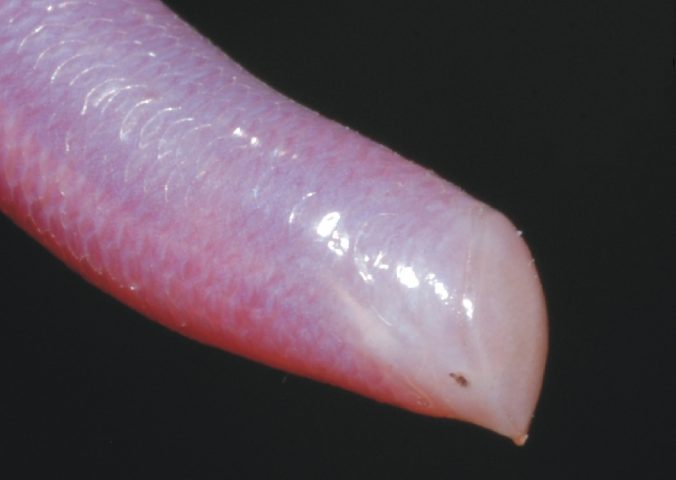
Source: EDGE of Existence — Madagascar blind snake Xenotyphlops grandidieri
Its scientific history shows how incomplete records can add to that difficulty.
The species was described in 1905, but the old specimens were labelled only “Madagascar”. That left later researchers with a very large island to search.
Roughly a century later, snakes collected in the northern coastal region provided much more precise places to investigate. Comparisons with older specimens helped researchers understand the identity and distribution of the newly found animals.
A long gap without a record is not, by itself, proof that a species has become extinct. It may also reflect a concealed way of life, limited searching or uncertainty about where to look.
The rediscovery also demonstrates the value of a specimen label. “Madagascar” and a carefully recorded collecting site are very different kinds of information.
シロフクロウ職員The locality is part of the evidence. A specimen tells us about the animal; a precise label helps connect it to a place we can investigate again.
10. Tuatara: A Different Branch from Lizards
Source: iNaturalist – ムカシトカゲ Sphenodon punctatus(mclaragil)
- Family: Sphenodontidae
- Main range: New Zealand, including offshore islands and protected conservation sites
At first glance, a tuatara looks like a lizard. Its classification reveals a deeper distinction.
Lizards and snakes belong to the order Squamata. An order is a broader classification level above family. The tuatara belongs to a different order, Rhynchocephalia, also called Sphenodontia in some accounts.
It is therefore unusual at more than one level: it is the only living species not just in its family, but in its entire order. New Zealand’s Department of Conservation recognises the tuatara as a single living species, Sphenodon punctatus.
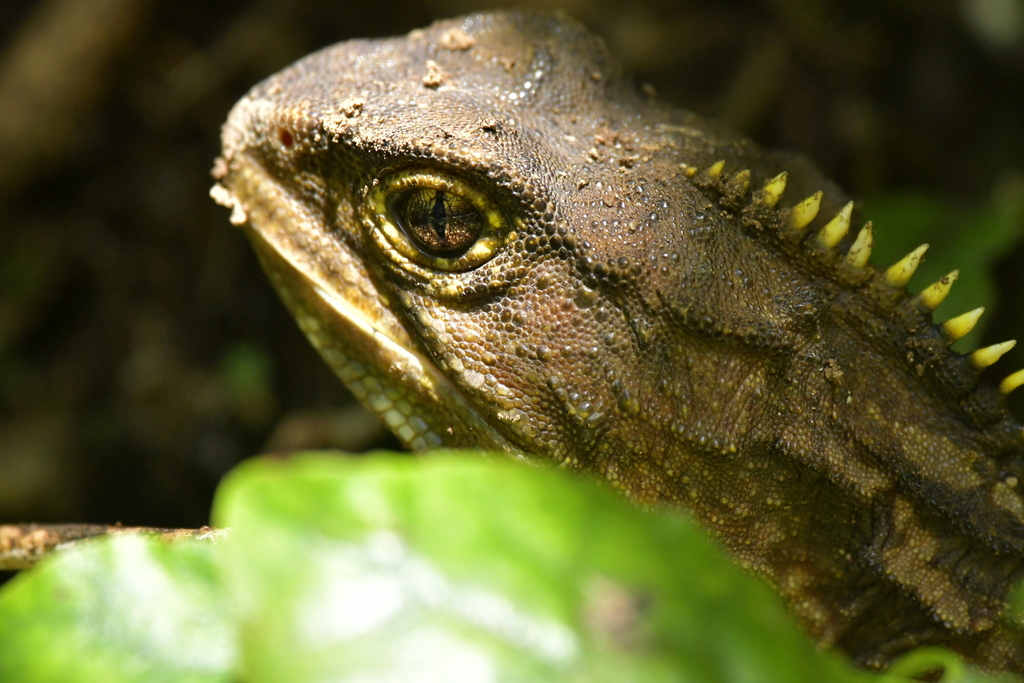
The teeth provide a memorable clue to its anatomy. There are two rows in the upper jaw and one in the lower jaw. When the mouth closes, the lower teeth fit between the upper rows.
Its food includes beetles, spiders and other small animals. It sometimes eats lizards, seabird eggs and chicks.
Yet its relationship with seabirds extends beyond predator and prey. Seabirds bring nutrients from the sea onto their nesting islands. Those nutrients enrich the soil and help support the small animals that tuatara eat. An animal resting beside a burrow is therefore connected to food webs extending into the surrounding ocean.
The tuatara also gives us an opportunity to explore something that affects this whole article: classification can change.
Why the Big-headed Turtle Is Missing
Source: iNaturalist – オオアタマガメ Platysternon megacephalum(fishtse)
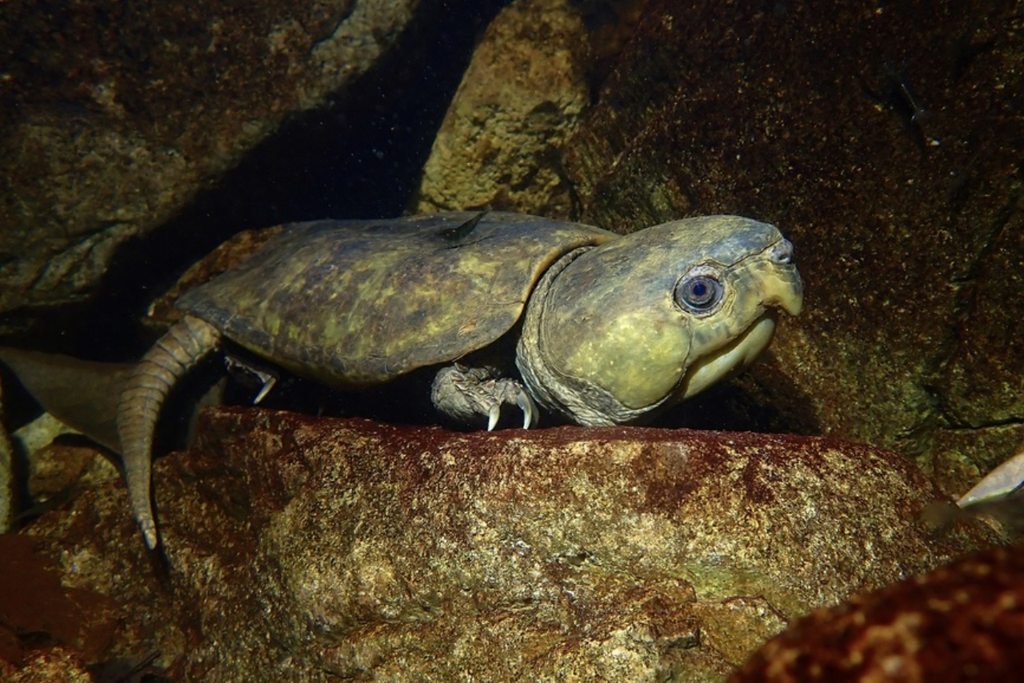
The big-headed turtle previously appeared on ECO LIFE PLANET as the only living species in its family.
Under the classification followed here, it no longer qualifies.
A 2025 study by Liang and colleagues compared genetic evidence and physical characteristics across big-headed turtle populations. The researchers recognised three species where one had previously been widely recognised.
| Scientific name | Treatment in the revision |
|---|---|
| Platysternon megacephalum | Retained with a narrower species definition |
| Platysternon peguense | Recognised as a separate species |
| Platysternon baiseensis | Described as a new species |
The study found deeply divergent lineages and described Platysternon baiseensis from the Baise–Hechi region of Guangxi, China. Under this treatment, Platysternidae contains more than one living species.
The turtles did not suddenly change in 2025. Nor did a new species come into existence when its description was published.
The differences were already there. Research changed how scientists interpreted them: variation once placed within a single species was recognised as evidence of separate species.
Tuatara Show the Opposite Change
Some older books recognise Sphenodon guntheri, often called Günther’s tuatara, as a second species.
Later research supported treating tuatara as one species. New Zealand’s Department of Conservation explains that the two-species treatment was discontinued in 2009.
In one case, a previously broad species was divided. In the other, previously separated animals were brought together.
Neither direction is automatically right. What matters is how well the classification fits the evidence.
ミミズク先生An older book may reflect the evidence available when it was written. When the species count changes, the useful question is not simply “Which number is correct?” but “What did researchers discover?”
Being the Only Species and Being Threatened Are Different Questions
Source: iNaturalist – ムカシトカゲ Sphenodon punctatus(christopherstephens)
If the sole living species in a family becomes extinct, that family loses all its living representatives.
However, the classification alone does not tell us how likely that loss is. Extinction risk depends on population trends, distribution, habitat and the pressures affecting the species.
Reading the Conservation Categories
The IUCN Red List assesses extinction risk. The categories used below are Least Concern (LC), Vulnerable (VU), Endangered (EN) and Critically Endangered (CR). Vulnerable, Endangered and Critically Endangered are collectively described as threatened categories.
The following table presents the global assessments cited for this article. The years identify those assessments; the table should not be read as saying that every species was reassessed in 2026.
| Species | Global IUCN category cited | Assessment year |
|---|---|---|
| Leatherback turtle | Vulnerable (VU) | 2013 |
| Pig-nosed turtle | Endangered (EN) | 2017 |
| Central American river turtle | Critically Endangered (CR) | 2006 |
| Chinese crocodile lizard | Endangered (EN) | 2014 |
| Earless monitor lizard | Endangered (EN) | 2019 |
| Florida worm lizard | Least Concern (LC) | 2007 |
| Red pipe snake | Least Concern (LC) | 2013 |
| Mexican burrowing python | Least Concern (LC) | 2012 |
| Madagascar blind snake | Critically Endangered (CR) | 2011 |
| Tuatara | Least Concern (LC) | 2019 |
Least Concern does not mean that an animal faces no problems anywhere. Likewise, sharing a threatened category does not mean that two species need the same conservation measures.
Different Lives, Different Threats
For the Central American river turtle, capture for food is a major concern. Removing large breeding adults also removes animals that could produce future generations. Its Critically Endangered assessment reflects severe pressures on the species.
For the Chinese crocodile lizard, protecting wooded streams and reducing capture for the pet trade address important threats.
For tuatara, introduced mammals are a central concern. Rats eat eggs and young and can affect the small animals available as food. Keeping introduced mammals away from island refuges is therefore an important part of conservation.
Leatherbacks face hazards including accidental capture in fishing gear, loss of nesting habitat and marine debris. Their journeys across national boundaries also make international cooperation important.
“One living species in a family” is a common feature. It is not a common conservation plan.
Global and Regional Assessments Can Differ
A widespread species may face very different conditions in different parts of its range.
The leatherback illustrates this clearly. In the 2013 IUCN assessments, it was classified as Vulnerable globally, while the East Pacific subpopulation was Critically Endangered. A subpopulation is a geographically or otherwise distinct part of the species’ overall population.
These assessments answer questions at different scales. Neither cancels out the other.
When reading a conservation category, check three things:
- Which species or population was assessed?
- What geographical area does the assessment cover?
- When was the assessment made?
Together, those details make a short label much more informative.
Extinction Risk and Trade Rules Have Different Jobs
Conservation systems also serve different purposes.
| System | Main purpose |
|---|---|
| IUCN Red List | Assesses extinction risk |
| National and regional red lists | Assess status within a defined country or region |
| CITES | Regulates international trade in listed wild animals and plants |
Being threatened on the IUCN Red List is not the same as being regulated under CITES.
For example, a species’ IUCN category describes its assessed extinction risk, while its CITES listing concerns international trade. Knowing which system a label belongs to helps us understand what it is—and is not—telling us. NOAA’s leatherback account presents legal listings separately from the species’ biology and threats.
One Shared Feature, Ten Different Lives
Source:メキシコカワガメ Dermatemys mawii(xarathos)
A leatherback’s ridged shell, a worm lizard’s shovel-like head and a tuatara’s rows of teeth all invite a closer look.
These ten reptiles share an unusual classification pattern. Their bodies reveal very different ways to live.
Their stories also show how we come to know them. A stomach preserved in a specimen can reveal a meal. A CT scan can uncover bones beneath scales. A precise locality can connect an old museum specimen with a living population.
Classification brings evidence together to describe differences and relationships. As that evidence grows, species may be separated or brought together.
The next time you encounter an unfamiliar reptile in a photograph, a field guide or a museum display, choose one detail and follow the question it raises.
Why that shape? How does it help the animal live? What evidence allows us to tell?
 タヌ山先生
Learning the name is a beginning. The interesting questions do not stop there.
Books from ECO LIFE PLANET
The Forest Museum Kindle series explores classification and natural history in greater depth.
The following books are in Japanese. The English titles below are descriptive translations.
- An Introduction to Taxonomy: The Basics of the Science of Organising the World, Level 1
View on Amazon Japan - A Spring Nature Observation Handbook: Fieldwork for Children and Adults
View on Amazon Japan - One Family, One Genus, One Species: The Narrowest Branches of the Tree of Life — Taxonomy Edition
View on Amazon Japan
These links are Amazon affiliate links.
References
- The Reptile Database — Species database
- NOAA Fisheries — Leatherback Turtle
- Naturalis — Turtles of the World: Carettochelys insculpta
- IUCN/SSC Tortoise and Freshwater Turtle Specialist Group — Dermatemys mawii, 058 (2012)
- Bishop et al. — Diet of Dermatemys mawii, an Aquatic Turtle That Relies Heavily on Terrestrial Vegetation (2022)
- ZSL EDGE of Existence — Chinese Crocodile Lizard
- DigiMorph, University of Texas at Austin — Lanthanotus borneensis (2001)
- Journal of Herpetology — Evidence of Population Genetic Structure within the Florida Worm Lizard (2005)
- Maschio et al. — Food habits of Anilius scytale in the Brazilian Amazonia (2010)
- Reptiles of Ecuador — Pipe Snake: Anilius scytale (2024)
- Wegener et al. — Morphological variation and taxonomic reassessment of the endemic Malagasy blind snake family Xenotyphlopidae (2013)
- New Zealand Department of Conservation — Tuatara
- Te Ara — Teeth: Tuatara (2009)
- Liang et al. — Taxonomic revision of the critically endangered big-headed turtles, with description of a new species (2025)
- IUCN SSC Marine Turtle Specialist Group — New Leatherback Red List Assessments Published (2013)
コメント