


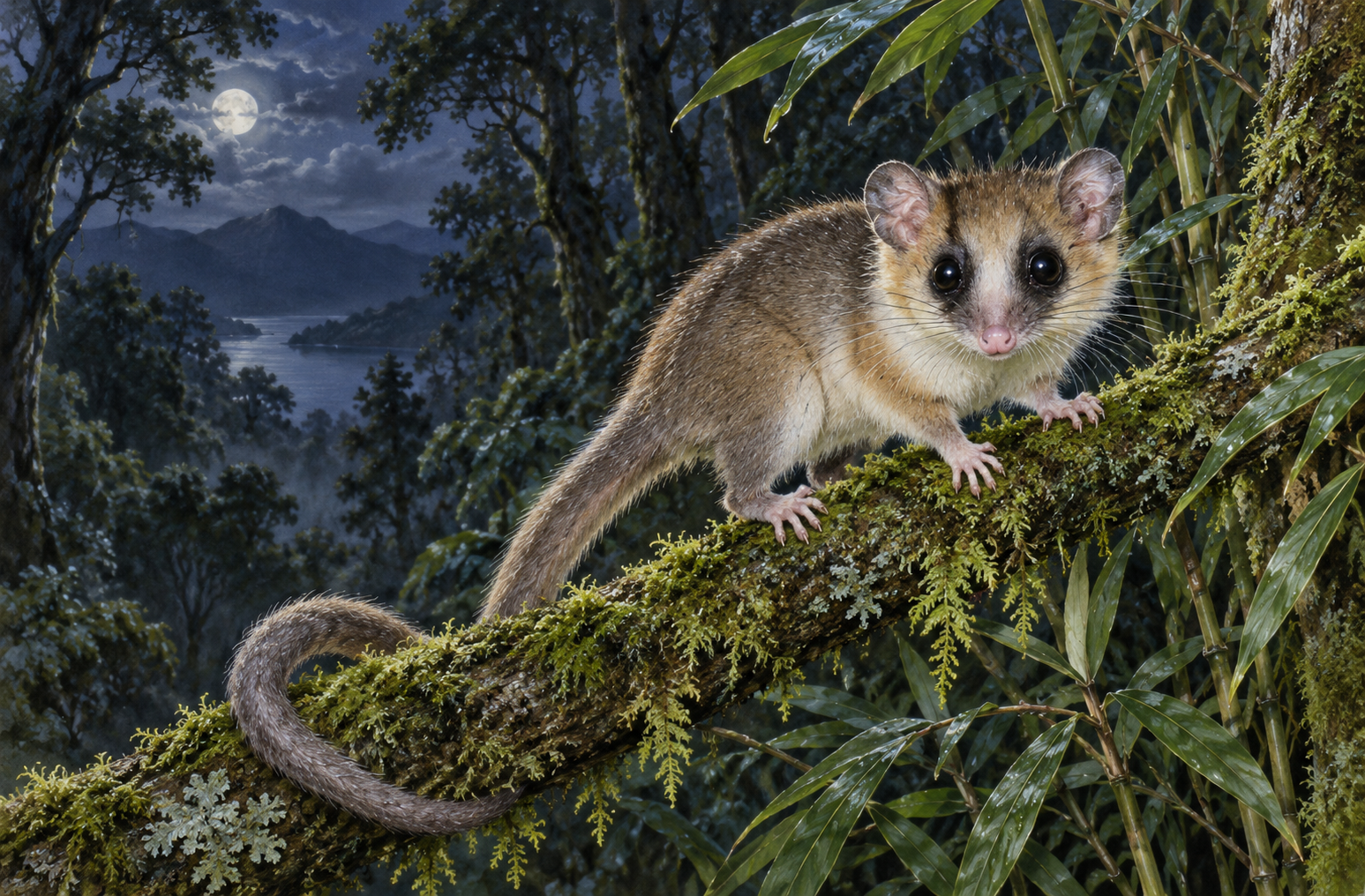
In the cool, rain-soaked forests of southern Chile and Argentina lives a tiny marsupial with rounded ears, dark rings around its eyes and a long tail that helps it move through branches. It is called the monito del monte—roughly, “little monkey of the woodland”—although it is neither a monkey nor a mouse.
Its appealing appearance makes many people want to look twice. That is a perfectly good place to begin. Look beyond its face, however, and a larger story emerges.
Monitos del monte move through branches at night, feed on fruits and insects, and use torpor to cope with cold seasons. Their nests offer shelter, resting places and sites for raising young. As they travel through the forest, they can also carry seeds away from the plants whose fruits they eat.
Their evolutionary history is just as remarkable. The genus Dromiciops is the only living genus in the marsupial order Microbiotheria. It is not an ancestor of the marsupials of Australia and New Guinea. Rather, it shares a more recent common ancestor with Australasian marsupials than with other living American marsupials.
Today, the Mammal Diversity Database recognises two living species. In this article, “monitos del monte” refers to the genus as a whole. Where evidence comes from research on one species, its scientific name is given.
A pair of rounded ears may catch our attention. From there, we can follow this small animal into the forest—and much further back into the history of marsupials.

Meet the Monito del Monte
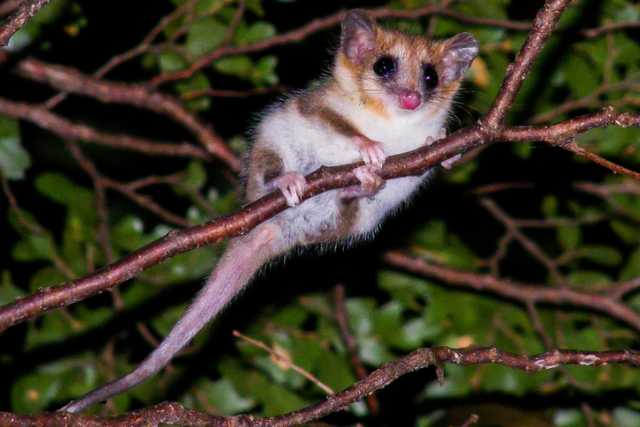
Source: iNaturalist – Southern monito del monte, Dromiciops gliroides(daniel_stange)
It Looks Like a Mouse, but It Is Not a Rodent
A monito del monte is a very small mammal, often weighing only a few tens of grams. It has dense fur, a short muzzle, rounded ears and striking dark markings around its eyes. Its small feet can grip narrow branches, while its long tail helps steady the body as it moves.
At first glance, its shape may bring a mouse or dormouse to mind. Yet monitos del monte are not rodents. They are marsupials—the wider mammal group that includes kangaroos, koalas, wombats and opossums.
Alternative names containing “opossum”, such as Chilean opossum and colocolo opossum, can also be misleading. Monitos del monte belong to the family Microbiotheriidae, not Didelphidae, the family that includes the Virginia opossum and many other American opossums.
 ミミズク先生
For comparison, the animal below is a Virginia opossum, Didelphis virginiana.👇️
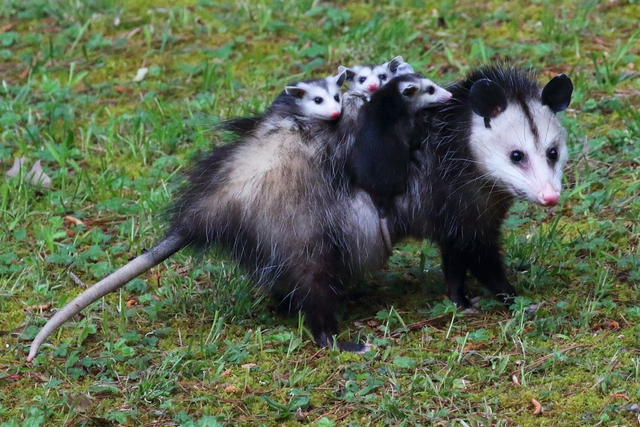
Source: iNaturalist – Virginia opossum, Didelphis virginiana(kodiakgarden)
Resemblance is a useful starting point, but it does not reveal ancestry by itself. Taxonomists compare teeth, skeletons, preserved specimens, fossils, locality records and molecular evidence rather than relying only on a familiar silhouette.
 シロフクロウ職員
It looks rather like a mouse. Is it one?
 メンフクロウ職員
Not at all. The resemblance is understandable, but appearance and ancestry are different questions. Before deciding, we need to look beyond the face—at the teeth, the skeleton, the specimen itself and the record that comes with it. Piano piano.
A familiar shape is a clue to examine, not a verdict.
What to Notice in a Photograph
When looking at a photograph of a monito del monte, try observing the following features:
- Dark fur forming rings around the eyes
- Rounded ears and a short muzzle
- Small feet gripping narrow branches
- A long, partly prehensile tail
- The surrounding branches, vegetation and possible shelters
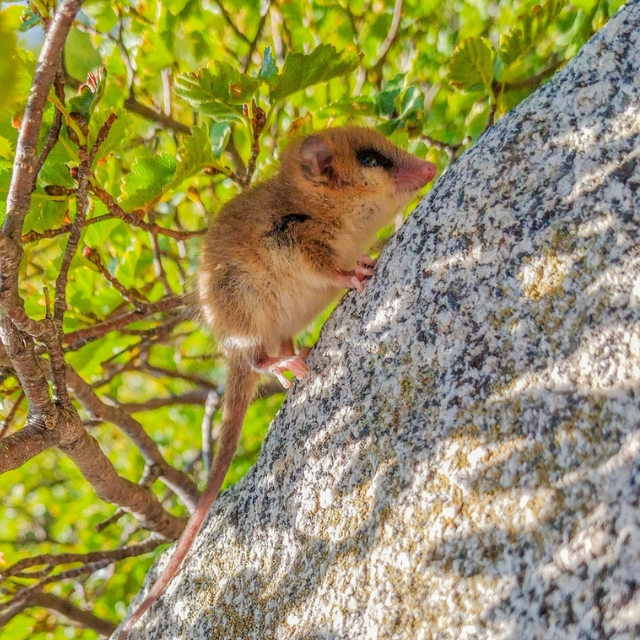
Source: iNaturalist – Dromiciops bozinovici(michellesuckel)
A photograph can show us what is visible. It cannot always tell us why a feature evolved or precisely how the animal uses it. Good observation begins by separating what we can see from what we are tempted to assume.
A Forest Dweller from Chile and Argentina
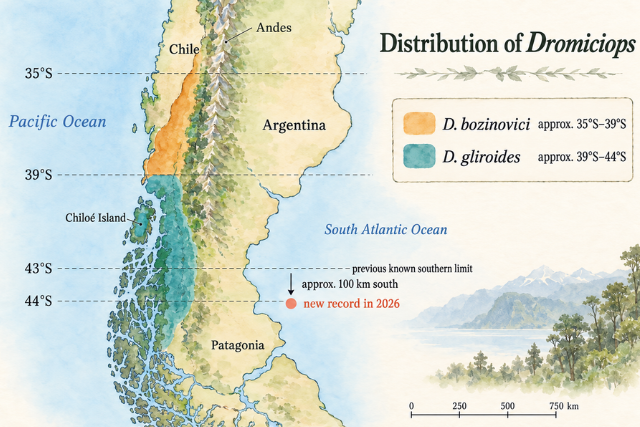
Illustration created with ChatGPT, based on the Mammal Diversity Database v2.5 and Nespolo et al. (2026).
The boundaries are schematic and should not be interpreted as precise range limits.
Not Confined to Chiloé Island
Chiloé Island lies within the range of the monito del monte, but these animals are not confined to the island. Members of the genus Dromiciops occur in south-central and southern Chile and in neighbouring parts of Argentina.
Under the current treatment of the Mammal Diversity Database, Dromiciops bozinovici occupies the broadly northern part of the genus’s range, approximately between 35°S and 39°S. Dromiciops gliroides occurs farther south, broadly from about 39°S to 44°S, including Chiloé Island.
These latitudes should not be treated as perfectly sharp boundaries. Field surveys, geographical sampling and changing taxonomic treatments can all affect how distributions are mapped.
A Newly Confirmed Southern Record
In 2026, researchers reported the southernmost known population of Dromiciops gliroides near Río Figueroa in Chile’s Aysén Region, at about 44°S.
One recovered adult male was genetically examined using mitochondrial and nuclear markers. The analysis placed it within the southern lineage of D. gliroides and extended the known range by roughly 100 kilometres south of the previously documented limit near Futaleufú.
The authors describe the finding as the southernmost known population of the species. However, only one recovered specimen was genetically examined, and systematic surveys are still needed to establish the population’s size, connectivity and long-term status.
Life in a Cool, Rainy Temperate Forest
The home of the monito del monte is not a tropical rainforest of constant heat. It is a cool, wet temperate forest shaped by Pacific weather systems, the Andes and marked seasonal changes.
Southern beeches, including species of Nothofagus, rise above a dense understorey. Bamboo-like Chusquea, shrubs, moss-covered logs, tree cavities and tangled branches create a layered habitat.
For a small arboreal mammal, this structure is more than scenery. It provides routes through vegetation, places to search for food, concealed spaces for nests and shelter from difficult weather.
The Spanish name monito del monte can be understood approximately as “little monkey of the woodland” or “little monkey of the bush”. It is an affectionate name for an agile animal moving through vegetation—but, once again, it is not a primate.
Night Life among the Branches
Monitos del monte are mainly nocturnal and arboreal. After dark, they travel along trunks, branches and dense vegetation in search of fruits, insects and other small invertebrates.
The proportions of these foods can change with season, locality and habitat. Fruit may be especially important when it is abundant, while insects provide another valuable source of energy and nutrients. Their diet reflects what the forest offers at different times of year.
The long tail is partly prehensile. In other words, it can grip or brace against a branch, helping the animal maintain balance and support its body. The limbs and feet remain central to movement; the tail does not replace them. Instead, it adds another point of contact in a complicated network of narrow branches.
The tail also provides a useful place for seasonal fat storage. As colder weather approaches and food becomes more difficult to find, these stored reserves can become important.
Surviving the Cold through Torpor and Hibernation
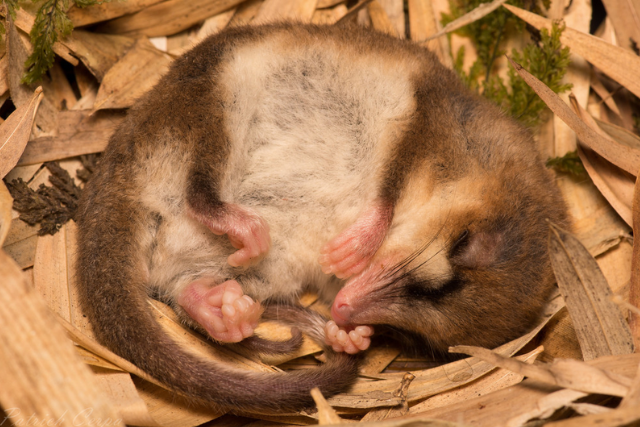
Source: iNaturalist – Southern monito del monte, Dromiciops gliroides(patrich)
Why a Small Body Loses Heat Quickly
Small mammals have a large surface area in relation to their body mass. This means that they tend to lose heat more quickly than larger animals.
Remaining warm and active through a cold, food-poor season can require a great deal of energy. Monitos del monte respond by adjusting their body temperature and metabolism rather than maintaining the same level of activity throughout the year.
This controlled reduction is called torpor. It is not ordinary sleep. During torpor, body temperature and metabolic activity fall, reducing the amount of energy required to stay alive.
Daily Torpor and Seasonal Hibernation
Torpor is a general term covering several patterns. Daily torpor may last for only part of a day. Longer and deeper bouts can continue for several days during an unfavourable season; this seasonal form is commonly described as hibernation.
Studies of Dromiciops gliroides have documented both short daily torpor and prolonged seasonal torpor. During an individual deep-torpor episode, metabolic rate can fall by about 96 per cent.
That figure describes an acute physiological change during torpor. It should not be confused with the amount of energy saved over an entire hibernation period.
In a separate 31-day winter study, hibernation was estimated to reduce energy expenditure by about 88 per cent compared with what active animals would have used. The animals were not simply “switched off”: they continued to use stored fat and some lean tissue, while periodic warming events remained part of the hibernation cycle.
Research comparing torpor between the two currently recognised species of Dromiciops remains limited. Findings from D. gliroides should not automatically be applied in exactly the same way to all populations or to D. bozinovici.
A Tail That Stores Energy
During seasons when food is available, monitos del monte can store energy as fat. The body and the base of the tail may consequently appear fuller before the colder months.
We should be cautious about diagnosing an individual animal’s condition from a photograph alone. Nevertheless, seasonal changes in body condition and tail fat are closely connected to the energy demands of winter.
シロフクロウ職員So a fuller-looking tail may be a reserve for a difficult season, rather than simply a change in appearance?
 タヌ山先生
タヌ山先生Exactly. Stored fat is not decorative. It is energy held in reserve when food is scarce and staying warm becomes expensive. Preparation matters. Some of us understand that instinctively.
メンフクロウ職員You mean the emergency biscuits in your desk drawer?
 タヌ山先生
タヌ山先生For the record, that is a carefully managed field provision. Entirely different category.
Torpor is not a passive way of waiting for winter to end. It is a flexible physiological strategy that helps a very small mammal manage changing balances between energy, food and temperature.
A Nest for Rest, Young and Winter
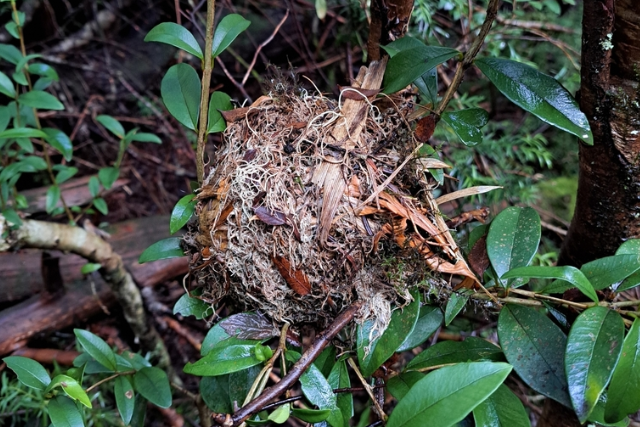
Source: iNaturalist – Southern monito del monte, Dromiciops gliroides(lucasoc)
Monitos del monte construct spherical or oval nests from plant material. Leaves from bamboo-like Chusquea are commonly used in the outer structure, while mosses, filmy ferns and other soft materials may be added inside.
Nests can be placed in tree cavities, decaying logs or dense understorey. Monitos del monte also use nest boxes installed by researchers, allowing aspects of their shelter use to be observed over time.
A nest is not simply a winter hibernaculum. It can provide a daytime refuge, a place for breeding and raising young, and protection from rain, wind and low temperatures.
Research using nest boxes has documented communal nesting. One four-year study of Dromiciops gliroides found that group use was more frequent in summer and early autumn, often involving females and young animals. In winter, torpor by solitary individuals and small groups was more frequent.
The cause of communal nesting should not be oversimplified. It may reflect social behaviour, age structure and family associations as well as the practical advantages of sharing shelter. One small nest can therefore serve several purposes: rest, concealment, reproduction, social contact and survival through an energetically difficult season.
How a Tiny Marsupial Moves Seeds
Fruit is an important seasonal food for monitos del monte. For plants, the movement of a fruit-eating animal creates an opportunity for seeds to travel away from the parent plant.
This process is called seed dispersal. After a monito del monte eats a fruit, some seeds can pass through its digestive tract and be deposited elsewhere as the animal moves through the forest.
Not every seed survives, germinates or grows into a mature plant. It must arrive in a suitable place and meet appropriate conditions. Even so, studies of Dromiciops gliroides show that it can disperse viable seeds from several forest plants.
The monito del monte does not eat fruit in order to plant a forest. Yet when feeding behaviour overlaps with a plant’s life cycle, its nightly routes can become part of the forest’s system of renewal.
A Remarkable Relationship with a Mistletoe
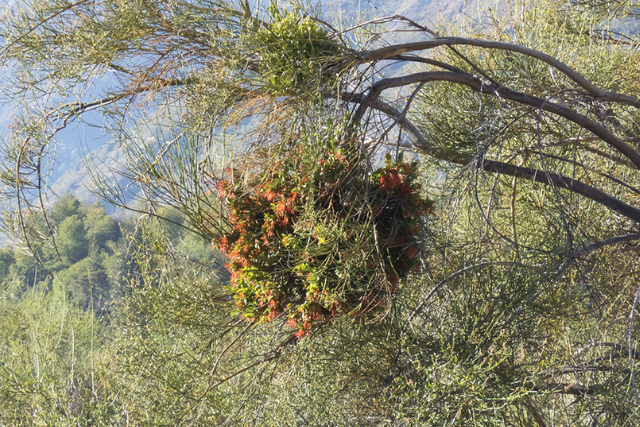
Source: iNaturalist – Tristerix corymbosus(ieremiel)
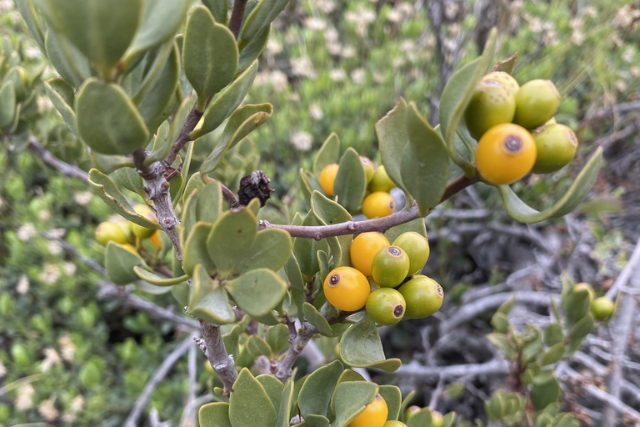
One memorable example involves Tristerix corymbosus, a South American mistletoe.
Mistletoes are parasitic plants that attach themselves to host plants. Tristerix corymbosus obtains water and mineral nutrients from its host but also produces energy through photosynthesis. It is therefore more precisely described as a hemiparasite.
Its seeds face a special problem. Falling onto ordinary soil may not be enough. To establish successfully, a seed needs to reach a suitable host branch.
Source: iNaturalist – Tristerix corymbosus(pau_miranda)
Dromiciops gliroides eats the fruits and moves through trees and shrubs. After the seeds pass through its digestive tract, some are deposited on branches or other suitable surfaces. Research indicates that the animal’s use of the forest overlaps with places where mistletoe seeds have an opportunity to establish.
The marsupial does not decide where a mistletoe should grow. The relationship arises from an overlap between the animal’s feeding and movement and the plant’s reproductive requirements.
When Forests Become Fragmented
Connected branches, shrubs and dense understorey provide routes for an animal that spends much of its active life above the ground. They also connect feeding sites, nests and places where seeds may be deposited.
For an arboreal mammal, a break in vegetation can mean more than a gap on a map: it can interrupt access to food, shelter and potential nest sites.
Roads, agricultural land, logging and other changes can divide habitat. Fragmentation may affect movement, shelter use, feeding and the ecological interactions that depend on an animal travelling through the forest.
A record showing that monitos del monte occur in a forest fragment does not necessarily tell us how many remain there or whether the population is stable. Presence, abundance and long-term population health are different questions.

One Order, One Family and One Genus—but Not One Species
Source: iNaturalist – Southern monito del monte, Dromiciops gliroides(eduardosilvar)
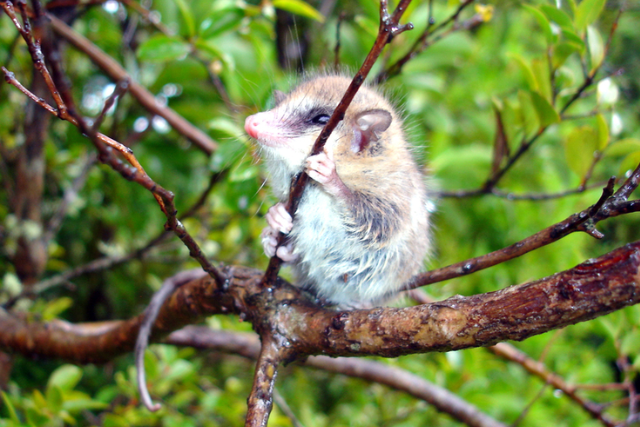
A monito del monte may resemble a rodent and carry the name “opossum”, but classification places it in a very different part of the mammal family tree.
Among living mammals, the order Microbiotheria contains one family, Microbiotheriidae. That family contains one living genus, Dromiciops.
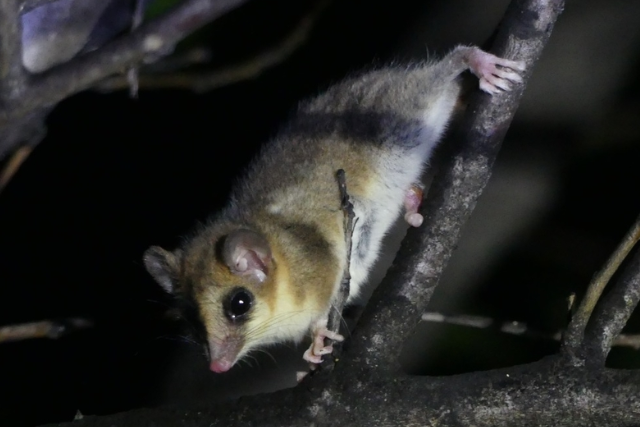
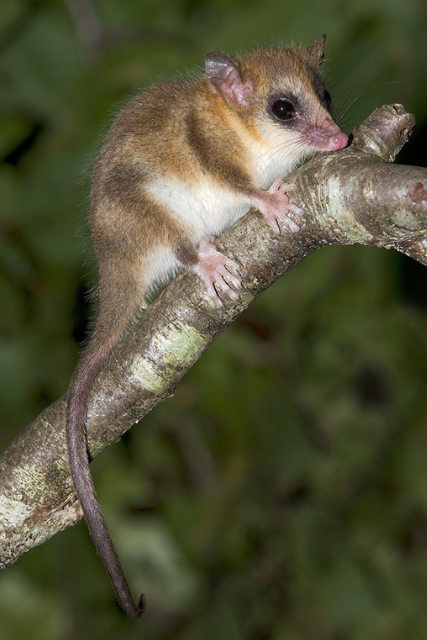
The story does not end there. The current Mammal Diversity Database recognises two living species within the genus.
| Taxonomic rank | Current treatment of living members |
|---|---|
| Order | Microbiotheria |
| Family | Microbiotheriidae |
| Genus | Dromiciops |
| Recognised living species | Dromiciops bozinovici and Dromiciops gliroides |
Source: iNaturalist – Dromiciops bozinovici(orlando_fuenzalida)
Source: iNaturalist – Southern monito del monte, Dromiciops gliroides(markc666)
It is therefore accurate to say that living Microbiotheria comprises one order, one family and one genus. Under the current treatment, it is not accurate to say that the family contains only one species.
 シロフクロウ職員
If there is only one living order, one family and one genus, why is it not a one-species group?
 ミミズク先生
Because the answer depends on how far down the classification we look. A single genus may contain several species. Here, the current evidence supports two living species within.
Descriptions such as “one family, one genus and one species” are useful for explaining a taxonomic arrangement, but they are not measures of an organism’s value or evolutionary success. The result may also differ if fossil taxa are included or a different classification is followed.
From One Species to Three—and Now Two
For many years, monitos del monte were commonly treated as a single living species, Dromiciops gliroides.
In 2016, researchers compared morphological and genetic evidence and proposed two additional species: D. bozinovici and D. mondaca. Under that arrangement, the genus contained three living species.
Further studies examined skull shape, geographical variation, DNA and samples collected across a wider part of the range. A genomic study published in 2022 supported a two-species model. In this arrangement, D. bozinovici is recognised as a separate species, while D. mondaca is included within D. gliroides.
The Mammal Diversity Database currently follows this two-species treatment. It also states that the systematics of Dromiciops remain “in considerable flux”. The present arrangement should therefore be described as the classification currently adopted by that database—not as an answer that can never change.
Why Taxonomy Changes
A taxonomic revision does not make earlier observations or specimens worthless. On the contrary, older material can become newly informative.
Preserved specimens can be measured again. Tissue samples can be analysed using newer techniques. Locality labels can reveal whether apparently different forms occupy separate or overlapping areas. Historical photographs and field records may help researchers reconstruct distributions that have since changed.
シロフクロウ職員Would DNA sequencing alone settle the matter?
タヌ山先生DNA sequencing is powerful evidence, not a magic stamp. We still compare specimens, morphology, geography, historical records and the sampling itself. A good classification is built from evidence that agrees—or from understanding exactly where it does not.
Taxonomy is not a process of attaching a permanent label and walking away. It is an investigation into how living populations differ, how they are related and which explanation best fits the available evidence.

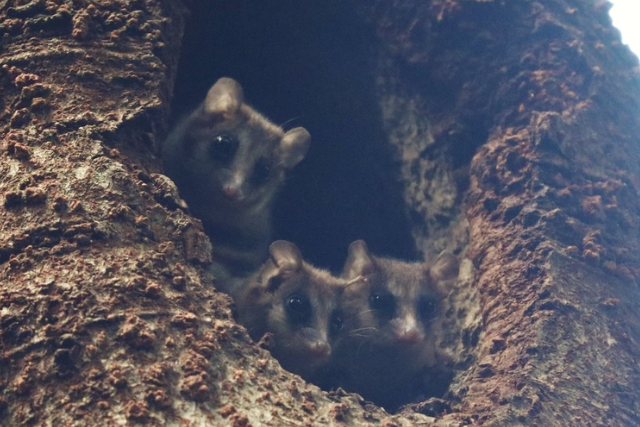
A South American Marsupial in a Wider Southern Story
Source: iNaturalist – チロエオポッサム Dromiciops gliroides(martinoli)
Related to Australian Marsupials—but Not Their Ancestor
Molecular phylogenetic studies place Dromiciops within Australidelphia, the large evolutionary grouping that also contains the living marsupials of Australia and New Guinea.
This relationship can sound surprising. Today, the monito del monte lives in South America, thousands of kilometres from kangaroos, koalas and wombats.
It does not mean that the monito del monte is their direct ancestor. Living species do not sit at the ends of a simple ladder in which one modern animal turns into another. Dromiciops and Australasian marsupials inherited parts of their biological history from a deeper common ancestor and then followed different evolutionary paths.
South America, Antarctica and Australia
To understand this geographical puzzle, we need to look beyond the modern arrangement of continents.
South America, Antarctica and Australia were once connected very differently. During earlier periods of Earth’s history, animals could disperse through southern land connections that no longer exist. Antarctica was not always the ice-covered barrier that it is today.
Fossils from South America and Antarctica, together with evidence from living marsupials, help researchers investigate when lineages separated and how they spread across the Southern Hemisphere. The exact timing and routes remain subjects of research, and the story should not be reduced to one effortless journey from one modern continent to another.
The survival of Dromiciops in South America preserves one living branch of this much wider evolutionary history.
Is the Monito del Monte a “Living Fossil”?
The monito del monte is sometimes called a “living fossil” because it belongs to a lineage with deep roots in the fossil record and has no other living genera in its order.
The phrase may draw attention to its long history, but it can also create the wrong impression. It does not mean that the animal has remained unchanged for millions of years or that evolution somehow passed it by.
Modern monitos del monte live in present-day forests. They cope with seasonal cold, use available foods, interact with other organisms and belong to populations that continue to change across generations.
ミミズク先生An old lineage is not an animal left behind by evolution. It has its own long history of change, survival and adaptation—and it is still making that history in the forest today.
What the Monito del Monte Reveals about a Forest
Source: iNaturalist – Southern monito del monte, Dromiciops gliroides(daniel_stange)
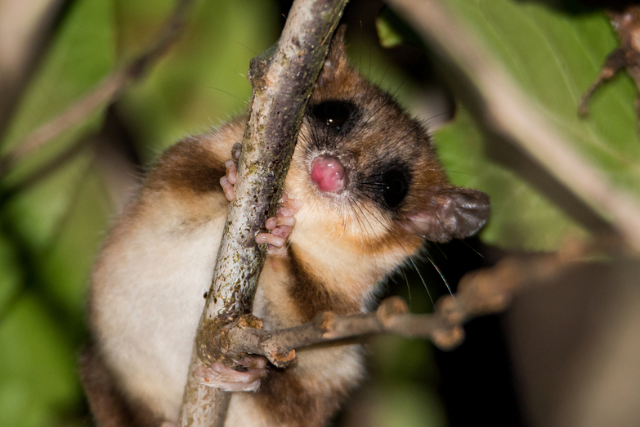
A monito del monte may first draw us in with rounded ears, dark eyes and a tiny body balanced on a branch. That first response matters. Curiosity often begins when we notice something appealing, unfamiliar or strange.
Close observation soon leads further. Its tail helps it move and stores energy for difficult seasons. Its nest supports rest, reproduction and shelter. Its use of torpor shows how a small mammal can adjust its energy expenditure. Its nightly feeding can move seeds through the forest.
Classification reveals another layer. Specimens, locality records, morphology and DNA have changed how scientists understand the boundaries within Dromiciops. Its evolutionary relationships then take us beyond the forests of Chile and Argentina, towards the deeper history shared by the southern continents.
The monito del monte does not need to stand alone as a single species to be extraordinary. Its ordinary acts of feeding, resting and moving through the forest already tell a remarkable story.
The next time an unfamiliar animal catches your eye, pause before searching for its name. Look at how it holds its body, what surrounds it and which details distinguish it from something more familiar.
 タヌ山先生
タヌ山先生Look closely enough, and one small animal can lead you into an entire forest—and a history far older than you might expect. That is why the details matter.
Explore More from the Museum of the Forest
ミミズク先生Please do explore the books from eco-life-planet as well. I hope they will offer you many more rewarding encounters with the living world.
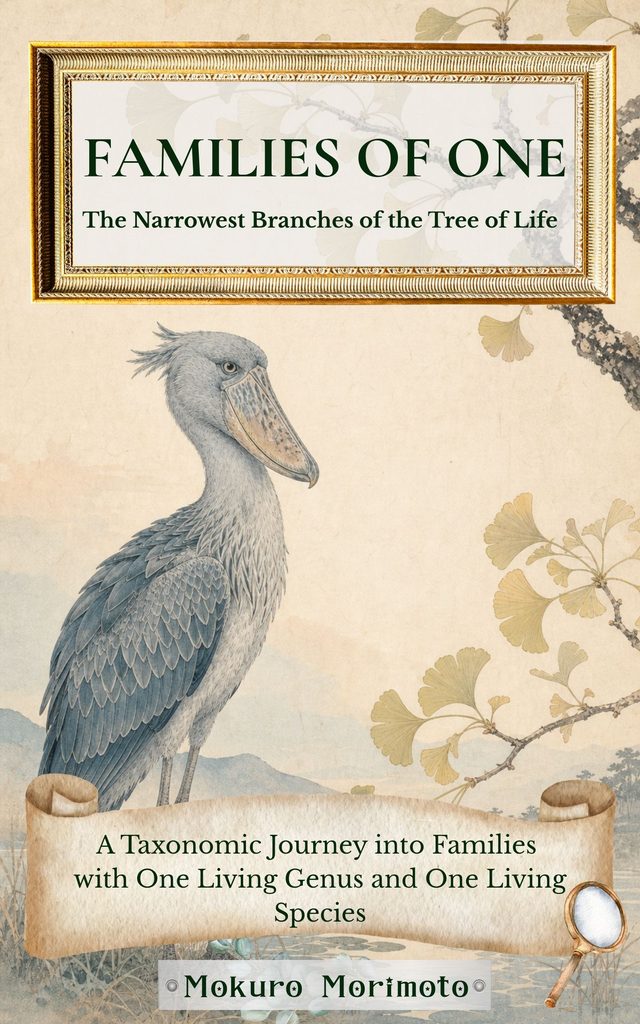
Kindle Books Currently Available in Japanese
The Japanese-language Museum of the Forest series includes expanded introductions to taxonomy, nature observation and unusual branches of the tree of life.
- An Introduction to Taxonomy: The Basic Science of Organising the World, Level 1 — Japanese-language edition
- Spring Nature Observation Handbook — Japanese-language edition
- Animals from Families of One: The Narrowest Branches of the Tree of Life — Japanese-language edition
The books include subjects and explanations that go beyond the material available in the blog articles.

References
Meet the Monito del Monte
- American Society of Mammalogists. Mammal Diversity Database: Dromiciops gliroides. Accessed September 2026.
- American Society of Mammalogists. Mammal Diversity Database: Dromiciops bozinovici. Accessed September 2026.
- Fontúrbel, F. E. et al. 2022. The ecology and evolution of the monito del monte, a relict species from the southern South America temperate forests. Ecology and Evolution 12: e8645.
Forest Habitat and Distribution
- American Society of Mammalogists. Mammal Diversity Database: Dromiciops gliroides. Accessed September 2026.
- American Society of Mammalogists. Mammal Diversity Database: Dromiciops bozinovici. Accessed September 2026.
- Nespolo, R. F. et al. 2026. The Southernmost Known Population of the Monito Del Monte, Dromiciops gliroides. Ecology and Evolution 16: e73227.
- Quintero-Galvis, J. F. et al. 2021. The biogeography of Dromiciops in southern South America: Middle Miocene transgressions, speciation and associations with Nothofagus. Molecular Phylogenetics and Evolution 163: 107234.
Torpor, Hibernation and Nesting
- Mejías, C. et al. 2022. Body Composition and Energy Savings by Hibernation: Lessons from the South American Marsupial Dromiciops gliroides. Physiological and Biochemical Zoology 95: 239–250.
- Nespolo, R. F. et al. 2021. Heterothermy as the Norm, Homeothermy as the Exception: Variable Torpor Patterns in the South American Marsupial Monito Del Monte (Dromiciops gliroides). Frontiers in Physiology 12: 682394.
- Nespolo, R. F. et al. 2024. Climate Change and Population Persistence in a Hibernating Marsupial. Proceedings of the Royal Society B 291: 20240266.
- Franco, M., Quijano, A. and Soto-Gamboa, M. 2011. Communal nesting, activity patterns, and population characteristics in the near-threatened monito del monte, Dromiciops gliroides. Journal of Mammalogy 92: 994–1004.
Seed Dispersal and Forest Relationships
- Amico, G. C., Rodríguez-Cabal, M. A. and Aizen, M. A. 2009. The potential key seed-dispersing role of the arboreal marsupial Dromiciops gliroides. Acta Oecologica 35: 8–13.
- Mora, J. P. and Soto-Gamboa, M. 2011. Legitimate seed dispersal of Ugni molinae by Dromiciops gliroides. Gayana Botánica 68: 107–110.
- di Virgilio, A., Amico, G. C. and Morales, J. M. 2014. Behavioral traits of the arboreal marsupial Dromiciops gliroides during the fruiting season of Tristerix corymbosus. Journal of Mammalogy 95: 1189–1198.
- Fontúrbel, F. E. et al. 2022. The ecology and evolution of the monito del monte, a relict species from the southern South America temperate forests. Ecology and Evolution 12: e8645.
Taxonomy and Evolution
- American Society of Mammalogists. Mammal Diversity Database: Dromiciops gliroides. Accessed September 2026.
- American Society of Mammalogists. Mammal Diversity Database: Dromiciops bozinovici. Accessed September 2026.
- D’Elía, G., Hurtado, N. and D’Anatro, A. 2016. Alpha taxonomy of Dromiciops (Microbiotheriidae) with the description of two new species of monito del monte. Journal of Mammalogy 97: 1136–1152.
- Quintero-Galvis, J. F. et al. 2021. The biogeography of Dromiciops in southern South America. Molecular Phylogenetics and Evolution 163: 107234.
- Quintero-Galvis, J. F. et al. 2022. Genomic diversity and demographic history of the Dromiciops genus: Implications for the systematics and conservation of the monito del monte. Molecular Phylogenetics and Evolution 168: 107405.
- Beck, R. M. D. et al. 2008. A dated phylogeny of marsupials using a molecular supermatrix and multiple fossil constraints. Journal of Mammalogy 89: 175–189.
コメント