


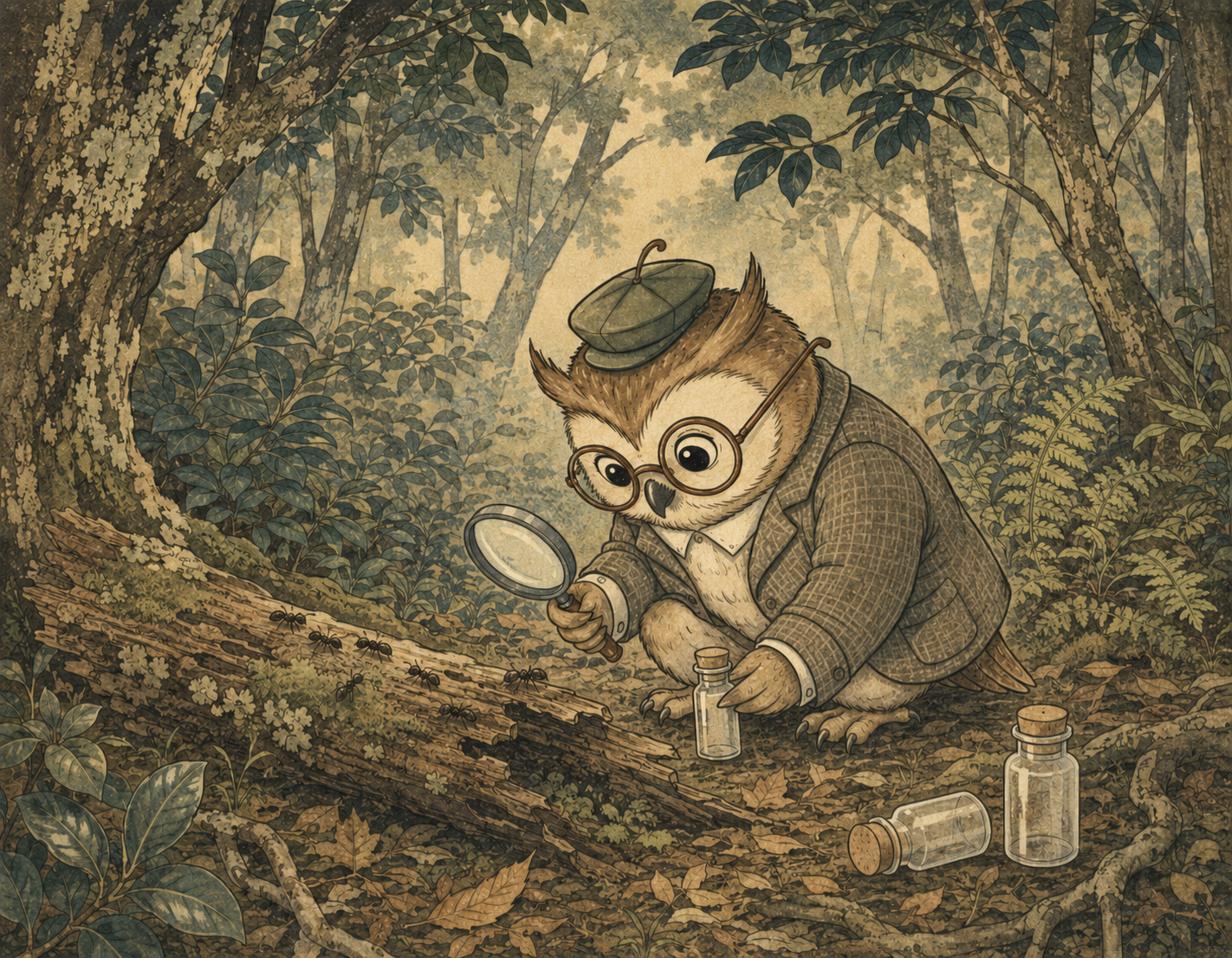
The shrubs beside a footpath and the grass at the edge of a park are full of living things that we may see without truly noticing. A tiny insect or an easily overlooked plant may have a scientific name, a particular way of life, and a history of observations that helps us understand where and when it occurs.
Finding an unfamiliar organism does not necessarily mean that you have discovered a species new to science. It does, however, begin with the same essential habits: pause, look closely, notice what is different, and compare what you have found with reliable information. That is where taxonomy begins.
You do not need to know every name at once. Start with one living thing. Observe its shape, colour, behaviour, season, and surroundings; then make a record of what you can see — including what remains uncertain. Small differences beneath our feet can change the way we see the whole living landscape.
 ミミズク先生
A forest may seem to be one sweep of green from a distance. Look more carefully, however, and it becomes a community of distinct lives — each with its own history, needs, and connections.
 メンフクロウ職員
Piano piano. Before you search for a name, notice where the creature is and what it is doing. Those small details often matter more than they first appear.

The Role of Taxonomy: Names, Records and Diversity

A woodland or park can seem to form a single scene: trees, grasses, insects and birds, all part of the same familiar view. Pause and look more closely, however, and differences begin to appear. Leaves have different shapes and arrangements. Insects differ in their antennae, wings and ways of moving. Some organisms live only in particular places or appear only at certain times of year.
Taxonomy helps us notice, describe and share these differences. It is the science of naming, describing and classifying organisms. It also provides a framework for comparing observations and asking how living things are related.
Learning taxonomy does not turn nature into a simple list. Quite the opposite: it helps us notice details we had missed, recognise questions we cannot yet answer, and understand how much there is still to discover.
In this section, we will explore the role of taxonomy, the different purposes of scientific and local names, and how to make a useful record when an identification remains uncertain.
ミミズク先生Knowledge does not merely fill empty spaces. Quite often, it shows us where the empty spaces are.
Differences and connections
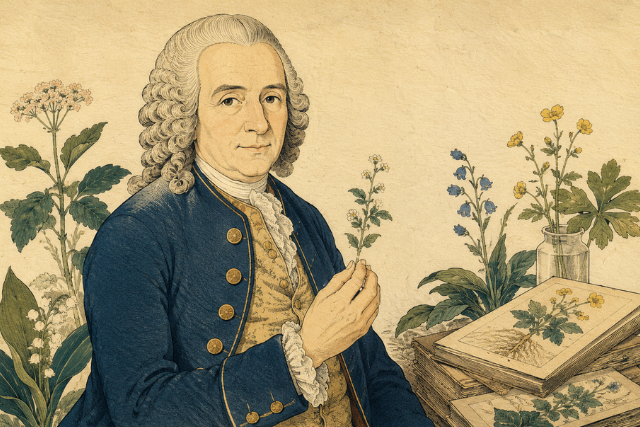
Illustration created with ChatGPT
Taxonomy is not simply a way of placing organisms into convenient groups. It is a science of careful comparison. Taxonomists study features such as form, structure, behaviour, habitat, development and geographical distribution in order to understand how organisms differ and how they may be related.
For observations to be useful beyond one person’s notebook, they need to be recorded in ways that other people can understand and check. A name becomes especially valuable when it is linked to supporting information: a photograph or specimen, the place and date of observation, and notes about the organism and its surroundings.
The eighteenth-century Swedish naturalist Carl Linnaeus made an important contribution to the foundations of modern biological naming. He arranged organisms in a hierarchy and helped establish the consistent use of two-part names for species. Such a name combines a genus name and a specific epithet. For example, the scientific name for our own species is Homo sapiens.
Linnaeus worked before evolutionary theory transformed biology, so he did not create modern evolutionary classification. Today, taxonomists draw on many kinds of evidence, including morphology, anatomy, behaviour, ecology, fossils, geographical distribution and DNA. They use this evidence to develop and test explanations for both biological differences and evolutionary relationships.
 タヌ山先生
タヌ山先生“They look alike” is a useful first observation — but it is never the final answer. Compare several features, check the habitat, and ask what the evidence actually supports.
Once we begin to look in this way, an ordinary walk changes. Leaves that first seemed identical may differ in their margins, veins or arrangement on the stem. Two similar beetles may belong to different groups, while two organisms that look quite unlike one another may share a deeper evolutionary history.
Taxonomy does not make nature tidier than it really is. It gives us better tools for recognising its real complexity.
Scientific names and local names
Living things may be known by more than one name. There are local or traditional names, everyday common names, names used in field guides, and scientific names.
Local names can carry valuable knowledge about a place. They may reflect seasonal changes, food traditions, livelihoods, folklore, or long familiarity with an organism. A single species may have several local names, while the same local name may refer to different organisms in different regions.
Scientific names serve another purpose. They help people working in different languages and places determine whether their observations, specimens and publications concern the same kind of organism. They do not make taxonomic questions disappear: classifications and accepted names can change when new evidence is examined. They do, however, provide shared conventions for tracking names and discussing those changes clearly.
For most species of animals, plants, algae and fungi, the scientific name has two parts: the genus name followed by the specific epithet. The genus begins with a capital letter, the specific epithet with a lower-case letter, and both are normally italicised. For example: Homo sapiens.
| Subject | How names are used | Example |
|---|---|---|
| Animals | Species normally have a two-part scientific name governed by the International Code of Zoological Nomenclature | Homo sapiens |
| Plants, algae and fungi | Species generally have two-part scientific names governed by the International Code of Nomenclature for algae, fungi, and plants | Quercus robur |
| Minerals | Mineral species have approved formal names based on features including chemical composition and crystal structure; they do not use biological scientific names | quartz |
| Rocks | Rocks are aggregates of minerals or other materials and are classified by features such as origin, composition and texture rather than as biological species | granite; basalt |
The naming rules for plants, algae and fungi are now set out in the Madrid Code, the current edition of the International Code of Nomenclature for algae, fungi, and plants. Published in 2025, it replaced the Shenzhen Code of 2018.
Minerals and rocks are included here because they often appear alongside living things in natural-history displays and field observations. Minerals are not organisms, but mineral species are formally named and assessed through mineralogical practice. Rocks are usually made of one or more minerals and are classified according to characteristics such as how they formed, what they contain, and their texture.
 シロフクロウ職員
So a scientific name helps people compare records across borders, while a local name may tell us how a community has lived alongside that organism. Neither kind of name replaces the other.
The International Code of Zoological Nomenclature
The International Code of Zoological Nomenclature, often referred to simply as the Code, sets out internationally agreed rules for establishing and using scientific names for animals.
Its purpose is to promote stability and clarity in zoological names. It sets conditions for a newly proposed name to become available, and it includes rules for deciding which name generally has precedence when more than one available name applies to the same taxon.
The Code also recognises the principle of binominal nomenclature: an animal species name is a combination of two names, the first a genus name and the second a specific name. The two-part form used for Homo sapiens is one familiar example.
The Code does not decide whether a population is a separate species or which genus it belongs to. Those are taxonomic judgements based on research. Scientists examine evidence from specimens, morphology, genetics, ecology, behaviour and distribution, then test whether a proposed classification is the best explanation of the available evidence.
タヌ山先生The Code tells us how names should be used. It cannot do the comparison for us. For that, you need evidence — specimens, observations, data, and a willingness to revise your first idea.
When identification is uncertain
Identification is the process of determining what kind of organism an observation, photograph or specimen represents and, where possible, assigning it to a recognised group or species. It may involve comparing what you found with field guides, identification keys, verified photographs, museum specimens, reliable databases or scientific publications.
In nature observation, it is perfectly normal not to know a species name straight away. Females and males can look different. Young organisms may look unlike adults. Seasonal forms and individual variation can be confusing, and closely related species may be difficult to distinguish from one photograph.
If the available evidence does not support a species-level identification, record what you can say with confidence. For example:
- “A beetle; family and species uncertain”
- “Probably a member of this plant family”
- “Similar to Species A, but the photograph does not show the feature needed for confirmation”
- “Identified to genus only”
For example, Bombus sp. means that the observation has been identified as belonging to the bumblebee genus Bombus, but that the species is not yet known. Use this kind of notation only when you are reasonably confident about the genus.
A record does not become useless because its species name is unknown. A photograph, date, location, habitat note and careful description may allow someone to identify it later — or may help you return with better questions next season. By contrast, an unsupported species name can mislead later readers and weaken the value of the record.
Uncertainty can arise for several reasons. An organism may resemble another species, a photograph may not show the necessary features, or the available evidence may be incomplete. In other cases, researchers may disagree about classification, or an accepted name may change as taxonomic and nomenclatural work continues. Good records make these uncertainties visible rather than hiding them.
メンフクロウ職員“Unknown beetle, found beneath oak bark in May” is an honest beginning. Keep the photograph and the details together, and someone may be able to take the record further later on.
Once we understand why names and records matter, a park or woodland becomes more than a pleasant backdrop. It becomes a place where differences can be observed, questions can be asked, and evidence can be gathered.
 ミミズク先生
Next, we will look at how taxonomists observe, compare and test those observations in practice.
How Taxonomists Think: Observation, Comparison and Verification
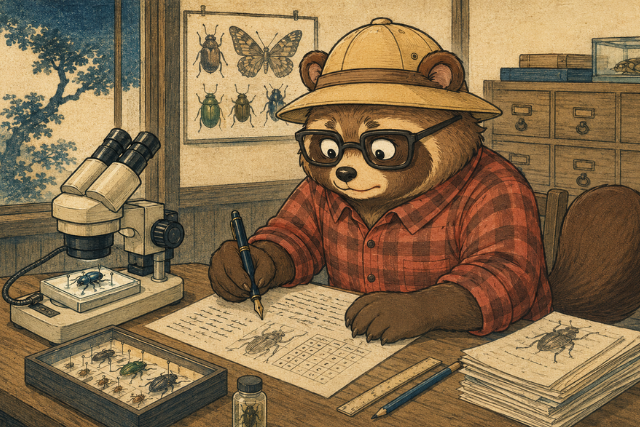
In taxonomy, the aim is not simply to guess an organism’s name as quickly as possible. What matters is what we observe, what we compare it with, and what evidence supports the conclusion.
When two organisms look alike, a first impression can be useful — but it is only a starting point. Taxonomists compare visible features, consult specimens and published research, and reconsider earlier ideas when new evidence becomes available.
This repeated process of observation, comparison and revision helps us investigate both the differences among organisms and their evolutionary relationships.
In this section, we will look at three habits of taxonomic thinking:
- Choosing features to observe
- Choosing a basis for classification
- Revising classifications in the light of evidence
シロフクロウ職員So taxonomy is not a contest to find the quickest label. It is a way of building an explanation that someone else can check.
1. Choosing Features to Observe
Classification begins by breaking down the impression that two organisms “look similar” into features that can be described and compared.
For plants, useful features may include the shape and arrangement of leaves, the structure of flowers and fruits, and the presence of hairs, spines or other surface features. For insects, taxonomists may look at the antennae, legs, wings, mouthparts and overall body form.
The wider setting can also matter. Habitat, season, behaviour, and associated organisms — such as the plant on which an insect was feeding — may all help with identification. These clues are usually most useful when considered alongside physical features, rather than on their own.
A striking similarity does not necessarily mean that two organisms are close relatives.
Birds and bats both use wings for powered flight, but powered flight evolved independently in their respective lineages. As flight structures, their wings are therefore analogous: they perform a similar function, but their adaptations for flight did not arise in a single winged common ancestor.
Look beneath this similarity, however, and a different relationship appears. A bird’s wing, a bat’s wing and a human arm are all modified vertebrate forelimbs inherited from a common ancestor. As forelimbs, they are homologous, even though they now have very different shapes and functions.
| Comparison | What it shows |
|---|---|
| Bird wing and bat wing as organs of flight | Analogy: similar function, evolved independently |
| Bird wing, bat wing and human arm as forelimbs | Homology: shared underlying origin from a common ancestor |
The same structures can therefore tell different stories, depending on the question being asked. This is why taxonomists rarely rely on a single feature. They compare several features and ask what each similarity or difference may mean.
タヌ山先生Similarity is evidence, but it still needs interpretation. Ask whether a feature was inherited from a common ancestor or evolved independently in response to a similar challenge.
2. Choosing a Basis for Classification
There is more than one way to divide organisms into groups. We could sort them by whether they fly, have a backbone, produce flowers, or belong to animals, plants or fungi. The usefulness of a grouping depends on the question we are asking.
A grouping based on flight may help us compare movement. A grouping based on habitat may be useful in an ecological survey. Neither, by itself, necessarily shows evolutionary relationships.
Modern biological classification aims, as far as the evidence allows, to reflect how lineages have descended and diverged from common ancestors. Bats and whales live in very different environments and move in very different ways, but both belong to the mammalian lineage.
Try It Yourself: How Would You Group Them?
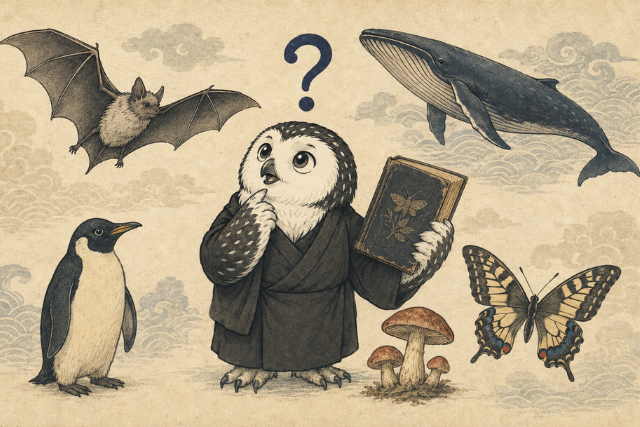
Divide the following into two or three groups:
A bat, a whale, a penguin, a butterfly and a mushroom.
You might start with one of these questions:
| Question | One possible grouping |
|---|---|
| Is it an animal or a fungus? | Animals: bat, whale, penguin and butterfly. Fungus: mushroom |
| Does it have a backbone? | Vertebrates: bat, whale and penguin. Invertebrate: butterfly. Fungus: mushroom |
| Can it fly? | Flying: bat and butterfly. Not flying: whale, penguin and mushroom |
The mushroom is the visible fruiting body produced by a fungus, rather than the whole organism. For this simple activity, however, it serves as a familiar representative of kingdom Fungi.
The final grouping also reveals a limitation of the question: asking whether a mushroom can fly tells us very little about fungi. A criterion may be easy to apply without being equally informative for everything being compared.
Different questions produce different groupings. One organism may have several relevant features, and no single criterion will work neatly for every purpose.
The aim is not to discover one magically correct arrangement. Choose a feature, explain why you selected it, and consider what your grouping does — and does not — tell you.
メンフクロウ職員If we sort by flight, the bat and butterfly belong together. If we sort by backbones, the bat joins the whale and penguin instead. The organisms have not changed; the grouping has changed because we asked a different question.
Grouping bats and butterflies together is useful when comparing flight, but it does not mean that they are close evolutionary relatives. Likewise, a penguin remains a bird even though it does not fly. “Being a bird” and “being able to fly” describe different kinds of information.
The German zoologist and entomologist Willi Hennig played a major role in developing phylogenetic systematics, often called cladistics. This approach aims to reconstruct evolutionary relationships by examining features inherited through common ancestry.
In phylogenetic systematics, particular attention is given to shared derived characters: features that appeared in the common ancestor of a group and were inherited by its descendants. These features are also called synapomorphies. They provide evidence for identifying branches in evolutionary history and for recognising monophyletic groups — a common ancestor together with all of its descendants.
ミミズク先生A classification is most useful when it tells us not only where an organism has been placed, but why.
3. Revising Classifications in the Light of Evidence
Classification is not a fixed list that must remain unchanged once published. It is an evidence-based explanation of evolutionary relationships, and explanations can improve.
Researchers may compare external form, internal anatomy, development, fossils, ecology, geographical distribution, DNA sequences and whole genomes. Each kind of evidence can reveal something different about the history of life.
DNA analysis has greatly improved our ability to investigate relationships that outward appearance alone may not reveal. It can help distinguish lineages that look very similar or reveal close relationships between organisms that look very different.
DNA does not, however, classify organisms automatically. Results can depend on which organisms and genetic regions were sampled, the quality of the data, and the methods used to analyse it. Different parts of a genome may also preserve different histories. For this reason, researchers interpret molecular results alongside evidence from specimens, morphology, ecology, distribution and other sources.
メンフクロウ職員A sequence in a database does not replace the specimen from which it came. We still need to know what was sampled, where it was found, and whether its identification can be checked.
The classification of flowering plants provides a useful example. The Angiosperm Phylogeny Group, usually known as APG, has developed a classification framework for angiosperms — the flowering plants — that aims to reflect their evolutionary relationships.
The first APG classification was published in 1998. Later editions incorporated growing amounts of molecular and other evidence. APG IV, published in 2016, remains the latest published version of the APG classification at the time of writing. It recognises 64 orders and 416 families of flowering plants.
A Note on the APG System
APG stands for Angiosperm Phylogeny Group. The APG system focuses on the orders and families of flowering plants and aims to arrange them in ways that reflect shared ancestry.
It is not a set of rules for creating plant names. Those rules are provided by the International Code of Nomenclature for algae, fungi, and plants, currently the Madrid Code. APG instead addresses a different question: how should flowering-plant groups be classified in the light of evidence about evolutionary relationships?
The APG system seeks to recognise monophyletic groups wherever possible. This helps avoid classifications based only on superficial similarity, which can sometimes unite organisms that developed similar features independently.
APG is not a classification of every plant lineage. It deals specifically with angiosperms, not mosses, liverworts, ferns, conifers, or other non-flowering plant groups.
シロフクロウ職員So the Madrid Code governs how names are established and used, while APG IV presents a classification of flowering-plant relationships. Similar territory, but different jobs.
A change in classification does not mean that earlier research was worthless. Earlier systems were based on the evidence and methods available at the time. Revisions are part of science: new observations and methods allow existing explanations to be tested, refined, and sometimes replaced.
Taxonomy depends on looking carefully, comparing evidence, and remaining willing to revise an explanation. Next, we will bring these habits into a park, garden, or familiar walking route and explore how to begin observing and recording nature for ourselves.
Starting Taxonomy Close to Home
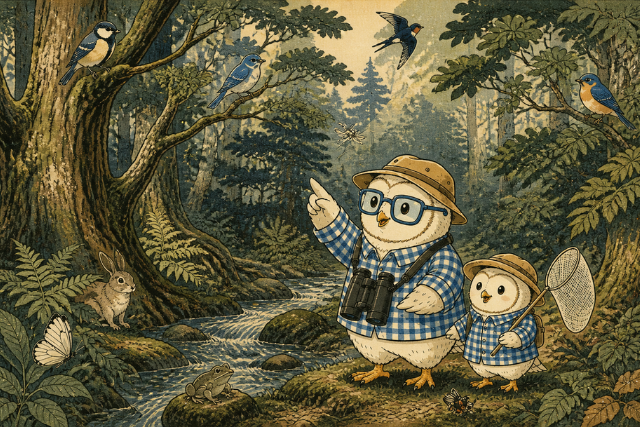
Taxonomy does not begin only in laboratories or museum collections. It can begin on the way to work or school, in a garden, or beside a park hedge — wherever we pause to ask, “What is this?” or “How is it different from the organism beside it?”
You do not need specialist equipment or extensive knowledge to begin. A date, a location, a photograph, and a few notes about what you noticed can provide evidence that you — or someone else — may examine later.
The immediate goal is not to produce a species name at any cost. It is to make an honest, useful record of what you observed.
ミミズク先生A name is helpful, certainly. But a careful observation comes first. That is how a passing encounter becomes a question that can be revisited.
The Basics of an Observation Record
When recording an organism, preserve more than its possible name. A useful observation tells us who observed what, where, and when.
Photographs are valuable, but written notes can capture details that an image may miss: approximate size, colour, shape, movement, behaviour, and the surrounding habitat. These details make it easier to compare an observation with field guides, museum specimens, and other records later.
Try to photograph both the whole organism and any visible features that might help with identification.
| If you find… | Useful photographs or notes |
|---|---|
| A plant | The whole plant; leaves from above and below; their arrangement on the stem; flowers, fruits or seeds; bark or stem where relevant |
| An insect | A full view from above; a side view where possible; the head and antennae; legs, wings and visible markings |
| A fungus | The whole fruiting body; its underside; how it grows on soil, wood or another surface; the nearby plants or material on which it is growing |
| Any organism | Its surroundings, approximate scale where possible, the date and place, and what it was doing |
Do not move an organism, damage a plant, or disturb a shelter simply to obtain a better photograph. Record what you can safely and responsibly. An incomplete but ethical observation is better than a detailed photograph obtained by harming an organism or its habitat.
メンフクロウ職員A photograph of the surrounding bark, soil, leaf litter, or plant can sometimes tell us more about an organism’s life than a forced close-up ever could.
Seven Things to Record
A simple observation note can include the following:
- Observer and date — Who made the observation, and when?
- Location — Where was the organism found? Record the place as precisely as is appropriate and safe.
- Identification, if known — Record a species, genus, family, or broader group only as far as the evidence supports.
- Appearance — Note approximate size, shape, colour, pattern, and visible structures.
- Behaviour or condition — What was it doing when you found it? Feeding, resting, flying, growing, or sheltering?
- Habitat and photographs — Describe the surroundings and, where possible, photograph both the organism and useful details.
- Remaining questions — What could you not determine, and what would you like to check next time?
If the name is unknown, describe what you can see: “possibly a beetle”, “a low-growing plant with white flowers”, or “an insect with long antennae found beneath loose bark”.
A record does not need to reach species level to be useful. Its photographs, date, location, habitat, and observed features may later make identification or comparison possible.
シロフクロウ職員A blank species name is not the same as an empty record. If the evidence is there, the identification may be added or revised later.
Using Field Guides, AI and Museum Collections
Field guides, identification keys, image searches, identification apps, AI tools, and museum resources can all help us investigate an observation. None should be treated as an unquestionable source of a final answer.
Use them first to generate possibilities:
- Could it belong to this family?
- Does this species occur in the region?
- Is it usually visible at this time of year?
- Does the size, habitat, or behaviour fit?
- Do the important features match?
- Are there similar species that must be ruled out?
Computer-vision tools can be very helpful for narrowing down possibilities, but their suggestions depend on the photographs and identifications used to train the model. Some groups and regions are better represented than others. A model may struggle when closely related species look alike, when an uncommon species has little available data, or when the photograph does not show the feature needed for a distinction.
iNaturalist explains that its computer-vision suggestions tend to perform better in places with many observations and active users. Some species may not be represented among its suggestions at all.
タヌ山先生Treat an AI suggestion as a hypothesis, not a verdict. Check whether the distribution, season, and visible features agree with what you observed.
Museum specimens and collection databases provide another kind of evidence. A specimen can preserve physical features for later study, together with information such as where and when it was collected. Collections therefore help researchers investigate form, past distributions, and changes in classification.
The National Museum of Nature and Science in Tokyo provides a searchable Collection Database of Specimens and Materials. It allows users to search information on specimens and other materials held by the Museum. As with most museum databases, however, online records represent only part of the material and information held by an institution.
Following a Taxonomic Address
When researchers work with specimens, observations, or biodiversity records, they often consult taxonomic catalogues. These are not simply picture guides in which an everyday name produces an instant answer. Instead, they arrange organisms in nested groups at different taxonomic ranks.
A species name forms one part of an organism’s taxonomic address. By following that address upwards — from species to genus, family, order, and beyond — we can see how a source places the organism within the wider living world.
メンフクロウ職員When I prepare Japanese beetle specimens for the collection, I often consult the Catalogue of Japanese Beetles. It is indispensable for checking Japanese names, distributions, and the classification adopted by the catalogue, although most of its explanations are in Japanese.
For readers working in English, the Catalogue of Life is a more practical place to begin. It is a global catalogue, rather than a photo-identification guide, and brings together information from specialist taxonomic datasets. You can search for a scientific name, use a known common name where available, or browse a classification tree from broad groups towards individual species.
A scientific name is often easier to search than a common name. Common names vary between regions and languages, whereas the same scientific name can usually be checked across international catalogues. If a field guide or AI tool suggests a name, use a catalogue to ask two useful questions:
- Is this name currently accepted in this source?
- Where does this organism sit within the classification?
タヌ山先生If you have a scientific name, start there. Catalogue of Life helps you trace the classification. Then use another source to check the details that matter for your observation.
An Example: Stag Beetles and Rhinoceros Beetles
An Example: Stag Beetles and Rhinoceros Beetles
Stag beetles and rhinoceros beetles provide a useful example of a taxonomic address.
Both groups are beetles, so they belong to the order Coleoptera. Within that order, both are placed in the superfamily Scarabaeoidea. Their addresses remain the same up to this point, but they then separate into different families.
| Familiar group | Simplified taxonomic address |
|---|---|
| Stag beetles | Animalia → Arthropoda → Insecta → Coleoptera → Scarabaeoidea → Lucanidae |
| Rhinoceros beetles | Animalia → Arthropoda → Insecta → Coleoptera → Scarabaeoidea → Scarabaeidae → Dynastinae |
Read the addresses from left to right: the groups become more specific at each step. Both begin in the animal kingdom, Animalia, then pass through the arthropods, insects, beetles, and Scarabaeoidea.
The important difference appears at the family level:
- Stag beetles belong to the family Lucanidae.
- Rhinoceros beetles belong to the family Scarabaeidae. Within that family, they are placed in the subfamily Dynastinae.
This is why the rhinoceros-beetle address extends one step further in the table. Dynastinae is a subfamily within Scarabaeidae, not a separate family.
The Japanese rhinoceros beetle, Trypoxylus dichotomus, provides a species-level example. Its current GBIF taxon page places it within the family Scarabaeidae and the subfamily Dynastinae.
シロフクロウ職員Stag beetles and rhinoceros beetles share the first part of their address, but they take different paths at the family level.
Large jaws and horns make these beetles memorable, but “beetles with impressive jaws or horns” is not a formal taxonomic group. Classification is based on evidence about many characteristics and evolutionary relationships, not simply on the most conspicuous feature.
Different catalogues and research publications may sometimes adopt different arrangements, particularly when new evidence changes our understanding of a group. A catalogue entry should therefore be read as the classification adopted by a particular source and version — not as the final word on every taxonomic question.
ミミズク先生A taxonomic address is not carved permanently in stone. It is a summary of present understanding, and present understanding can change.
From Names to Records
Once you have found a name and its place in a classification, other resources can extend the investigation. GBIF connects scientific names with occurrence records from museum specimens, surveys, and biodiversity-observation datasets.
GBIF.org uses the Catalogue of Life Extended Release, or COL XR, as its default taxonomic framework for organising these records. This framework helps GBIF connect names used by many different data sources. Like any large management classification, however, it should not be treated as a replacement for specialist catalogues, taxonomic revisions, or the scientific literature on a particular group.
In simple terms:
| Resource | A useful question it can help you ask |
|---|---|
| Catalogue of Life | “What name is accepted here, and where is it placed in the classification?” |
| GBIF | “Where and when has this name been recorded in shared biodiversity data?” |
| A regional checklist or museum database | “Which names and records are relevant to this particular place or collection?” |
Following a hierarchy may initially feel slower than entering a familiar word into a search box. It gives the name context, however: the name becomes part of a map of related organisms rather than an isolated fact.
メンフクロウ職員Once you know the address, you can keep the name, photograph, specimen, and record in the right place. That makes the information useful to the next person as well.
Questions That Grow from One Name
Identifying an organism does not bring observation to an end. A name allows us to ask more focused questions:
- What does it eat?
- Which season is it active or visible in?
- Where does it live?
- How does it survive the winter or dry season?
- Which related species resemble it?
- Has its distribution changed over time?
Identifying a butterfly, for example, may lead us to investigate the plants used by its larvae, the flowers visited by adults, its overwintering stage, and differences in its geographical distribution. One species can become an entry point into ecology, evolution, seasonal change, and the environmental history of a place.
ミミズク先生A name is not the end of an enquiry. It is a handle by which we can lift a much larger set of questions.
Everyday taxonomy is not measured by how many scientific names we can memorise. It begins with looking closely at one organism, preserving what we observed, and allowing one question to lead to another.
Next, we will look at how labels, record numbers, and simple organisation can carry an observation beyond the day on which it was made.
Labels and Organisation: Keeping Records for the Future
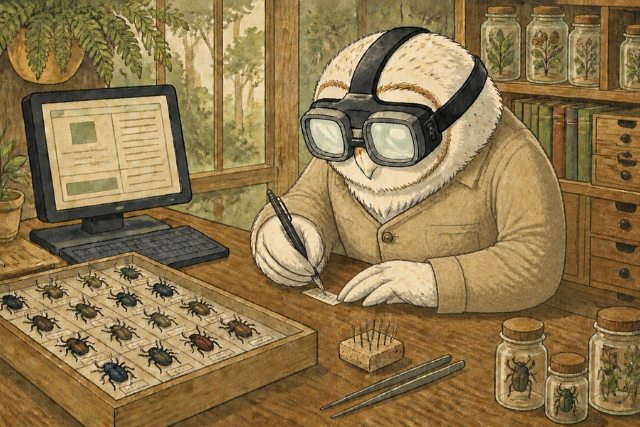
A photograph or specimen preserves part of an organism’s appearance. Without information about when, where, and by whom it was recorded, however, it becomes much harder to check the observation or compare it with other records.
A specimen can carry this information on a label. A digital photograph needs to remain connected to an observation note, record number, or database entry. Even when the organism has not yet been identified, evidence about the encounter may make later identification and comparison possible.
This section introduces the basics of specimen labels, observation records, and simple organisation.
シロフクロウ職員A record is not only a picture or a name. It is a trail that lets another person understand what happened, where it happened, and when.
Labels and Provenance
A natural-history specimen label is not merely a name tag. It records the specimen’s provenance: where, when, by whom, and, where relevant, how it was collected.
The accepted name or classification of an organism may change as research develops. The collection event itself is part of the past, and the original information documenting it should be preserved. Locality, date, and collector information can later be clarified or supplemented, but such changes should form part of the record’s history.
An unidentified specimen with reliable provenance may therefore remain useful. By contrast, a specimen with a name but no locality or date has lost much of its potential value.
Digital photographs do not carry physical labels, but the same principle applies. Use a record number, file name, observation notebook, spreadsheet, or database entry to keep each image connected to its date, place, and supporting notes.
ミミズク先生A name tells us what someone thought a specimen was. Its provenance tells us where the specimen came from. The first may change; the second must be preserved.
Essential Information for a Label or Photo Record
For a specimen, the most fundamental information usually includes the collection locality, date, and collector. For a photographic observation, “collector” can be replaced by observer or photographer.
Record these details even if you do not know the organism’s name.
| Information | What to record |
|---|---|
| Place | Country, state, province, prefecture, or other administrative area; municipality; and a more precise locality where appropriate |
| Date | The date on which the organism was observed, photographed, or collected |
| Recorder | Collector, observer, or photographer |
| Organism | A species name, or the broadest identification supported by the evidence, such as “a species of Lucanidae” or “unidentified flowering plant” |
| Surroundings | Woodland, riverbank, garden, wetland, beneath bark, or another description of where the organism was found |
| Additional notes | Behaviour, weather, associated plants, collection or observation method, and other details that may help someone interpret the record |
Coordinates and elevation can also be valuable, particularly when you may need to revisit a site or compare records across a landscape. Record locations as precisely as is appropriate for your own notes, while considering later whether every detail should be made public.
For plants and insects, it can be helpful to record the plant on which an organism was found. Do not call it a host plant unless there is evidence that the organism feeds, develops, or lives in association with it.
メンフクロウ職員“Found on oak” records what we observed. “Oak is its host plant” makes a biological claim. A small difference in wording can make a large difference in meaning.
Recording Dates Clearly
Dates written only as numbers can be ambiguous. For example, 1 11 1991 could be read as 1 November or 11 January, depending on the convention used by the reader.
For spreadsheets, databases, and digital photo records, the form 2026-08-29 clearly presents the year, month, and day. It follows ISO 8601 ordering and avoids many differences between regional date conventions.
Darwin Core — the biodiversity-data standard used to exchange information through systems including GBIF — recommends values conforming to ISO 8601-1:2019 for its eventDate field. This field can record a date, date and time, or a time interval during which an observation or collection event occurred.
Some entomologists use a Roman numeral for the month on handwritten labels, as in 29 VIII 2026. This is not ISO 8601, but it clearly distinguishes the month from the day and remains familiar in some specimen collections.
タヌ山先生In my laboratory, you may see 29 VIII 2026 on a handwritten insect label. In a spreadsheet, I would use 2026-08-29. The important point is that another person can interpret the date correctly.
A simple record might look like this:
JAPAN: Fukuoka Prefecture, Fukuoka City, Hakosaki,
29 VIII 2026
Observer: T. Tanuyama
Park woodland edge; beneath loose bark
Unidentified beetle
Record no. TT-2026-041
For a digital record, the same information can be entered into separate fields rather than placed in one block of text.
Protecting Sensitive Locations
Precise locality information can be valuable for research, but publishing it may place some organisms at risk. Rare species, commercially collected organisms, and species vulnerable to disturbance may require special care.
Keep the most accurate location in a secure original record where appropriate. When sharing an observation publicly, you might:
- Report only a broader locality
- Replace exact coordinates with a generalised location
- Withhold coordinates from the public version
- Share detailed information only with an appropriate museum, researcher, or conservation body
Simply deleting decimal places is not always enough to protect a site. If coordinates are generalised, the published record should also indicate the area of uncertainty and explain that the location has been altered or withheld. GBIF’s guidance stresses that both the generalised coordinates and their uncertainty should be documented so that later users understand the limits of the data.
シロフクロウ職員Accuracy and openness are both valuable, but they are not always the same thing. We can preserve the precise location without publishing it to everyone.
The appropriate level of detail depends on the species, place, and purpose of the record. Follow any rules used by the observation platform, land manager, museum, or conservation authority involved.
Separating Collection Data from Identification
In natural-history collections, information about the collection event is often kept separate from the identification.
A collection-data label, sometimes called a locality or field label, records facts associated with the collecting event, such as:
- Locality
- Date
- Collector
- Collection method or field number
A separate determination label records the taxonomic identification, usually including:
- The taxon name
- The person who made the identification
- The date or year of determination
This separation matters because identifications can change. If a specimen is reidentified, preserve the original collecting label and add a new determination label or note according to the collection’s procedures. Do not erase, discard, or silently rewrite the original evidence.
For a digital observation, use the same principle: keep the original observation data unchanged while recording later identifications, corrections, and their dates as part of the record’s history.
シロフクロウ職員The earlier identification may be wrong, but it is still part of the specimen’s history. Add the correction; do not erase the path by which we reached it.
Collection methods can also provide useful context. For insects, a note might say that a specimen was found at light, in a pitfall trap, with a sweep net, or beneath bark. Beginners do not need to imitate a specialist’s abbreviations. Clear wording is more useful than a code that nobody else can interpret.
 シロフクロウ職員
Dr Tanuyama, some of your old insect envelopes were marked only “Tanu”.
 タヌ山先生
タヌ山先生You and Curator Barn knew they were mine.
 メンフクロウ職員
We did. Someone opening the drawer fifty years from now may not. A short label saves time today; a clear label saves information for the future.
If collecting is involved, make sure that it is lawful and appropriate for the species and location. Protected land, threatened species, and the movement of specimens across borders may be subject to permits or other restrictions.
Record Numbers and a Simple Organisation System
It is easy to postpone organisation until photographs or specimens have accumulated. By then, the place, behaviour, or circumstances of an observation may be difficult to remember, and the connection between images, notes, and specimens may be lost.
Organise records on the same day where possible, or while the details are still fresh.
A unique personal record number can connect the different parts of an observation. For example:
JM-2026-001The same number can appear in:
- An observation notebook
- A spreadsheet or database
- A photograph folder
- A personal specimen label
- Correspondence about identification
Several photographs of the same organism from the same observation can use suffixes:
JM-2026-001_01.jpg
JM-2026-001_02.jpg
JM-2026-001_03.jpg
This keeps multiple views together without requiring every detail to appear in the file name. Locality, habitat, and identification notes can remain in the notebook or spreadsheet linked by the same record number.
| Item | Example |
|---|---|
| Observation record | JM-2026-001 |
| First photograph | JM-2026-001_01.jpg |
| Second photograph | JM-2026-001_02.jpg |
| Identification | “Lucanidae; species uncertain” |
| Notes | “Found beneath loose bark at a woodland edge” |
Do not base the identifier only on the organism’s current name. If the identification changes, a stable record number can remain the same.
メンフクロウ職員Names may change. A well-designed record number should not need to change with them.
A personal field or observation number is not necessarily the same as a museum accession or catalogue number. If a specimen is later accepted by a museum, the institution may assign its own identifier. Keep the original field number in the documentation so that earlier photographs and notes can still be connected to the specimen.
There is no single numbering system that every observer must use. The important requirements are that each identifier is unique within your own system, used consistently, and never silently reassigned to a different record.
Preparing a Record for Expert Advice
Sometimes careful comparison still leaves an organism unidentified. In that case, preserve what you know and make the uncertainty clear.
A museum, natural-history society, biological recording group, university outreach programme, or well-run field meeting may be able to offer advice. Before asking, prepare:
- Photographs of the whole organism and relevant details
- The observation date and general location
- Notes about habitat, size, and behaviour
- The identification level you feel confident about
- The names of any candidates you considered
- A clear explanation of what remains uncertain
This does not guarantee that the organism can be identified. Some species require characters that are not visible in photographs, and some groups require examination by a specialist. A well-prepared record nevertheless makes it easier for another person to understand what was observed and what evidence is available.
Museums and universities do not necessarily provide a public identification service, and staff may not be able to respond to individual requests. Check the institution’s website or enquiry policy before contacting it.
Do not post or deliver a specimen without prior agreement. The institution may be unable to accept it, and collecting, transporting, or importing biological material may require permission.
シロフクロウ職員Ask before sending anything. A mysterious parcel containing an unannounced specimen is not the ideal beginning to a professional enquiry.
If someone later provides a new identification, add their name, the date, and the revised determination to your notes. Preserve the earlier information rather than replacing it without explanation.
Labels and organisation are modest tasks, but they allow an observation to outlast the memory of the day on which it was made. A specimen, photograph, or note becomes more useful when another person can understand where it came from, what was observed, and how the identification developed.
Next, we will consider how individual records can contribute to a broader understanding of biodiversity — and how taxonomy changes the way we see our own place within nature.
How Taxonomy Changes the Way We See Nature
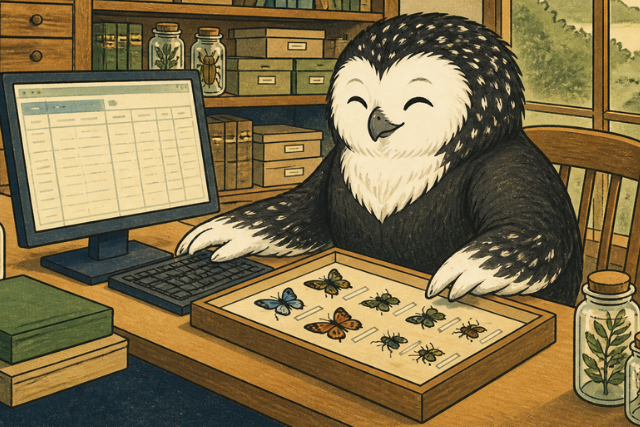
Observing a familiar organism and recording its name or features may seem like a small act. When many such records are brought together across places and generations, however, they can help us investigate which organisms were present, where they occurred, and when they were observed.
Taxonomy reveals more than relationships among other species. It also places humans within the living world. We, too, are organisms shaped by evolutionary history and dependent on relationships with other species and our environment.
To conclude, let us consider how individual observations can contribute to biodiversity knowledge—and how taxonomy can change the way we look at nature.
ミミズク先生One observation cannot describe an entire landscape. But without individual observations, there would be no larger record to examine.
Records That Support Biodiversity Knowledge
To understand biodiversity, it is not enough to know what organisms exist. We also need evidence of where and when they have been recorded.
Museum specimens, environmental surveys, researchers’ field records, and photographs contributed through community-science projects preserve different kinds of evidence that an organism was present.
When these records are connected to taxonomic information, researchers can compare distributions across places and periods, investigate seasonal patterns, and look for changes that may deserve closer study.
The Global Biodiversity Information Facility (GBIF) provides access to data shared by museums, herbaria, research organisations, government agencies, community-science projects, and other publishers. Much of this information takes the form of occurrence records.
An occurrence record provides evidence that an organism or taxonomic group was recorded at a particular place and, in most cases, at a particular time. Depending on the source, that evidence might be a preserved specimen, a field observation, a photograph, or the result of a biological survey.
The absence of a record does not necessarily mean that an organism was absent. There are many other possibilities:
- Few people may have surveyed the area.
- Surveys may have taken place in the wrong season.
- The organism may be small, nocturnal, short-lived, or otherwise difficult to detect.
- The group may be difficult to identify.
- Existing records may not have been digitised or published.
- The search method may not have been suitable for that organism.
Records are also unevenly distributed across regions and taxonomic groups. Easily photographed or popular organisms often receive more attention than inconspicuous species.
タヌ山先生A blank space on a map can mean “not found.” It can also mean “not searched for,” “not recognised,” or “not yet shared.” Those are very different conclusions.
One observation is rarely enough to support a broad conclusion. Nevertheless, an observation accompanied by a date, locality, photograph or specimen, and an honest statement of identification confidence can provide a useful starting point.
When records are shared through an appropriate recording scheme, survey, or observation platform, they may help reduce gaps in biodiversity knowledge. Their usefulness depends on the quality of the evidence, the information supplied, and the question for which the data are later used.
Data published through GBIF must meet baseline requirements and are commonly structured with shared standards such as Darwin Core. GBIF also processes incoming records and attaches flags when it detects potential problems or uncertainties involving dates, coordinates, taxonomic interpretation, or other fields.
These checks help users find possible problems, but they do not guarantee that every identification, date, or locality is correct. Publishers and data users must still decide whether records are suitable for a particular purpose.
シロフクロウ職員A database can help us find and compare records. It does not relieve us of the need to ask where the information came from and how confidently it was identified.
Seeing Humans as Part of Nature
Taxonomy does not place humans outside its system. Our species has the scientific name Homo sapiens. We are mammals, primates, and members of the great ape family Hominidae.
Humans did not evolve from the chimpanzees or bonobos alive today. Instead, the human lineage and the lineage leading to chimpanzees and bonobos descended from an earlier common ancestor. After separating, these lineages continued along their own evolutionary paths.
Chimpanzees and bonobos belong to the genus Pan and are more closely related to each other than either is to humans. Together, however, humans, chimpanzees, and bonobos form a closely related part of the great ape family tree.
Evidence from fossils, anatomy, and genomes continues to refine our understanding of these relationships. Estimates vary according to the evidence and methods used. The Smithsonian Human Origins Program places the common ancestor of the human and chimpanzee lineages at approximately six to eight million years ago, while a 2025 analysis based on complete ape genomes estimated a range of about 5.5 to 6.3 million years ago. These are estimates of evolutionary divergence, not the known age of a single identified ancestral species.
タヌ山先生Evolution is not a ladder with humans waiting at the top. It is a branching history. Our branch is recent, and it remains connected to the rest of life.
Understanding how other organisms live also helps us avoid imagining humanity as separate from nature. Human societies depend on food, water, soils, climate, microorganisms, plants, animals, and the ecological processes created through their interactions.
Every organism requires particular conditions in which to survive and reproduce. Once we begin to recognise those requirements, changes to a riverbank, forest, wetland, or urban green space no longer appear to affect an empty background. They affect living communities composed of organisms with different needs.
This knowledge does not by itself tell us what every environmental decision should be. It does, however, give us better questions to ask:
- Which organisms live here?
- What conditions do they require?
- What might be lost or altered?
- What evidence do we have?
メンフクロウ職員In a collection, every specimen belongs to a larger story. Outside the museum, every habitat does too. Change one part carelessly, and the effects may reach much further than we expect.
Beginning Your Next Observation
You do not need to memorise a long list of scientific names or taxonomic ranks before beginning to study nature.
The next time you walk through a park, woodland, garden, or riverside, choose one organism that catches your attention. Begin with two simple questions:
- What does it resemble?
- How is it different?
If you cannot identify it, record what you can. Note its appearance, location, surroundings, behaviour, and the date. A broad but well-supported description such as “unidentified beetle” is more useful than a confident species name based on insufficient evidence.
If you do find a reliable name, let it open the door to further questions:
- What does this organism eat?
- Where does it reproduce or develop?
- At what time of year can it be seen?
- Which organisms are its closest relatives?
- How can it be distinguished from similar species?
- Has it always lived in this region?
You do not need to answer everything during a single observation. Revisiting the same place in another season may reveal different species, life stages, behaviours, or interactions.
メンフクロウ職員Returning to the same place is not repeating the same observation. The weather changes, the seasons turn, and different organisms become visible. Familiar ground can continue producing new questions.
At first, a landscape may appear to contain only broad categories: trees, grasses, birds, or insects. As observation and comparison become more precise, that landscape begins to resolve into many distinct organisms, each with its own characteristics, history, and relationships.
Taxonomy does not give us a finished catalogue containing every answer. It offers a method for looking carefully, comparing evidence, recognising both differences and connections, and preserving what we do not yet understand as a question for the future.
ミミズク先生What first appears to be a confused woodland becomes more legible with every careful question. Not because its complexity disappears, but because we begin to recognise the lives and relationships within it.
Explore the Forest Museum Book Series
 メンフクロウ職員
If you have enjoyed this introduction, please take a look at the Forest Museum Kindle books from eco-life-planet. They explore natural history, taxonomy, and the pleasure of looking closely at the living world.
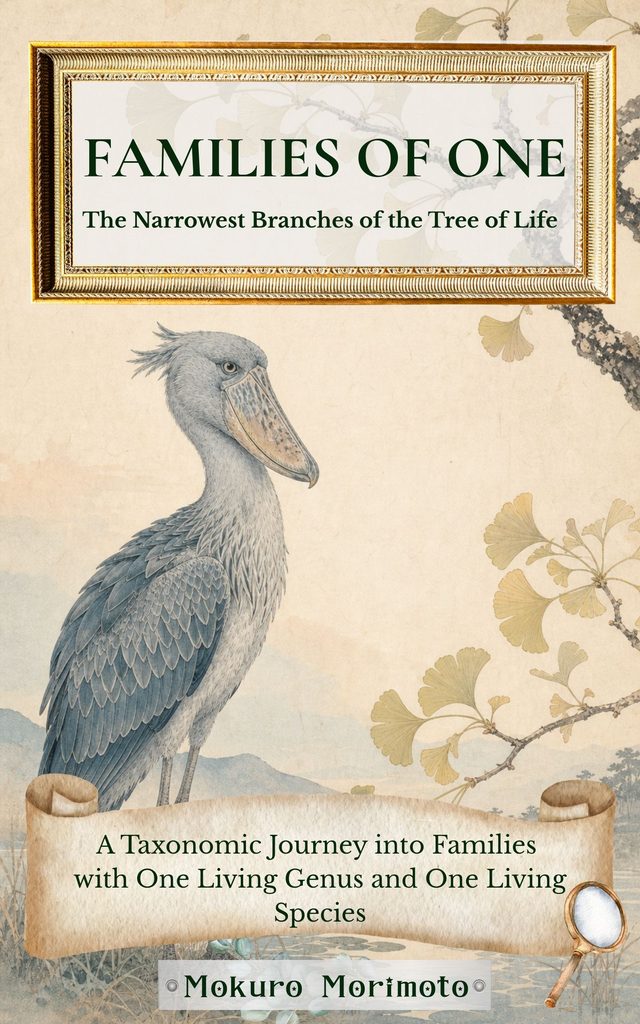 シロフクロウ職員
You will also meet some taxonomically unusual organisms — species that represent especially distinctive branches of the tree of life.
ミミズク先生This book offers a friendly introduction to the first principles of taxonomy, inviting readers to explore one curious question at a time.
References and Further Reading
Taxonomy, Scientific Names and Classification
- Convention on Biological Diversity. What Is Taxonomy?
- International Commission on Zoological Nomenclature. Preamble to the International Code of Zoological Nomenclature.
- International Commission on Zoological Nomenclature. Article 5: Principle of Binominal Nomenclature.
- International Commission on Zoological Nomenclature. Article 23: Principle of Priority.
- International Commission on Zoological Nomenclature. Frequently Asked Questions.
- International Association for Plant Taxonomy. International Code of Nomenclature for Algae, Fungi, and Plants: Madrid Code Online.
- International Association for Plant Taxonomy. The Madrid Code: 2025 Edition of the International Code of Nomenclature for Algae, Fungi, and Plants.
- Catalogue of Life. Species and Classification.
- Catalogue of Life. Browse the Classification Tree.
- Catalogue of Life. Glossary: Accepted Names and Synonyms.
- International Mineralogical Association, Commission on New Minerals, Nomenclature and Classification. The IMA List of Minerals.
Observation, Comparison and Evolution
- University of California Museum of Paleontology. Homologies and Analogies.
- University of California Museum of Paleontology. Bird and Bat Wing Phylogeny: Analogy.
- University of California Museum of Paleontology. Phylogenetics: Shared and Derived Characters.
- Willi Hennig Society. Willi Hennig.
- Angiosperm Phylogeny Group. “An Update of the Angiosperm Phylogeny Group Classification for the Orders and Families of Flowering Plants: APG IV.” Botanical Journal of the Linnean Society 181, no. 1 (2016): 1–20. https://doi.org/10.1111/boj.12385
- Global Biodiversity Information Facility. APG IV: Angiosperm Phylogeny Group Classification for Flowering Plants.
Observations, Identification and Collections
- iNaturalist. What Is Computer Vision?
- iNaturalist. Why Can’t Computer Vision Identify My Photo Correctly?
- iNaturalist. Which Taxa Are Included in the Computer Vision Suggestions?
- National Museum of Nature and Science, Tokyo. Collection Database of Specimens and Materials.
- National Museum of Nature and Science, Tokyo. Collections and Databases.
- Catalogue of Japanese Beetles (2026 Edition).
- Catalogue of Japanese Beetles: Family Lucanidae.
- Catalogue of Japanese Beetles: Family Scarabaeidae.
- Catalogue of Japanese Beetles: Subfamily Dynastinae.
- Waller, John. How to Migrate from the Legacy GBIF Backbone Taxonomy to Catalogue of Life Extended Release. GBIF, 2026.
- Catalogue of Life. Catalogue of Life Extended Release.
- Global Biodiversity Information Facility. Trypoxylus dichotomus (Linnaeus, 1771).
Labels, Dates and Data Management
- Biodiversity Information Standards (TDWG). Darwin Core Quick Reference Guide.
- Biodiversity Information Standards (TDWG). Darwin Core Term: eventDate.
- Global Biodiversity Information Facility. Darwin Core.
- Chapman, Arthur D. Current Best Practices for Generalizing Sensitive Species Occurrence Data. Copenhagen: GBIF Secretariat, 2020. https://docs.gbif.org/sensitive-species-best-practices/master/en/
GBIF’s guidance emphasises preserving original data while documenting any generalisation, restriction, or withholding applied to shared sensitive-species records.docs.gbif - Global Biodiversity Information Facility. Data Quality Requirements for Occurrence Datasets.
- Global Biodiversity Information Facility. Occurrence Issues and Flags.
- Global Biodiversity Information Facility. Current Best Practices for Generalising Sensitive Species Occurrence Data.
Biodiversity Records and Human Evolution
- Global Biodiversity Information Facility. Primary Biodiversity Data.
- Global Biodiversity Information Facility. Occurrence Data.
- Global Biodiversity Information Facility. Data Quality Requirements for Sampling-Event Datasets.
- Smithsonian National Museum of Natural History, Human Origins Program. Genetics.
- Smithsonian National Museum of Natural History, Human Origins Program. Introduction to Human Evolution.
- Smithsonian National Museum of Natural History, Human Origins Program. Frequently Asked Questions.
- Makova, K. D., et al. “Complete Sequencing of Ape Genomes.” Nature (2025). https://doi.org/10.1038/s41586-025-08816-3
The article provides complete telomere-to-telomere genome sequences for six ape species and adds evidence relevant to research on great-ape evolutionary history.pmc.ncbi.nlm.nih+1
コメント