


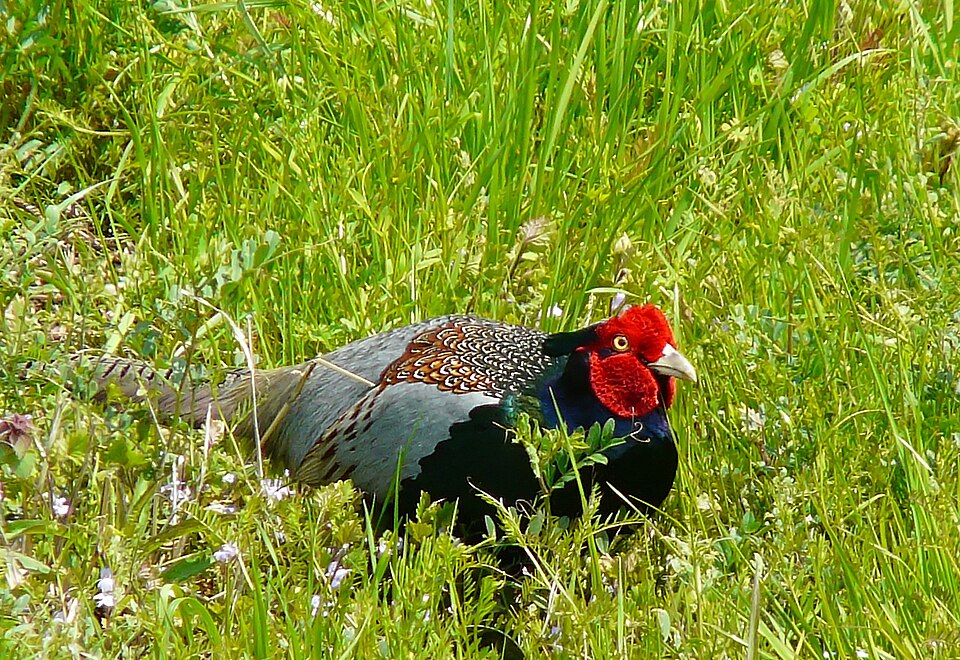
What is your country’s national animal? And do you know how it earned that title — through an act of parliament, a scientific vote, or simply generations of shared affection?
Japan offers a particularly interesting case. The Green Pheasant is widely celebrated as the country’s national bird, and the Great Purple Emperor as its national butterfly — yet neither title was ever written into law. Some emerged through scholarly debate within learned societies; others through nothing more formal than folklore and long-standing cultural custom.
 ミミズク先生
So why these particular species, and not others?
Behind each emblem lies a small, quiet story about how people in Japan have come to perceive, cherish and live alongside the natural world — shaped by taxonomy, folklore and, in one memorable case, a postage stamp.
Step inside our museum galleries as we explore how Japan’s “national” species came to represent the country, and what their histories reveal about Japan’s relationship with nature.
Meet the Museum Curatorial Team
Before we begin, let’s introduce the team guiding you through the galleries today.
 メンフクロウ職員
Piacere, I’m Curator Barn! I’m your guide on the museum floor and out in the field — I look after our specimens and help connect them to the stories you might spot on your next walk outdoors.
ミミズク先生Good day, I’m Prof. Horned. I look into the history and ideas behind Japan’s relationship with nature — from old texts and folklore to how these species came to be seen as symbols in the first place.
 タヌ山先生
タヌ山先生Hi, I’m Dr. Tanuyama. I handle the science side — species, genetics, ecology, and what conservation actually looks like once a species gets legal protection.
 シロフクロウ職員
Bonjour, I’m Registrar Snowy. I keep the official record straight — names, dates, classifications, and exactly which of these titles are legally recognised and which are not.

What Do We Mean by Japan’s “National” Animals?
When people hear the phrase “national animal,” many picture a creature enshrined by an act of parliament, much like a national flag or anthem. In Japan’s case, that picture doesn’t quite fit.
No Japanese law has ever designated a national bird, butterfly, fish, or mammal. And here’s a detail worth holding onto as we go further: not even the species we’ll be exploring in this article gained their titles the same way. The Green Pheasant was selected as Japan’s national bird by the Ornithological Society of Japan in 1947. The Great Purple Emperor was named the national butterfly by the Entomological Society of Japan in 1957.
Both were decisions made by scientific societies, not by government. The Common Carp, by contrast, is widely called Japan’s “national fish” without ever having gone through a comparable formal selection — its status rests on culture and popular association rather than academic vote. The Japanese Serow has a different story again, tied to legal protection and conservation history rather than a title bestowed by any single body.
メンフクロウ職員Allow me to put that on record precisely, since it matters for everything that follows. National symbol does not automatically mean legally designated. The same English phrase can describe quite different systems, depending on the country — and, as we’ll see, depending on the species even within Japan.
 シロフクロウ職員
Attendez… do I understand correctly? Some of these titles were formally voted upon by learned societies, whilst others simply emerged through popular custom without any official decision at all?
 ミミズク先生
More or less. In some cases, Japan’s academic societies took the lead in deciding which species best represented aspects of the country’s natural heritage. But “academic society” isn’t a single process, either — and public affection alone was enough to make the carp a household symbol, with no vote required.
When societies did deliberate, considerations could include the species’ connection with Japan, its ecological or cultural significance, its familiarity to the public, and its place in the country’s natural heritage. That said, the history is rarely as tidy as a checklist. The Great Purple Emperor, for instance, had already been debated informally among entomologists since the 1930s, and its appearance on a commemorative postage stamp in 1956 became part of the story that culminated in the following year’s selection.
タヌ山先生Which is really the point. These species shouldn’t be read simply as winners of a popularity contest, nor as the product of one standardised scientific process applied evenly across the board. Each has its own history — and those differences are part of what make them worth exploring on their own.
How Other Countries Choose Their National Animals
Japan’s approach becomes easier to appreciate once we look elsewhere. Around the world, national animals arrive at their status through a genuinely wide range of routes — some legal, some cultural, some almost accidental.
- United States — Bald eagle (national bird). Featured on the Great Seal since 1782, but only formally enacted into law in December 2024, through Public Law 118-206.
- United States — American bison (national mammal). Designated as the national mammal by the National Bison Legacy Act in May 2016.
- United Kingdom — European Robin (unofficial national bird). Widely described as Britain’s national bird after topping a 2015 public poll of over 224,000 voters, but never formally designated by law.
- France — Gallic Rooster. A cultural and historical emblem rooted in Latin wordplay (Gallus meaning both “Gaul” and “rooster”); never given formal legal status.
- India — Bengal tiger (national animal) and Indian peafowl (national bird). Both formally notified by the Indian government, most recently reconfirmed in 2011.
- South Africa — Springbok (national animal). Officially listed among South Africa’s national symbols, alongside the Blue Crane as national bird and the Galjoen as national fish.
- Canada — Beaver. Declared “a symbol of the sovereignty of Canada” by the National Symbol of Canada Act in 1975.
- Scotland — Unicorn. Traditionally regarded as Scotland’s national animal — a mythical creature used in Scottish heraldry since the Middle Ages.
- China — Giant panda. Widely regarded as a national treasure and China’s most recognisable living symbol, though not the subject of any specific “national animal” law.
ミミズク先生There’s something rather charming about this variety. A national symbol can be written into law, chosen by public vote, inherited through centuries of heraldry, or — as with Scotland’s unicorn — not even be a real animal at all. Given that range, it’s difficult to sort the world neatly into “countries with official national animals” and “countries without.” It’s more of a spectrum.
Japan sits within that spectrum too. What makes its case unusually clear is that several of its best-known “national” species acquired their status through learned societies and long-standing custom, largely outside the formal machinery of government — not because Japan is the world’s sole exception, but because it offers such a clean example of how far cultural and academic recognition alone can carry a species.
タヌ山先生One more thing worth flagging before we move on: being a national symbol doesn’t automatically mean a species is legally protected, endangered, or even rare. Those are separate questions, handled by entirely different systems — as we’ll see clearly when we get to the Japanese Serow.
メンフクロウ職員And that’s where it gets genuinely interesting. A species can represent a country, appear in folklore, sit in a museum collection, and still hold a completely different status out in the wild. With all of that in mind, let’s meet the four species themselves.

Japan’s National Bird: The Green Pheasant
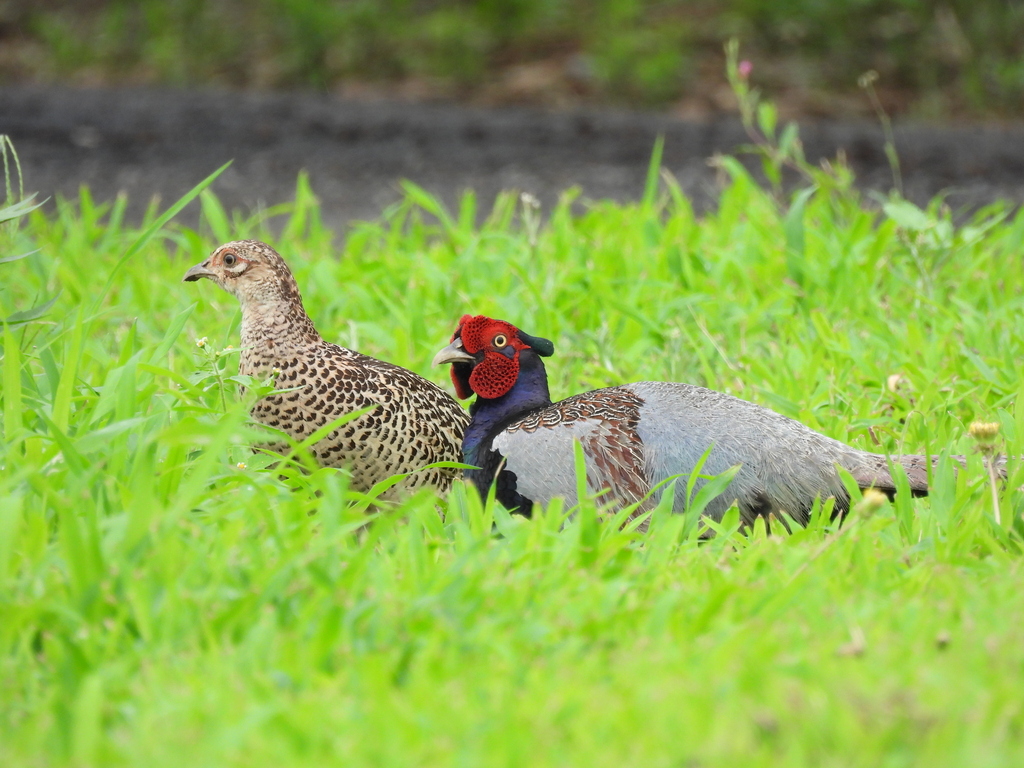
Photograph: iNaturalist observation no. 226382917.(renshuchu)
- Common name: Green Pheasant (Japanese Green Pheasant)
- Japanese name: Kiji (キジ)
- Scientific name: Phasianus versicolor
- Family: Phasianidae (Order Galliformes)
- Distribution: Native to Japan; mainly Honshu, Shikoku and Kyushu
- Conservation status: Least Concern (IUCN Red List)
Walk through open country and rural edges in Japan in early spring, and you may suddenly be startled by a sharp, carrying call — ken, ken — followed by the sudden, drum-like beating of wings. That is the Green Pheasant (Phasianus versicolor), Japan’s national bird, announcing its territory.
The male is a striking bird: an iridescent, bottle-green breast, a bluish-purple sheen at the neck, and vivid red facial skin, all set off by a long, tapering tail. Its species name, versicolor (“many-coloured”), suits it well — the plumage shifts through several tones depending on the light. In spring, males perform a display called horo-uchi (母衣打ち), rapidly drumming their wings against their body to produce a sound that carries surprisingly far across open ground.
 メンフクロウ職員
Mamma mia, that wing-drumming is hard to miss. It can carry a surprisingly long way across open ground!
出典:Birdlover.jp ‐ 【野鳥動画】キジの母衣打ち(ほろうち) / Japanese green pheasant
Watch: territorial wing-drumming (horo-uchi) performed by a male Green Pheasant
Here’s a detail that surprises many people, including some in Japan: the Green Pheasant’s status as a distinct species is a fairly recent scientific development. For years, it was classified as a subspecies of the widespread Common Pheasant (Phasianus colchicus), found across much of the Asian mainland. The 2024 edition of the Ornithological Society of Japan’s revised Check-list of Japanese Birds treats the Green Pheasant as a species distinct from the Common Pheasant. This taxonomic change also increased the number of bird species recognised as endemic to Japan.
ミミズク先生Taxonomy is rarely as settled as a museum label might suggest. A species boundary isn’t always a fixed line in the sand — sometimes it shifts as genetic evidence accumulates, even for a bird as familiar as a national symbol.
The story of how this pheasant came to represent Japan begins not in an ancient court, but in the uncertain years just after the Second World War.
How the Pheasant Became Japan’s National Bird
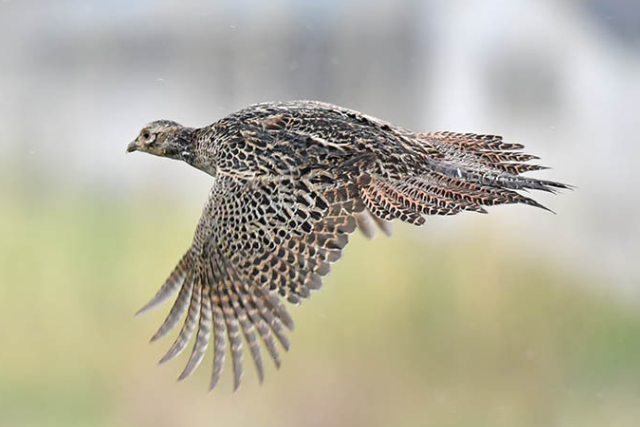
Photograph: iNaturalist observation no. 254181910.(m_sato)
The Green Pheasant was selected as Japan’s national bird in March 1947 — a decision made by the Ornithological Society of Japan, not by the Japanese government.
Twenty-two ornithologists gathered for the selection meeting on 22 March 1947.
メンフクロウ職員Several candidates were discussed: the Rock Dove, as a symbol of peace; the Japanese Bush Warbler and the Eurasian Skylark, both celebrated for their song; and the Copper Pheasant (Syrmaticus soemmerringii), another bird found only in Japan.
シロフクロウ職員So it wasn’t simply a case of “which bird do people like best”?
ミミズク先生Not quite. At the time, the Green Pheasant and Copper Pheasant were regarded as Japan’s only two endemic bird species. That rarity, together with the pheasant’s familiarity and cultural associations, helped make it a strong candidate.
This history matters, but it’s worth adding a note of accuracy here. The exact chain of events — how much the decision was driven by any single external recommendation, as opposed to a broader post-war interest in bird protection and nature education — is not entirely clear from the surviving accounts. Later retellings have sometimes presented the story as a straightforward response to a recommendation from the Allied occupation authorities, but the documented part of the story is the discussion and decision within the Ornithological Society of Japan itself.
シロフクロウ職員In other words, we can be confident about who chose the bird and when. The wider story of why the process began deserves a little more caution.
タヌ山先生It’s also worth updating that “only two endemic birds” figure for today’s readers. Ornithological knowledge has moved on quite a bit since 1947.
The National Museum of Nature and Science’s catalogue of Japanese endemic species now lists sixteen endemic bird species, plus six additional species that breed only in Japan — a considerably richer picture than the 1947 committee had in front of them.
A Bird Woven into Japanese Life
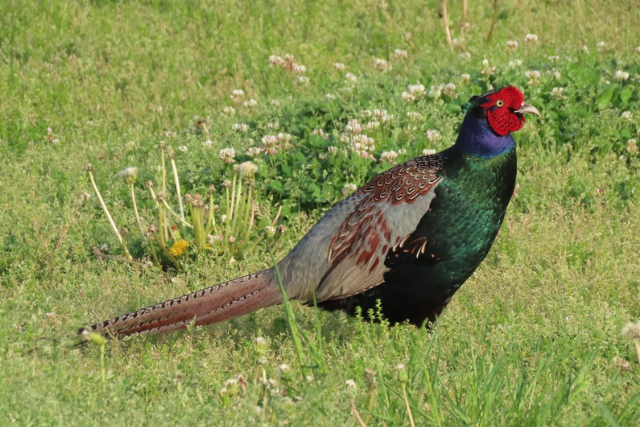
Photograph by username. Source: iNaturalist observation no. 211385131.(belvedere04)
Several strands came together in the pheasant’s favour, and they reveal something about how post-war Japan thought about a national symbol.
Biological value.
Endemism was the strongest card in the pheasant’s favour — a bird found nowhere else on Earth made an unusually clear symbol of Japan’s natural distinctiveness. It also helped that the pheasant is a year-round resident rather than a passing migrant, making it a familiar, everyday presence across the seasons rather than an occasional visitor.
Cultural value.
The pheasant’s connection to Japanese culture runs deep. It appears as a loyal companion in the folk tale Momotarō, and features in the Man’yōshū, Japan’s oldest surviving poetry anthology, compiled in the 8th century. The male came to represent courage; the female, fierce maternal devotion — an association still remembered today in a well-known saying.
A detail that might surprise modern readers: the pheasant was also a familiar game bird, valued as food across rural Japan. In 1947, this was not seen as a contradiction. If anything, its familiarity in both the countryside and hunting culture reinforced how deeply embedded it already was in everyday life — a reminder that a national symbol doesn’t have to represent untouched wilderness.
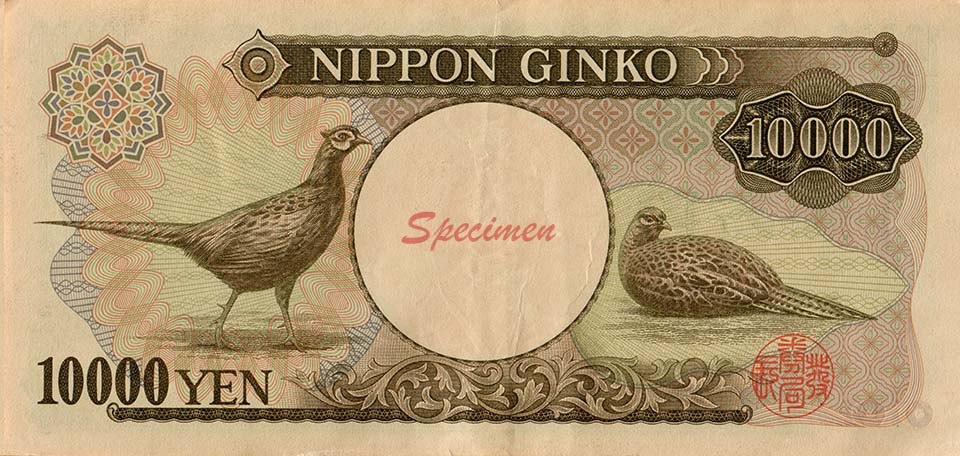
The reverse side of Japan’s former 10,000-yen banknote, issued from 1984 to 2007, depicting a pair of Green Pheasants (Phasianus versicolor), Japan’s national bird.
Source: Wikimedia Commons – Series D 10K Yen Bank of Japan note – back (Eclipse2009, public domain).
メンフクロウ職員It even made it onto the money. The pheasant appeared on the reverse of an earlier ¥10,000 banknote, issued in 1984, alongside a portrait of Fukuzawa Yukichi on the front. That older note is still legal tender today, if you know where to look for it.
“The Pheasant in the Burning Field”
The Japanese phrase yakeno no kigisu — “the pheasant of the burning field” — captures a parent’s willingness to risk everything for its young, especially a mother’s devotion. Kigisu is simply an old word for pheasant. The saying is sometimes extended into a fuller phrase, “the pheasant of the burning field, the crane of the cold night,” pairing it with the image of a crane warming its chicks beneath its wings through a freezing night.
According to the traditional story behind the saying, pheasants nest in open grassland through spring and summer. If fire swept through that grassland — as could happen during controlled seasonal burning — a parent bird was said to spread its wings over the nest and stay put, shielding its eggs or chicks rather than fleeing, even at the cost of its own life.
タヌ山先生I should flag this clearly, as the scientist in the room: this particular behaviour has never been confirmed through rigorous observation. It sits in folklore, not in established pheasant biology.
ミミズク先生Quite right — and that’s precisely what makes it worth keeping in the story. What matters isn’t whether the behaviour is scientifically proven, but what the saying tells us about how people once watched this bird, and chose to remember it. A piece of folklore like this is a kind of cultural evidence in its own right, even when it isn’t biological evidence.
A National Symbol, and a Modern Genetic Puzzle
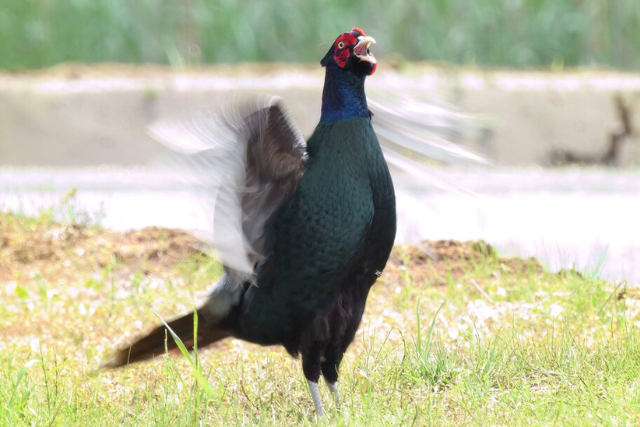
Source: iNaturalist observation no. 277647676.(nekoq_in)
More than seventy-five years after its selection, the Green Pheasant faces a challenge nobody at that 1947 meeting could have anticipated.
Japan’s pheasant population is divided into several regional populations, distinguished by subtle differences in plumage and geography. These regional populations are increasingly at risk of losing their distinct genetic character — not through interbreeding among themselves, but through hybridisation with a different species altogether. The Common Pheasant, including birds of Korean and other continental stock, has been released into parts of Japan for game hunting for decades. Because the two species are close relatives, they interbreed readily and produce fertile offspring, gradually blurring the genetic boundaries of Japan’s native populations in places where introduced birds have become established.
シロフクロウ職員In our records, this process is formally documented as genetic introgression—or, in broader conservation contexts, genetic dilution. It occurs when distinct populations that evolved in geographical isolation begin interbreeding, causing their unique local adaptations and genetic identities to blend together until they are effectively lost.
 メンフクロウ職員
Think of it rather like this: every Italian household has its own minestrone recipe, shaped by its own region and its own taste. Pour several of those pots together, and you’ll still have minestrone at the end — but once it’s all stirred into one, there’s no practical way to separate the local recipes back out again.
This isn’t a problem unique to pheasants. Similar genetic mixing, caused by well-intentioned but poorly considered releases, is a recognised concern for other Japanese species too, including the freshwater fish Ayu, the Japanese rice fish (Medaka), and fireflies. When a population that adapted over many generations to a specific local environment is diluted by outside stock, its resilience to disease and local conditions can weaken — a quiet threat to biodiversity that has nothing to do with a species being globally rare.
タヌ山先生It’s a useful reminder that protecting nature isn’t just about preventing extinction. Sometimes it’s about being careful not to erase genetic history that took many generations to build — history that, once lost, usually can’t simply be put back into the landscape the way the animal itself can.
Still a Bridge Between Nature and Culture
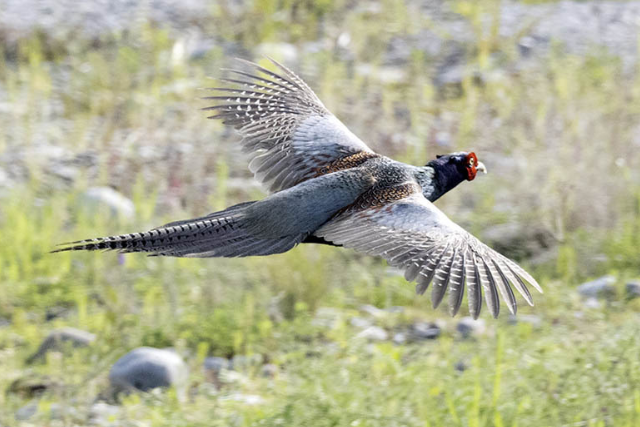
Source: iNaturalist – キジ Phasianus versicolor(m_sato)
Despite this quiet challenge, the Green Pheasant remains a genuine link between Japan’s natural and cultural life. It has been adopted as the official bird of numerous cities and towns across the country, and its resilient, everyday presence continues to make it a fitting emblem of the Japanese landscape.
In 1947, the pheasant was chosen partly because it seemed to embody something distinctly Japanese: a resident bird, familiar to ordinary people, rooted in literature and folklore, and closely tied to the countryside. Today, the same bird also reminds us that being “native” is not a fixed, unchanging status — taxonomy has shifted, our understanding of Japan’s biodiversity has expanded, and conservation now has to think about genetic relationships within a species, not only the number of individuals in the field.
ミミズク先生A national symbol isn’t a museum label that freezes an animal in time. Perhaps the more interesting question is what it means to us now — and that, rather like the bird itself, seems to be still very much in motion.

Japan’s National Butterfly: The Great Purple Emperor
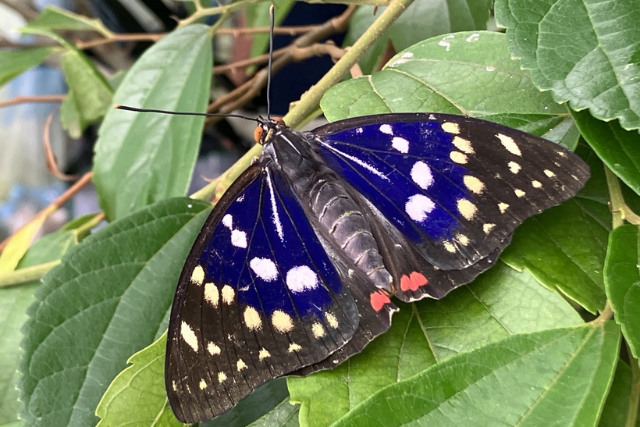
Source: iNaturalist – オオムラサキ Sasakia charonda(manbousalsa)
- Common name: Great Purple Emperor
- Japanese name: Ō-murasaki (オオムラサキ, “great purple”)
- Scientific name: Sasakia charonda (Hewitson, 1863)
- Family: Nymphalidae, subfamily Apaturinae
- Distribution: Japan (southwestern Hokkaido, Honshu, Shikoku, Kyushu), Korean Peninsula, China, Taiwan, northern Vietnam
- Conservation status in Japan: Near Threatened (NT)
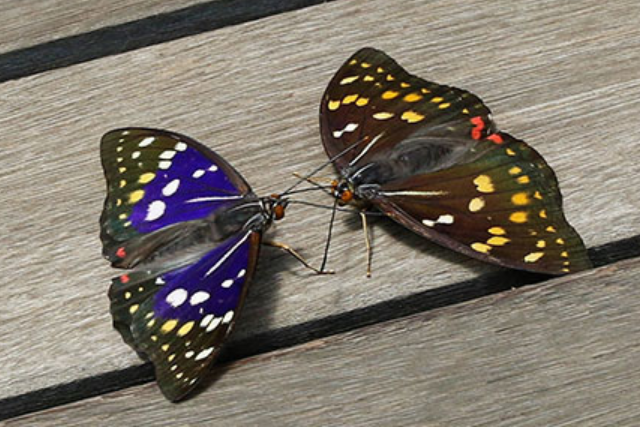
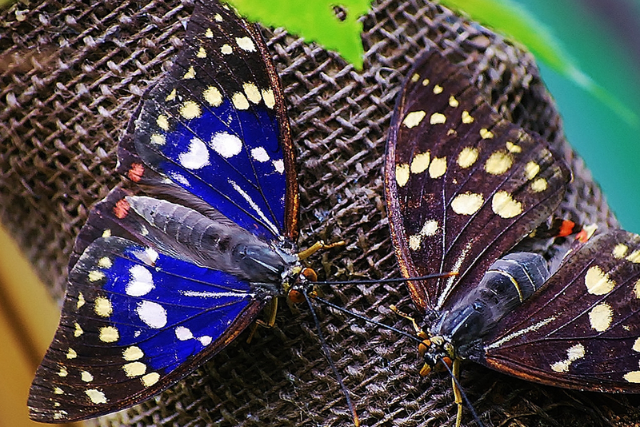
A large butterfly with a flash of blue-violet across its wings appears in Japan’s traditional countryside every midsummer. This is the Great Purple Emperor, Sasakia charonda — Japan’s national butterfly.
That title is worth clarifying from the outset: it is not a legal designation or a form of protected status. S. charonda was selected by the Entomological Society of Japan in 1957 as a species representing the country — a cultural and academic recognition, not a statute.
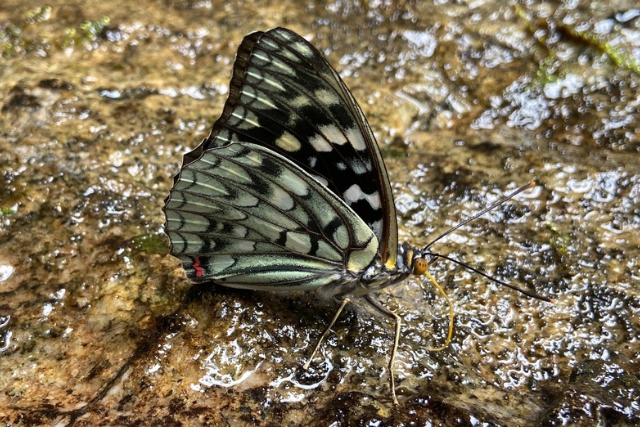
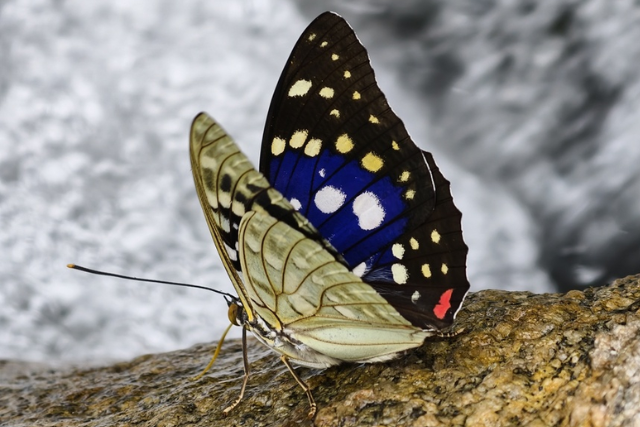
The choice makes considerably more sense once you meet the butterfly itself. Males have dark wings with an intense blue-violet sheen that flashes in and out of view as the light shifts. Females are larger but lack the male’s brilliant colour, wearing a subtler pattern of olive-brown instead. With a wingspan of roughly 75–110 mm, it ranks among the largest nymphalid butterflies in Japan. Adults feed almost entirely on the sap of oak trees such as Quercus acutissima and Quercus serrata, along with fermenting fallen fruit — flower nectar barely features in their diet at all.
シロフクロウ職員Alors, if I understand correctly, it was not merely a matter of choosing the most attractive butterfly in Japan?
ミミズク先生Not quite. Beauty certainly helped its case — but there’s a good deal more to the story.
A Name With Two Stories
Source: 北杜市オオムラサキセンター ‐ オオムラサキの観察方法 夏
The butterfly’s scientific name carries real history, though not all of it is equally certain.
It was first described in 1863 by the British entomologist William Chapman Hewitson, based on a specimen collected near Yokohama two years earlier by the British plant-hunter Robert Fortune. Hewitson placed it in an existing genus, Diadema, naming it Diadema charonda. In 1896, another British entomologist, Frederic Moore, recognised that the species didn’t quite fit that genus and established a new one especially for it: Sasakia, with charonda as its type species.
The genus name honours Chūjirō Sasaki (1857–1938), a pioneering figure in Japanese entomology — we’ll return to him shortly. The species name, charonda, is traditionally associated with Charondas, a lawgiver of Catania in Sicily who is generally placed in the 6th century BC, though the ancient sources disagree on the exact dates. Hewitson himself left no note confirming exactly what he had in mind, so this remains the traditional interpretation rather than a settled fact — one of entomology’s small, unresolved puzzles.
シロフクロウ職員I rather like that we can’t pin this one down with complete certainty. Knowing precisely where the historical record runs out is every bit as important as knowing the facts we do have.
Chūjirō Sasaki: A Name Written Into a Butterfly
Source: iNaturalist – オオムラサキ Sasakia charonda(paul1229)
Chūjirō Sasaki worked during Japan’s rapid scientific modernisation, from the Meiji period into the early Shōwa era. As one of the first professors attached to the sericulture laboratories at the Imperial University’s College of Agriculture — later Tokyo Imperial University — he is credited with delivering Japan’s first proper lecture course in entomology, training a generation of researchers who followed.
His research addressed thoroughly practical problems: identifying pests damaging apple orchards, and studying silkworm diseases in ways that helped push Japan’s silk industry to a world-leading standard. Less widely known is that, as a student, Sasaki took part in the excavation of the Ōmori Shell Mounds — generally regarded as Japan’s first scientific archaeological dig.
タヌ山先生It’s easy to forget how interconnected early modern science really was. The same person laying groundwork in entomology could just as easily be out digging shell middens on a weekend.
メンフクロウ職員That is rather difficult to imagine in the style of research today, isn’t it? One person working across entomology, sericulture and archaeology.
ミミズク先生Indeed. When I was a young researcher, there was no dedicated entomology laboratory where I studied, so I was welcomed into a botanist’s laboratory. I began by studying insects through their relationships with plants. That was more than half a century ago — and Professor Sasaki was born in the final years of the Edo period. There were far fewer specialised scientists then, so crossing the boundaries between fields was often not an exception at all, but simply how a curious researcher worked.
Frederic Moore’s decision to name the new genus after his Japanese colleague was, in effect, a piece of international scientific courtesy — a British entomologist choosing to honour a Japanese one at a time when such recognition crossed borders far less often than it does today. Sasaki’s own insect collection, including specimens of the very species that bears his name, is preserved today at the University of Tokyo’s University Museum.
What Is a Dedication Name, Exactly?
Source: iNaturalist – オオムラサキ Sasakia charonda(catfish1987)
Naming a species after a person — what taxonomists call a dedication, or eponym — is one of biology’s oldest customs, stretching back roughly 270 years to the time of Linnaeus. Scientists use it to honour mentors, collectors, colleagues, or figures they admire, preserving that gratitude permanently within the language of science.
One long-standing unwritten rule goes with this custom: you don’t name a species after yourself.
Nothing technically prevents it, but doing so is considered rather poor form. A dedication is meant to be a gift of recognition given to someone else — naming a species after yourself would be a little like writing your own thank-you card. When it does happen, it tends to raise eyebrows across the scientific community precisely because it’s so rare.
Two well-known examples show how the tradition usually works. The element einsteinium, discovered in the debris of a 1952 thermonuclear test, was named for Albert Einstein in tribute to his contributions to physics. And in 2014, a rove beetle that Charles Darwin himself had collected in Argentina back in 1832 was finally described as a new species, Darwinilus sedarisi — its genus honouring Darwin, its species name honouring the writer David Sedaris, whose work had inspired the describing scientist’s own fascination with beetles.
メンフクロウ職員There’s something rather fitting about a Japanese national symbol carrying, quite literally, the name of one of the people who helped establish entomology as a modern science in this country.
シロフクロウ職員So the scientific name is almost a little piece of Japanese scientific history, hiding in plain sight.
ミミズク先生Precisely.
Why the Great Purple Emperor Was Chosen
Source:iNaturalist – オオムラサキ Sasakia charonda
The idea of choosing a national butterfly for Japan first surfaced in 1933, when the entomologist Teiso Esaki proposed it at a meeting of the Butterfly Society. The discussion continued, on and off, for more than two decades.
ミミズク先生During the 1930s, an early poll of society members did put the Great Purple Emperor in first place — but turnout fell short of half the membership, so no formal decision was reached at that time. The matter was only settled in 1957, at the Entomological Society of Japan’s 40th anniversary meeting, twenty-four years after Esaki’s original proposal.
By most accounts, the final debate came down to two strong candidates: the Great Purple Emperor and the widely familiar Swallowtail butterfly. The Swallowtail had real advantages — it was known nationwide, easily recognised by children and adults alike, and its flight was seen by many as embodying a particularly Japanese elegance. Two practical points, however, worked against it: its caterpillars feed on citrus leaves, making it a genuine agricultural pest — an awkward contradiction for a species meant to represent national pride — and it was considered by some in the committee simply too common and ordinary to serve as a distinguished symbol.
メンフクロウ職員Accidenti! At the time, those practical concerns really could count against a butterfly being chosen to represent the country.
 シロフクロウ職員
It does make you think about how a society’s idea of a fitting national symbol can change over time.
The Great Purple Emperor’s case rested on several strengths together: its size, striking blue-violet colouring, wide distribution across Japan, and a certain dignity of bearing that struck contemporaries as distinctly fitting. A commemorative postage stamp featuring the species, issued in 1956, had already raised its public profile in the year before the final vote — a small but telling piece of the story.
タヌ山先生How the final vote unfolded in 1957 isn’t as clearly documented as some retellings suggest. What we can say with confidence is what actually mattered in the debate — size, colour, distribution, and the Swallowtail’s inconvenient appetite for citrus trees.
ミミズク先生Citrus has long held an important place in Japanese agriculture, of course — and it remains one of the country’s most familiar fruit crops.
 メンフクロウ職員
Quite so. Japan’s mikan — sweet, easy-to-peel satsuma mandarins — are rather different from the large oranges many readers may picture. They are small, fragrant, and a favourite part of the Japanese winter.
シロフクロウ職員The sweet satsuma mandarins known in Japanese as Unshū mikan. They are such a familiar part of everyday life here.
Japan’s “National Fish”: Carp, Koi and a Hidden Native Lineage
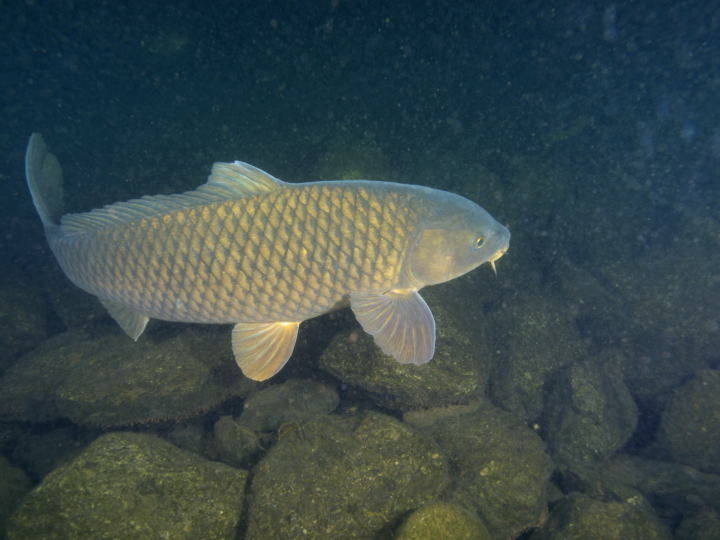
Source: 水中写真のすき間 ‐ コイ在来型 (コイ科 コイ属) Cyprinus carpio (Linnaeus, 1758)
- Common names: Common carp; koi for ornamental varieties
- Japanese name: Koi (コイ, 鯉)
- Scientific name: Often written as Cyprinus carpio; the taxonomy of East Asian carp and Japan’s native lineage remains under discussion
- Family: Cyprinidae
- Order: Cypriniformes
- Distribution: Carp of the Cyprinus carpio complex have been moved widely through aquaculture and ornamental trade; Japan retains a genetically distinctive native lineage
- Conservation context in Japan: The native Japanese carp lineage is listed as a Threatened Local Population (LP); Lake Biwa is one of its most important remaining refuges
If Japan had an official national fish, you might expect something rare, endemic, or especially wild. Instead, one of the strongest candidates is a fish found in garden ponds, temple moats, village waterways and ornamental pools around the world: the carp.
In Japan, it is simply koi — and that small word has travelled remarkably far. Today, “koi” is recognised internationally as the name for brilliantly coloured ornamental carp, nishikigoi. Yet the story behind Japan’s so-called national fish is far more complicated than those graceful colours suggest.
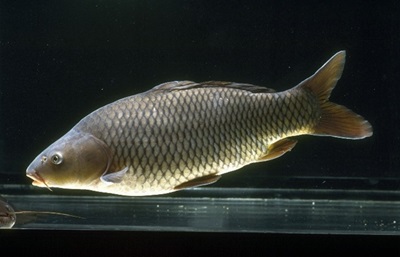
There is a serious conservation story beneath the surface. A genetically distinctive Japanese native carp lineage has been heavily affected by the spread and hybridisation of introduced Eurasian and domesticated carp lineages. In Lake Biwa, however, a comparatively little-mixed native population persists in deep offshore water and is recognised as a Threatened Local Population on Japan’s Red List.
A National Fish That Was Never Formally Selected
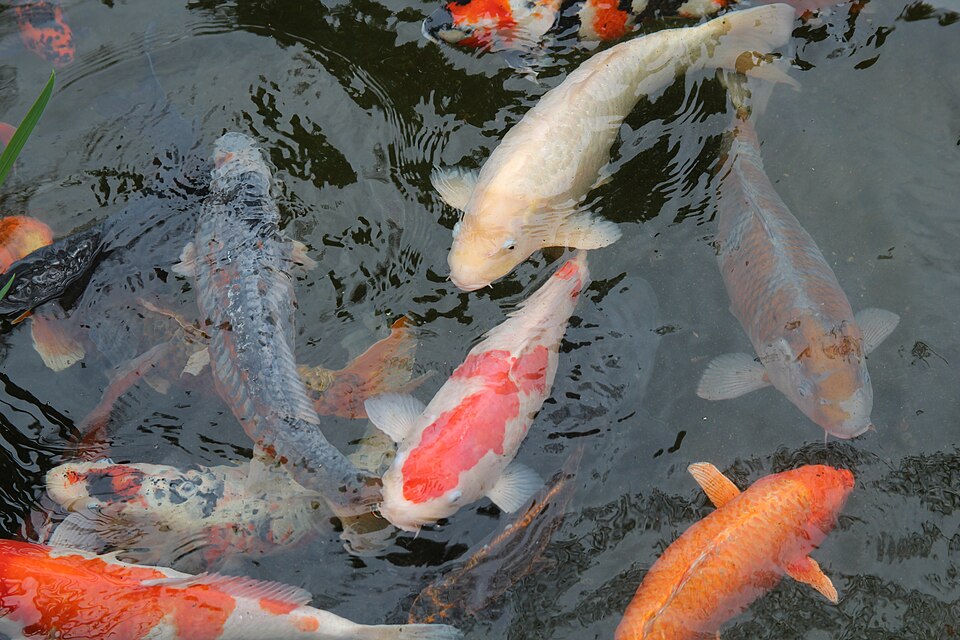
Source: WIKIMEDIA COMMONS – 2024 JapanischerGartenKL Kois

The Green Pheasant has a clear moment of selection: in 1947, the Ornithological Society of Japan chose it as the national bird. The Great Purple Emperor likewise has a documented selection by the Entomological Society of Japan.
The carp has no equivalent event.
There is no known formal decision by the Ichthyological Society of Japan declaring carp to be Japan’s national fish. Instead, its status has emerged from centuries of cultural familiarity and association.
シロフクロウ職員Donc… unlike the Green Pheasant, there is no precise date in our registers where one can point to an entry and say, ‘That was the day the carp became Japan’s national fish.
ミミズク先生Exactly. It is almost the opposite of a formal appointment. The carp simply became so deeply woven into Japanese culture that the label followed.
Carp have long been part of life in the Japanese archipelago. Archaeological sites have yielded carp remains, and the fish has been valued as food for centuries. Its best-known cultural role appears every May in koinobori, the carp-shaped streamers flown for Children’s Day.
The image comes from an old East Asian story in which a carp that swims up a waterfall becomes a dragon. In Japan, it became a wish that children would grow healthy, brave and able to overcome difficulties.
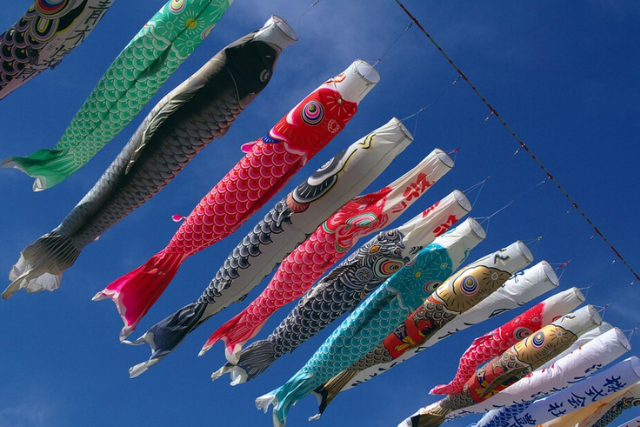
Source:WIKIMEDIA COMMONS – File:Carp streamer.jpg(suneko)
 ミミズク先生
It is a lovely example of a symbol travelling across cultures and acquiring a distinct local life. The carp’s climb towards the waterfall became, in Japan, an emblem of persistence and hope for a child’s future.
From Food Fish to “Living Jewel”
Source:水産庁 ‐ 錦鯉について(2025年4月)
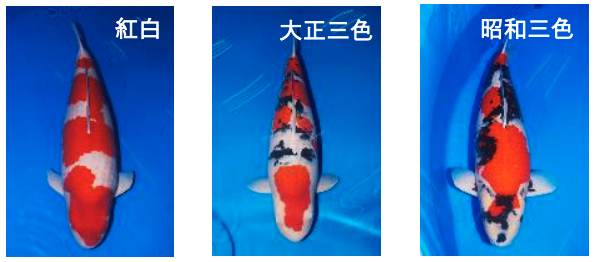
It is important to distinguish ordinary carp from nishikigoi, the ornamental coloured varieties that many people outside Japan simply call “koi”.
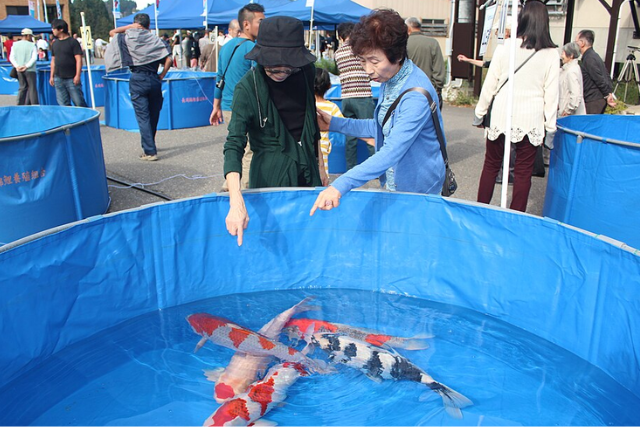
In the early nineteenth century, during the late Edo period, colour mutations began to appear among carp raised as food in the mountain villages of Yamakoshi, in what is now Nagaoka, Niigata Prefecture. Breeders selected and crossed these unusual fish over generations, developing increasingly distinctive patterns of red, white, black, gold and blue.
The result is an extraordinary example of selective breeding turning a food fish into a living art form. Today, nishikigoi are often described as “living jewels”, and their major varieties include Kōhaku, Taishō Sanshoku and Shōwa Sanshoku.
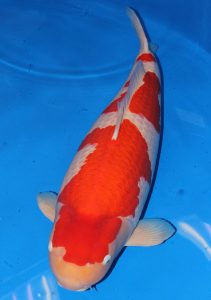
At the extreme end of the market, an exceptional female Kōhaku known as S Legend sold at a 2018 auction in Hiroshima Prefecture for ¥203 million. That was a record-setting, highly unusual sale — not the ordinary price of a koi — but it shows the international prestige these fish can command.
メンフクロウ職員Here is the koi that sold for ¥203 million (around $1.8 million / €1.55 million at 2018 average exchange rates)! 👇
出典:新高滝観魚園 ‐ 2億の錦鯉?!!!
シロフクロウ職員Oh là là … a fish valued at more than a fine country house is a rather dizzying thought. Yet, from our curatorial records, that figure simply documents decades of meticulous selective breeding, connoisseurship, and an international community that values an exceptional koi as a living work of art.
 タヌ山先生
タヌ山先生And since she’s female, her offspring may one day fetch handsome prices too. You could say that, in this family, even the kids are born with pretty expensive prospects.
ミミズク先生Dear me. There he goes again.
Two Very Different Stories
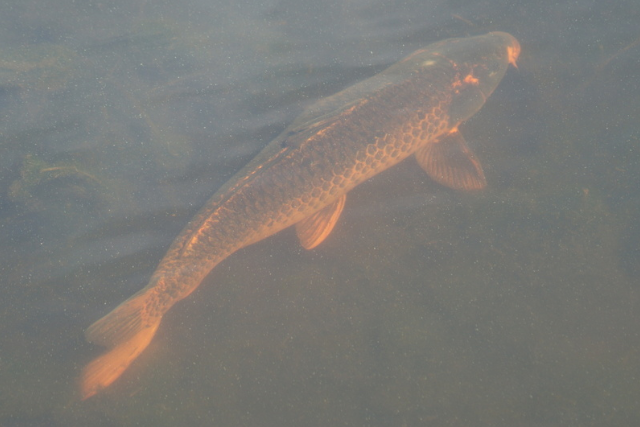
Soource:iNaturalist – ニシキゴイ Cyprinus rubrofuscus(upney_mews)
ミミズク先生Here is the carp’s central paradox.
The ornamental fish admired around the world as Japanese koi belongs to a wider carp group that can become a serious ecological problem when introduced outside its native context. Carp are included in the Invasive Species Specialist Group’s list of “100 of the World’s Worst Invasive Alien Species”, because invasive populations can disturb sediments, cloud water, alter aquatic plants and disrupt native freshwater communities.
That does not mean every carp is “bad”, nor does it mean that Japan’s native lineage should be treated as an invasive species in its own home waters.
タヌ山先生This is the crucial distinction. A scientific name isn’t a moral label. The same kind of fish can be a treasured cultural animal in one place, an introduced ecosystem engineer in another, and a threatened native lineage somewhere else.
ミミズク先生In ecology, context matters. A species may be widespread and secure on a global scale while causing real damage when introduced elsewhere. Conservation status and invasive impact are two different questions.
DNA Reveals a Hidden Japanese Carp
Source:国立環境研究所 ‐ DNAが語る日本のコイの物語(2017年12月)
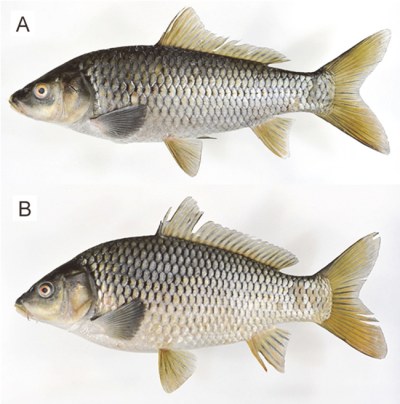
For more than a century, people had noticed two broad forms of carp in Japanese waters: a relatively slender “wild type” and a deeper-bodied “cultivated type”, more like farmed carp.
Modern mitochondrial and nuclear-DNA analyses revealed that the difference was not merely cosmetic. The slender wild type represents a genetically distinctive Japanese native lineage. The deeper-bodied type is associated with introduced and domesticated Eurasian lineages.
シロフクロウ職員How can researchers distinguish these hidden lineages when two fish may look almost identical?
タヌ山先生DNA carries clues to ancestry that our eyes can’t reliably pick up. Mitochondrial DNA helps trace the maternal line, while markers in nuclear DNA show how much mixing has happened between lineages. Put together, they let researchers identify native ancestry, introduced ancestry, and the different degrees of hybridisation in between.
Across much of Japan, hybridisation has made this history difficult to read. Introduced carp lineages have spread widely through aquaculture, food production and stocking, especially since the modernisation of fisheries in the late nineteenth and early twentieth centuries. Their descendants can look much like native carp while carrying mixed ancestry.
Lake Biwa offers one of the clearest remaining windows into the older story. In one study of carp sampled from waters deeper than 20 metres offshore, more than 80 per cent carried mitochondrial DNA associated with the Japanese native lineage. Nuclear-DNA studies also indicate that these deep-water fish have experienced comparatively limited hybridisation.
ミミズク先生This does not mean every deep-water carp is genetically unmixed, nor that Lake Biwa is the only place where native ancestry remains. But it does make the lake’s deeper water one of the most important refuges for the native Japanese carp lineage.
How Did the Lineages Become Mixed?
One important chapter began in the early twentieth century. In 1904, mirror carp and leather carp from Germany were introduced to Japan to improve food-carp production. These fast-growing fish later became part of aquaculture and breeding programmes, and German carp also contributed distinctive scale patterns to some ornamental koi varieties.
That single event does not explain every instance of genetic mixing seen in Japan today. But it illustrates a larger pattern: moving fish for food production, stocking or ornament can have consequences that continue for generations after the original purpose has been forgotten.
メンフクロウ職員The same international exchange that helped create new varieties of beautiful koi also became part of the story of genetic change in Japan’s carp populations. That is a rather complicated legacy for one shipment of fish.
Protecting More Than a Symbol
Source:琵琶湖博物館 ‐ 水族トピック展「龍になったといわれるコイ」を開催します!(2024年1月)
Source:琵琶湖博物館 ‐ 水族トピック展「龍になったといわれるコイ」を開催します!(2024年1月)
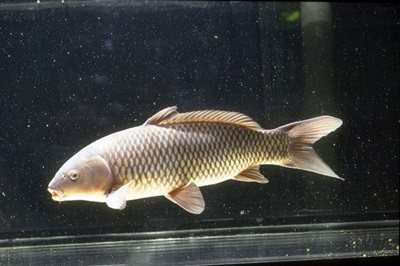
メンフクロウ職員They look very similar, but there are small differences in their appearance too.
The conservation question is not simply whether carp remain plentiful. In many waters, they do. The question is whether Japan’s genetically distinctive native lineage — and the habitats it needs to breed — can survive.
Researchers use genetic markers to identify native ancestry and monitor where it remains. Conservation also depends on protecting spawning habitat: reed beds, connected waterways and seasonally flooded shallow margins. Just as importantly, it means avoiding further releases of non-native or genetically mixed carp into natural waters.
The Lake Biwa Museum and other research institutions are helping to maintain threatened freshwater fish through research, collection management, breeding and public education. The National Institute for Environmental Studies continues to study the distribution, spawning ecology and habitat use of native fishes in Lake Biwa.
シロフクロウ職員Which brings us back to the question we began with. If the carp was never formally appointed as Japan’s national fish, what exactly are we trying to preserve?
タヌ山先生Not just the symbol. We’re trying to preserve the living population behind it — its genetic diversity, its habitat, and the ecological history carried in both.
A “National Fish” With Two Histories
Source:WIKIMEDIA COMMONS – Nagaoka Koi Show 05.jpg(KoiQuestion)

The carp may be Japan’s least straightforward national symbol. It is a cherished food fish, a Children’s Day emblem, a globally admired ornamental animal, and a fish that can cause serious ecological problems when introduced to the wrong waters.
At the same time, Japan’s own native carp lineage has been affected by hybridisation with introduced stock. Its survival is a reminder that culture and conservation cannot be separated neatly.
ミミズク先生Perhaps a national symbol is not a perfect portrait of a country. Sometimes it is a doorway — something familiar that leads us towards a far more complicated natural history.
メンフクロウ職員And once you know what lies beneath the surface, an ordinary carp becomes rather extraordinary.
Japan’s “National Animal”: The Japanese Serow
出典:iNaturalist – ニホンカモシカ Capricornis crispus( jiroiguchi)
- Common name: Japanese Serow
- Japanese name: Nihon-kamoshika (ニホンカモシカ)
- Scientific name: Capricornis crispus (Temminck, 1845)
- Family: Bovidae
- Subfamily: Caprinae
- Distribution: Endemic to Japan; found mainly in mountainous parts of Honshu, Shikoku and Kyushu
- Legal status in Japan: National Special Natural Monument under Japan’s cultural-property protection system
- Conservation context: Assessed globally as Least Concern, but several regional populations in Japan are listed as Threatened Local Populations (LP)
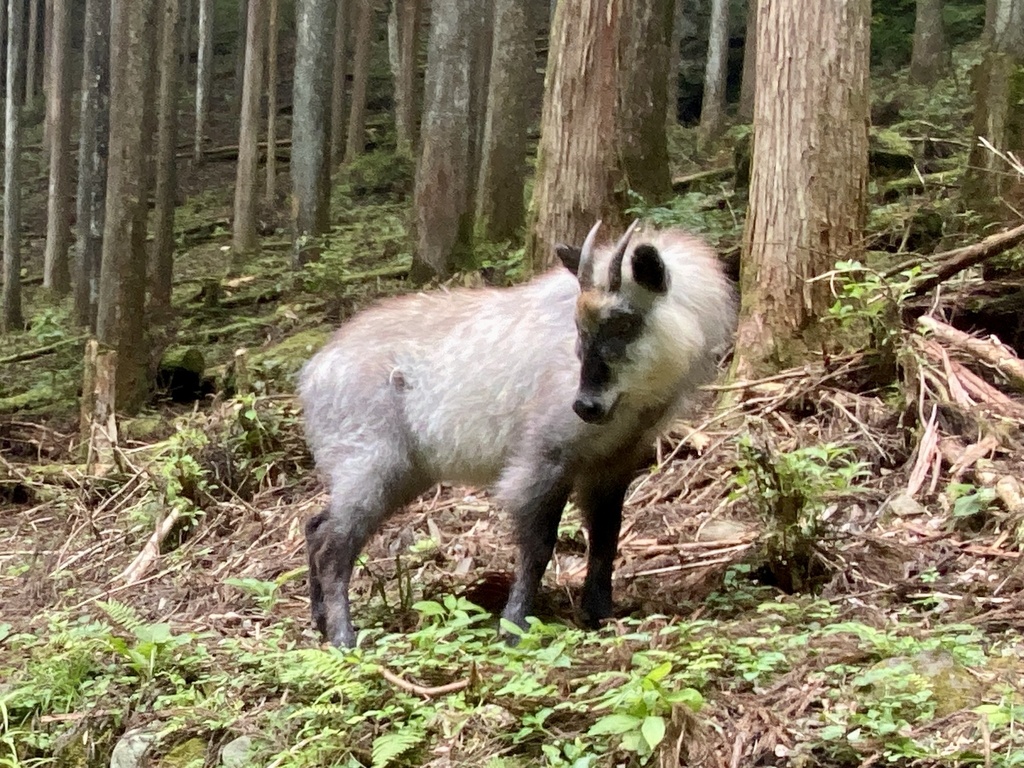
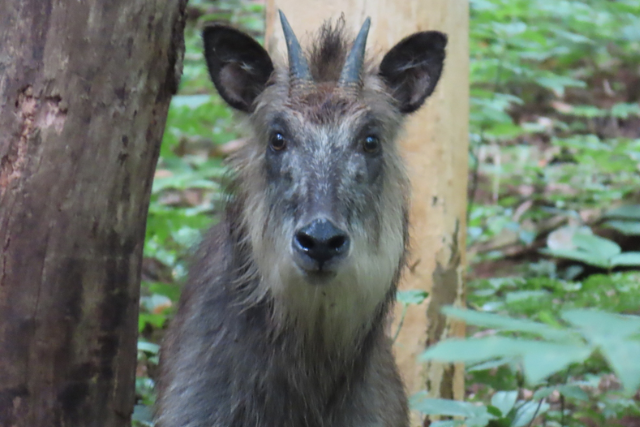
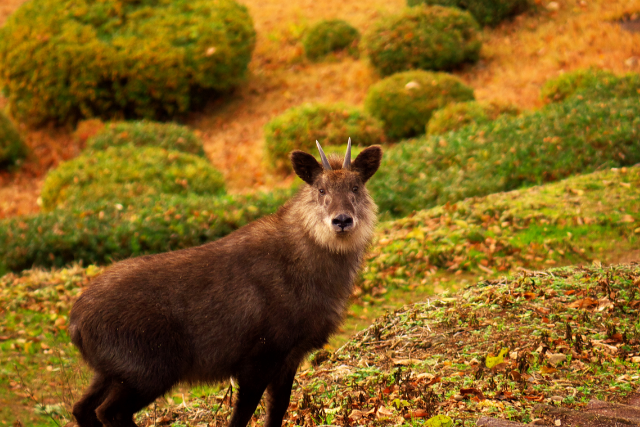
Deep in Japan’s mountain forests lives an animal that seems to belong to an older landscape. With a compact body, sturdy legs and short, unbranched horns, the Japanese Serow, Capricornis crispus, can stand almost motionless on a steep slope, watching quietly from the edge of the trees.
It is an animal sometimes described as Japan’s “national animal”. But, as with the Common Carp, that phrase needs a little care.
Japan has not formally designated the Japanese Serow as its official national animal. Nor is there reliable evidence that the Mammal Society of Japan formally selected it for that role. Its special place comes instead from a combination of endemism, cultural association and unusually strong legal protection.
The Japanese Serow is found naturally nowhere else on Earth. It is also the only wild bovid native to the Japanese archipelago — although its closest familiar relatives are goats and sheep rather than deer.
メンフクロウ職員In Japan, this animal is affectionately known as kamoshika.
シロフクロウ職員Its Japanese name contains shika, meaning “deer”. Is it actually related to Sika Deer?
タヌ山先生Not at all. Despite the name, a serow isn’t a deer. It’s in the cattle family, Bovidae, and it’s actually closer to goats and sheep than to the true deer in Cervidae.
Japanese Serow are usually solitary and territorial. Both males and females carry small horns, and their powerful legs make them well suited to forested mountains, rocky slopes and steep ground.
ミミズク先生For people whose lives were closely tied to the mountains, the high forests were never merely empty land. They were places of work, hunting, danger and reverence. An animal such as the serow, encountered alone on a steep and remote slope, could easily come to represent the quiet power and mystery of the mountain world.
A Symbol With Legal Protection
Source:iNaturalist – ニホンカモシカ Capricornis crispus(timur_kalininsky)
メンフクロウ職員The Japanese Serow was once in serious trouble.
From the late nineteenth century into the early twentieth century, people hunted it for meat and hides. By the first half of the twentieth century, it had become so scarce that it was sometimes described as a “phantom” of the remote mountains.
The Japanese government designated it a Natural Monument in 1934. In 1955, it was given the stronger status of National Special Natural Monument under the cultural-property system.
Historical estimates from around that time suggested that only a few thousand animals remained nationwide. These figures should be treated cautiously: a precise nationwide count was not possible then. What is clear is that hunting pressure had severely reduced the species.
シロフクロウ職員So 1955 was not the year the serow became a national animal. It was the year Japan gave it especially strong legal protection.
タヌ山先生Exactly. A cultural symbol is easy to celebrate, but a protected species takes real work — monitoring populations, managing habitats, and making tough conservation calls based on solid data.
The serow’s symbolic importance also reflects its habitat. Mountain forests have long held a special place in Japanese cultural and religious traditions. An animal that lives quietly among steep slopes and remote woods came to represent an enduring image of Japan’s mountainous natural heritage.
Recovery Changed the Question
Source:WIKIMEDIA COMMONS –
.jpg?uselang=ja)
File:Jike, Toyama, Toyama Prefecture 939-2214, Japan – panoramio (3).jpg(河田鷹介)
Protection worked. Hunting pressure declined, and populations in much of Honshu recovered substantially during the later twentieth century.
Surveys from 1978 estimated 75,000–90,000 serow nationwide; a 1984 estimate was about 100,000. These are historical national estimates, not current population totals. Japan has not produced an equivalent nationwide count in recent decades.
The recovery was a genuine conservation success. Yet it also brought new challenges.
In some parts of central and northern Japan, serow expanded into areas with commercial forests and farmland. They can browse young trees, including planted conifers, as well as fruit trees and other crops. In those areas, the animal came to be seen not only as a protected mountain species, but also as a source of practical conflict.
ミミズク先生“Save the animal” was only the beginning of the conversation. The next question was how people, forests and serow could share the same landscape.
One Species, Uneven Fortunes
Source: WIKIMEDIA COMMONS – File:Kamoshika4.JPG
 メンフクロウ職員
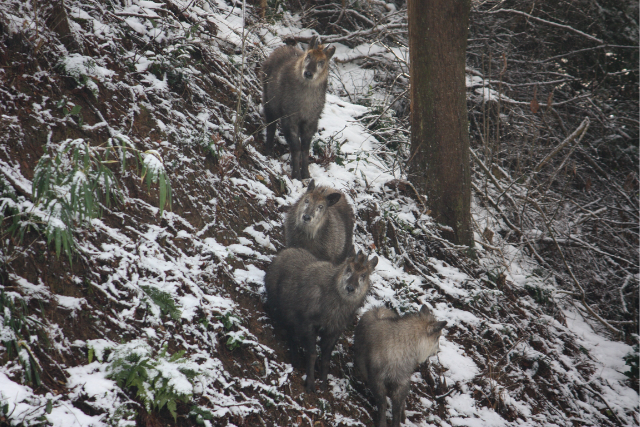
The Japanese Serow does not have the same story everywhere in Japan.
Some populations have recovered strongly. Others remain small, isolated or declining. The contrast is especially clear in Kyushu.A special survey conducted in 2018 and 2019 estimated that about 200 Japanese Serow remained in the mountains of Kumamoto, Miyazaki and Ōita prefectures. This was roughly one tenth of the estimate made about 25 years earlier.
The decline cannot be explained by one cause alone. Likely pressures include habitat fragmentation, changes in forest vegetation, accidental capture in traps set for other animals, disease, and competition for food with Sika Deer, Cervus nippon, in some areas.
The historical extinction of the Japanese Wolf is sometimes mentioned in discussions of Japanese ungulates. However, it would be too simple to treat the loss of one predator as the explanation for today’s regional differences. Modern serow conservation depends on evidence from each landscape.
シロフクロウ職員Alors… looking at the records, it would be quite misleading to state simply that ‘the Japanese Serow is increasing’, or conversely that ‘the Japanese Serow is endangered’ across the board.
タヌ山先生Precisely. The national picture and the local picture aren’t always the same. Conservation has to ask which population, in which place, and under what conditions.
This is why several regional populations—including those in Kyushu, Shikoku, the Kii Mountains and the Suzuka Mountains—are listed in Japan as Threatened Local Populations, or LP. That label does not mean the species is disappearing throughout Japan. It means that a geographically distinct population faces a high risk of local extinction.
Protection and Management
Source:iNaturalist – ニホンカモシカ Capricornis crispus(kibashiri)
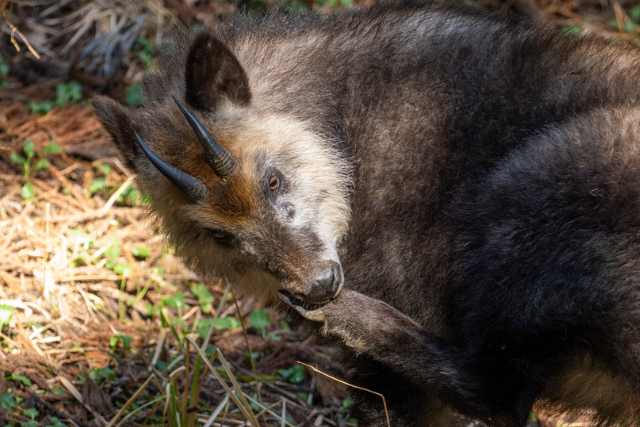
As a National Special Natural Monument, the Japanese Serow receives exceptionally strong legal protection. Capturing, injuring or killing one without the necessary authorisation is prohibited.
That does not mean action is impossible wherever serious forestry or agricultural damage occurs. Under the relevant procedures, local authorities may obtain permission for regulated capture or population-management measures. Decisions should take account of local abundance, habitat condition, damage levels and the conservation needs of neighbouring populations.
This makes serow management more demanding than a simple choice between “protect” and “remove”.
- Where numbers are low, priorities may include habitat protection, monitoring and preventing accidental deaths.
- Where browsing damage is persistent, priorities may include protecting plantations and crops while assessing the local population carefully.
- In every case, management needs reliable field data rather than assumptions based on the species’ national reputation.
メンフクロウ職員So even a Special Natural Monument is not managed in exactly the same way everywhere?
タヌ山先生Correct. Legal protection sets an important baseline. But it doesn’t replace the need for careful, place‑by‑place conservation.
More Than a Symbol
Source:iNaturalist – ニホンカモシカ Capricornis crispus(boogan_boy)
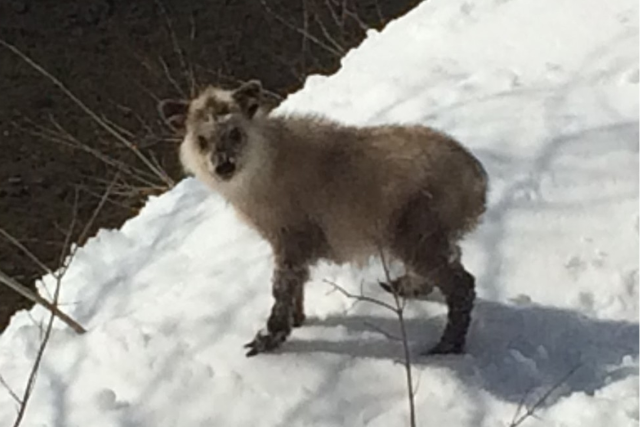
The Japanese Serow is found nowhere else naturally. It is a National Special Natural Monument, a survivor of severe hunting pressure, and a familiar symbol of Japan’s steep, forested mountains.
It is also a reminder that conservation is not static. Protection allowed many serow populations to recover. Now Japan faces a more complex responsibility: reducing conflict where numbers are high, while preventing local disappearance where populations are fragile.
ミミズク先生A symbol is not always a picture of a country at its simplest. Sometimes it records the country’s relationship with nature—including the difficult parts.
From a rarely seen animal of the remote mountains to a protected national treasure, and then to an animal requiring careful local management. That is quite a journey for one quiet mountain dweller.
メンフクロウ職員The Japanese Serow belongs in this story not because it has been formally appointed Japan’s national animal, but because few species show so clearly how cultural reverence, legal protection and living ecosystems can become inseparable.
Symbol, Monument or Endangered? How Wildlife Protection Works in Japan
Source:サキシマスジオ Elaphe taeniura ssp. schmackeri(wildpokedex)
Having met some of the animals associated with Japan—the Green Pheasant, the Great Purple Emperor, the Common Carp and the Japanese Serow—a natural question arises.
What about frogs, snakes, lizards, bats and all the other creatures that have never been given a “national” title? Does Japan have a national reptile or a national amphibian? And how do terms such as Natural Monument and Red List fit into the picture?
The short answer is that Japan has no single system for deciding which animals are important. Different institutions recognise wildlife for different reasons—and those reasons should not be confused.
シロフクロウ職員So being famous is not necessarily the same as being protected, and being endangered is not necessarily the same as being a national symbol?
タヌ山先生Precisely. These systems are built to answer different questions — like whether an animal represents something meaningful about Japan, whether it’s part of the country’s natural heritage, and how high its extinction risk actually is.
Not Every Group Has a National Representative

Source:WIKIMEDIA COMMONS – Mustela erminea nippon on backpack

Japan has no officially recognised national reptile or national amphibian. There is also no widely established equivalent to the Green Pheasant or Great Purple Emperor for these groups.
That does not mean reptiles and amphibians matter less. It simply reflects the different roles of scientific societies and conservation institutions.
The Herpetological Society of Japan supports research and conservation concerning reptiles and amphibians. It also recommends standard Japanese names for species found in Japan. Selecting a ceremonial representative for every major group is not a general feature of Japanese zoology.
The Green Pheasant and the Great Purple Emperor became national symbols in a particular historical setting: the decades after the Second World War, when interest in natural history, education and Japanese cultural identity was especially strong.
メンフクロウ職員We should not expect every branch of zoology to choose its own national mascot. A symbol emerges only when science, culture and a particular moment in history happen to meet.
ミミズク先生Science can tell us what a species is, where it lives and how it is changing. It does not require every group of animals to produce a ceremonial representative.
Three Different Questions
The easiest way to understand Japan’s wildlife systems is to keep three questions separate.
| System | The question it asks | What it does | Direct legal protection? |
|---|---|---|---|
| National symbol | What animal has come to represent Japan culturally or socially? | Gives a species symbolic or representative status | Usually no |
| Natural Monument | What part of Japan’s natural heritage has special scientific or cultural value? | Officially designates and protects natural heritage, including animals, plants, habitats and geological features | Yes |
| Red List | How high is a species’ or population’s risk of extinction? | Assesses conservation status and helps guide conservation policy | No, not by itself |
A species can belong to more than one category. The Japanese Serow is a useful example: it is associated with Japan as a symbolic animal, is protected as a National Special Natural Monument, and has also been assessed from a conservation perspective. These labels overlap, but they do not mean the same thing.
Natural Monuments: Nature as Heritage
Japan’s Natural Monument system, Tennen Kinenbutsu, is part of the cultural-property protection system. That may sound surprising at first: why would wildlife be protected through cultural-property legislation?
The answer is that Japan treats some parts of nature as heritage. Natural Monuments can include animals, plants, habitats, geological formations and minerals that are especially valuable for understanding Japan’s natural history.
They are not designated simply because they are rare. Their value may come from scientific importance, a distinctive relationship with a landscape, a remarkable local population, or a long connection with culture and history.
シロフクロウ職員So a Natural Monument is not merely an endangered species with a grander title?
タヌ山先生Exactly. A species can be a Natural Monument without being globally threatened. And a threatened species doesn’t automatically get you Natural Monument status.
The system also includes a stronger category: the Special Natural Monument. The Japanese Serow is one example. The Crested Ibis and Oriental Stork are others.
The Onagadori, a traditional Japanese breed of long-tailed chicken, is another Special Natural Monument. It is not a wild species, which makes an important point: Natural Monument status is about heritage value, not simply wildness or extinction risk.
Under the Cultural Properties Protection Act, actions that could alter a designated Natural Monument or affect its preservation generally require authorisation. For designated animals, unauthorised capture or harm may be restricted.
メンフクロウ職員Sinceramente, being a Natural Monument doesn’t make preservation any easier from where I stand. We still need good records, clear identification, careful monitoring—all the unglamorous work. What the designation really does is tell society, “this belongs to all of us, and it’s worth knowing, studying and passing on.” That responsibility isn’t just for researchers. It belongs to everyone who shares the same landscape.
Red Lists: A Scientific Warning System
A Red List answers a different question again: how great is the risk that a species—or a distinct population—could disappear?
Japan’s Ministry of the Environment assesses wild species using evidence such as their distribution, population trends, habitat change and known threats. The result is a Red List category: a scientific assessment of extinction risk, based on evidence rather than cultural prestige.
The categories include:
- EX — Extinct
- EW — Extinct in the Wild
- CR — Critically Endangered
- EN — Endangered
- VU — Vulnerable
- NT — Near Threatened
- DD — Data Deficient
- LP — Threatened Local Population
A Red List category is not a cultural honour. Nor does Red List status, by itself, automatically prohibit capture, trade, development or habitat loss.
メンフクロウ職員So a Red List is like a medical record: it identifies the urgency of a problem, but it is not the treatment itself?
タヌ山先生Exactly. It shows where we need to take a careful look. And after that, the real work kicks in — legal protection, habitat restoration, and on‑the‑ground conservation.
Red List assessments can inform other measures. For example, some species may also be designated under Japan’s Act on Conservation of Endangered Species of Wild Fauna and Flora, which can impose legal restrictions on capture, possession and trade.
A Snake With No National Title
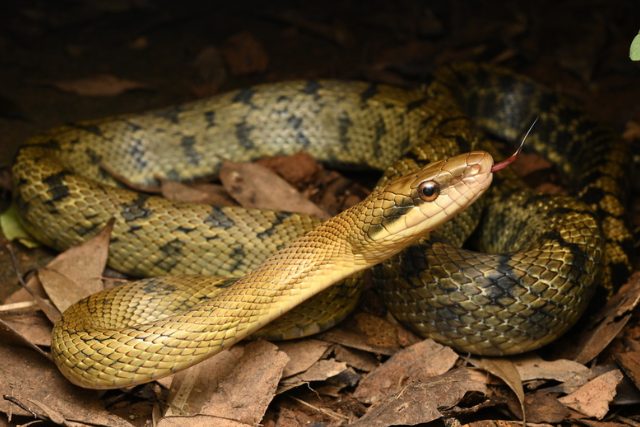
The Sakishima Beauty Snake, Elaphe taeniura schmackeri, is a useful example.
It has no national title, and its Red List status does not automatically make it a Natural Monument. Yet it is listed as Vulnerable (VU) in Japan’s current national Red List because of its extinction risk.
Its value does not depend on being a national symbol. It is part of the distinctive wildlife of the Sakishima Islands, and its Red List category signals that its wild population needs careful attention.
タヌ山先生A label only really tells us something when we understand the question it was meant to answer.
The Great Purple Emperor offers a different combination. It is Japan’s national butterfly and is listed as Near Threatened on the national Red List, but its cultural title does not itself create legal protection.
The Japanese Serow offers another. It is often treated as a cultural national animal, and it is a Special Natural Monument. Yet its global IUCN assessment is Least Concern, while several regional Japanese populations are recognised as Threatened Local Populations.
A Moving Picture
ミミズク先生One final point matters: Red List categories can change.
Japan is publishing its fifth national Red List in stages, with different groups assessed on different schedules. Updated assessments for birds, reptiles and amphibians were released in March 2026, while other groups continue to follow their own assessment timetable.
This means that a conservation category should always be checked against the latest assessment for the particular group concerned. A label in an older field guide, website or museum panel may no longer be current.
シロフクロウ職員In other words, even a Red List label comes with a date.
タヌ山先生Precisely. Conservation science is not a set of labels carved in stone. As surveys, genetic studies and population data improve, our understanding must improve too.
More Than One Way to Care
Japan’s wildlife is not protected by one grand title or a single list.
National symbols tell stories about culture and identity. Natural Monuments recognise parts of the natural world as heritage worthy of legal protection. Red Lists provide a scientific warning about extinction risk. Other laws can then create specific restrictions and conservation measures.
タヌ山先生And that’s why the animals we’ve met can’t just be dropped into one big “national animal” list. A species might be a cultural symbol, a protected natural treasure, a conservation priority — or even all of those at the same time.
シロフクロウ職員Which means we should look at the labels carefully before deciding what they actually tell us.
ミミズク先生Quite right. The interesting question is not simply which animal represents Japan, but why that animal came to represent it.
Living with Nature: What Japan’s “National” Animals Can Teach Us
Source:逢瀬公園・緑化センター ‐ 国蝶オオムラサキ
メンフクロウ職員The animals we have met so far tell very different stories,don’t they.
The Green Pheasant became a national bird through a decision by a scientific society. The Great Purple Emperor became a national butterfly through a similar act of academic recognition. The Common Carp acquired its symbolic status through centuries of cultural association rather than any formal selection. The Japanese Serow became one of Japan’s most strongly protected wild animals through the Natural Monument system, even though no learned society ever declared it a “national animal”.
Taken together, these stories reveal something more interesting than a simple list of Japan’s national creatures. They show how culture, science, law and everyday life can shape the way people relate to wildlife—sometimes in the same direction, sometimes in tension with one another.
ミミズク先生A symbol tells us what a society chooses to remember. Conservation asks a rather different question: what must we actually do if we want that living world to remain?
That distinction matters. A species may be culturally beloved without being endangered. Another may be legally protected without being rare nationwide. A third may be declining in one region while thriving in another.
Four Emblems, Four Ecological Realities
Each species we have explored also points to a genuine, ongoing conservation challenge.
- Green Pheasant: its taxonomic status has shifted in recent years, as researchers reassess its relationship with other pheasant populations across East Asia. Even a familiar national symbol can be re-evaluated as scientific understanding develops—and distinguishing genuinely native populations from introduced or hybridised stock remains an important part of that work.
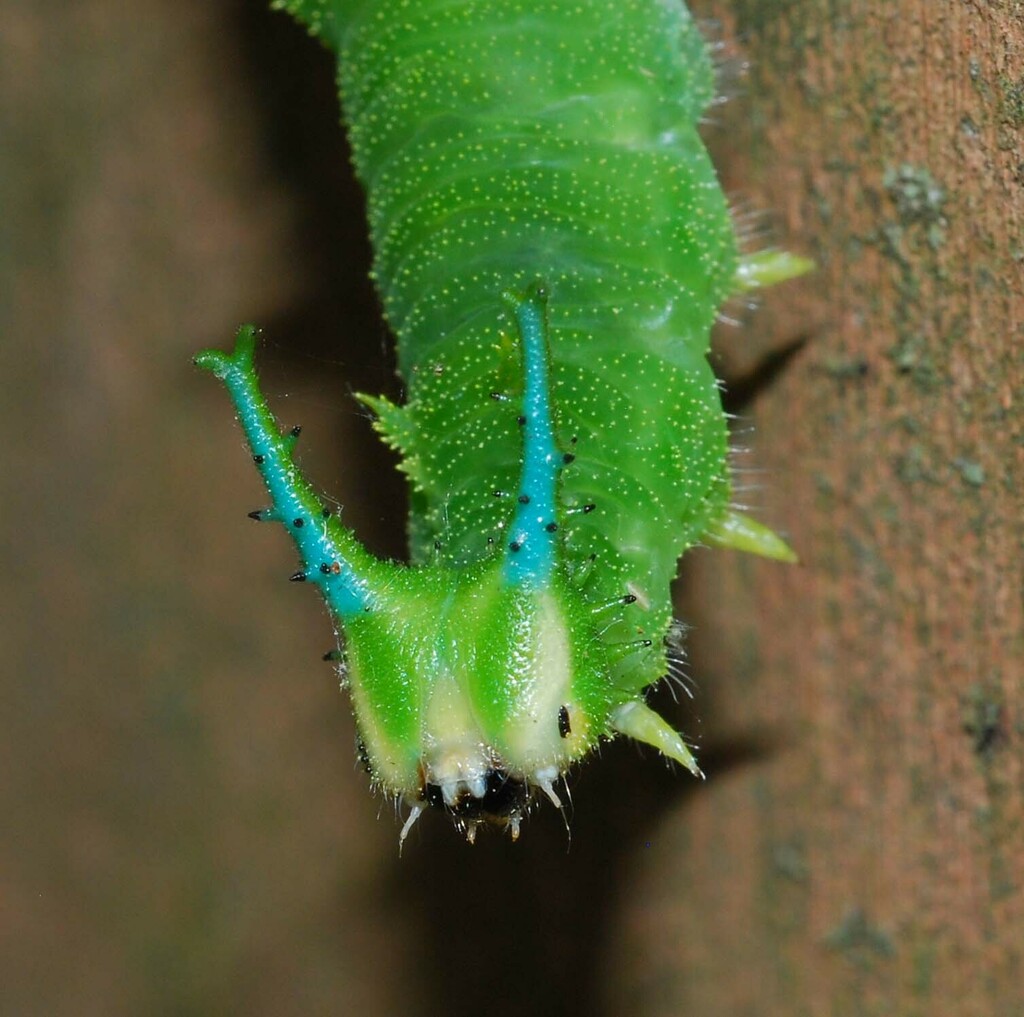
- Great Purple Emperor: its fortunes are closely tied to satoyama, the traditionally managed woodlands where farmers once coppiced oak and other deciduous trees. Without that regular cutting, the canopy closes over, shading out the host plants its caterpillars depend on.
- Common Carp: centuries of stocking, food-fish farming and the ornamental koi trade have blurred the boundary between Japan’s native carp lineage and introduced Eurasian and domesticated stock, leaving genuine native ancestry difficult to trace outside a few refuges such as Lake Biwa.
- Japanese Serow: conservation success has not been uniform. Populations in parts of central Honshu have recovered enough to damage forestry plantations, while populations in Kyushu and other western regions remain small, fragmented and vulnerable.
タヌ山先生This is exactly why conservation can’t be boiled down to a simple list of “good” and “bad” animals, or “safe” and “endangered” species. We’ve got to look at populations, habitats, genetics and human land use together — region by region.
Protection Is Not Always Straightforward
There is another lesson hidden in these stories: measures designed to protect wildlife can create difficult choices for the people living alongside it.
A protected species may damage crops or forestry plantations. A well-intentioned release programme may unintentionally alter the genetic makeup of a wild population. A habitat that once supported rich biodiversity may depend on continued human management—and grow poorer once that management stops.
メンフクロウ職員In the museum, we see a similar principle in how we care for our collections.
シロフクロウ職員Alors… if you have enjoyed this stroll through our galleries, do take a moment to explore our other articles and records across the museum!
 ミミズク先生
Please do explore the books from eco-life-planet as well. I hope they will offer you many more rewarding encounters with the living world.

References and Further Reading
日本の国の象徴とされる生き物とは?
馬渕 浩司, 松崎 慎一郎 ‐ 日本の自然水域のコイ:在来コイの現状と導入コイの脅威(2017年11月)
産経ニュース ‐ 「時は来た」 ハクトウワシが米国の国鳥に 日本はキジ、中国は「日本絡み」のツルにNO(2024年12月)
Yahoo!ニュース ‐ ハクトウワシ、米国鳥指定 バイデン大統領が署名(2024年12月)
国鳥:キジ(雉)― 日本鳥学会
日本野鳥の会 ‐ キジ Phasianus versicolor
Birds of the World – Green Pheasant Phasianus versicolor
あきた森づくり活動サポートセンター – いつからキジは国鳥なのでしょうか!?
国蝶:オオムラサキ ― 日本昆虫学会
兵庫県立 丹波の森公苑 ‐ 国蝶オオムラサキの舞う⾥⼭づくり
国魚:コイ ― 日本魚類学会
国立環境研究所 ‐ 琵琶湖のコイの生態調査(2020年4月)
日本経済新聞 ‐ 世界の富豪「ニシキゴイ」に夢中 1匹2億300万円も(2019年2月)
日本経済新聞 ‐ 在来ゴイよ琵琶湖に戻ってこい 漁業者ら調査や保護活動(2017年12月)
Marshall et al. (2019), Aquatic Conservation: Marine and Freshwater Ecosystems.
国獣:ニホンカモシカ ― 日本哺乳類学会
石川県 ‐ ニホンカモシカ(Capricornis crispus)の積雪期における生息状況 桜井 道夫
森林総合研究所 ‐ 混生地におけるニホンカモシカ(Capricornis crispus)とニホンジカ(Ceruns nippon)の食性 堀野 眞一,柔畑 勤(1986年5月)
岸元 良輔 ‐ カモシカの社会構造と食害問題(1996年6月)
富山市科学博物館 ‐ No.543 かつては幻の動物 ニホンカモシカ(2023年8月)
富山県自然博物園ねいの里 ‐ ニホンカモシカ (CAPRICORNIS CRISPUS)
岐阜県 ‐ 特別天然記念物カモシカ 食害対策 捕獲個体調査(2022年3月)
日本の動物保護の仕組み ― 象徴、天然記念物、レッドリストの関係性
日本爬虫両棲類学会 – 日本産爬虫両生類標準和名リスト 掲載種選定ポリシー
環境省 ‐ はじめに―レッドリスト・レッドデータブックの概要
「国の象徴動物」から学ぶ、自然との共生
京都大学 ‐ 湖と海で環境DNAの拡散距離は異なる―生物多様性調査に向けた環境DNAの”生態”の解明―(2025年4月)
コメント